
One of the most unsettling moments for a parent is watching a young child suddenly stop using an arm after what seemed like an ordinary everyday movement. A toddler who had been laughing and playing moments earlier may suddenly begin crying, hold one arm close to the body, and refuse to move it at all.
In many cases, the trigger appears surprisingly minor. A parent pulls the child up quickly to prevent a fall. Someone lifts the child by one hand. A small child resists walking across a parking lot and instinctively gets tugged forward.
Soon afterward, the child refuses to use the arm.
This condition is commonly known as “nursemaid’s elbow,” though doctors usually refer to it as radial head subluxation. Despite how alarming it can look, it is actually one of the most common arm injuries seen in young children and is usually treatable within minutes.
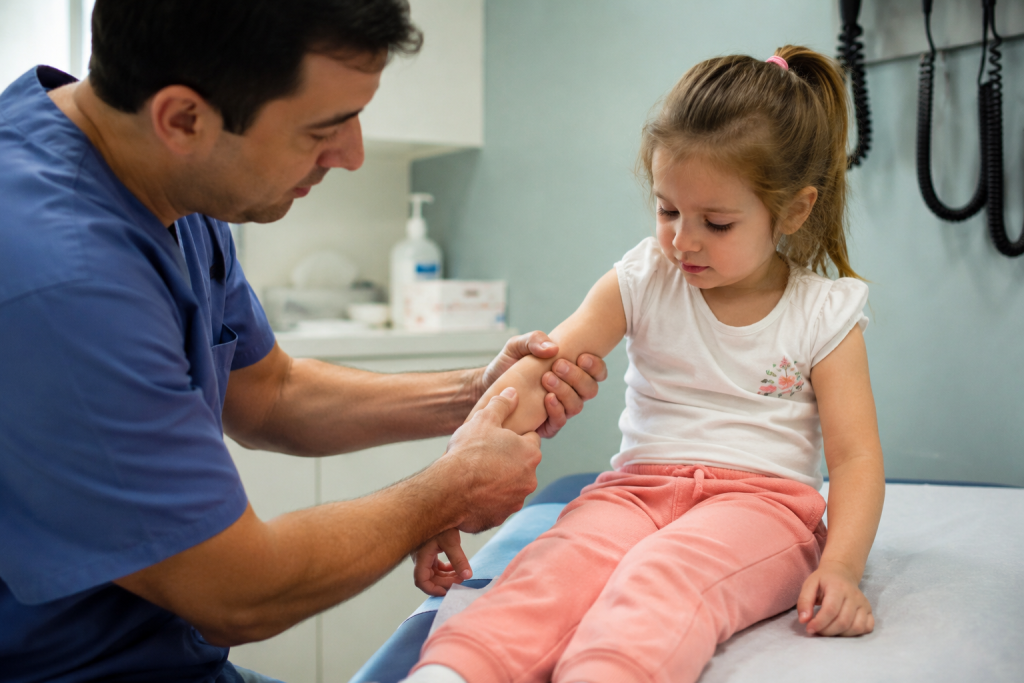
Why This Injury Mostly Happens in Toddlers
The anatomy of a young child’s elbow is very different from that of an adult. Children’s bones are still developing, and the ligaments that stabilize their joints are softer and more flexible.
The forearm contains two long bones called the radius and ulna. Near the elbow, the top portion of the radius is held in place by a band of tissue known as the annular ligament. In small children, that ligament is relatively loose and thin compared to older children and adults.
When sudden pulling force is applied to the arm, the top of the radius can partially slip out of position beneath the ligament. Even though the movement is small, it can immediately cause pain and loss of normal arm movement.
This injury is most common between the ages of one and four. After around age five or six, the structures around the elbow become stronger and more stable, making the condition far less likely.
How It Usually Happens
One of the reasons this injury surprises parents is because it often occurs during completely ordinary moments.
Doctors frequently see cases involving:
- lifting a child by one hand;
- pulling a child away from danger;
- swinging a child by the arms during play;
- sudden jerking movements while walking hand in hand;
- older siblings pulling on the child’s arm;
- attempts to stop a child from falling.
Many parents assume an injury would require significant force, but pediatric specialists often explain that only a relatively small amount of traction can trigger the problem in toddlers.
In some situations, caregivers do not even realize exactly when the injury happened because the movement seemed so harmless.
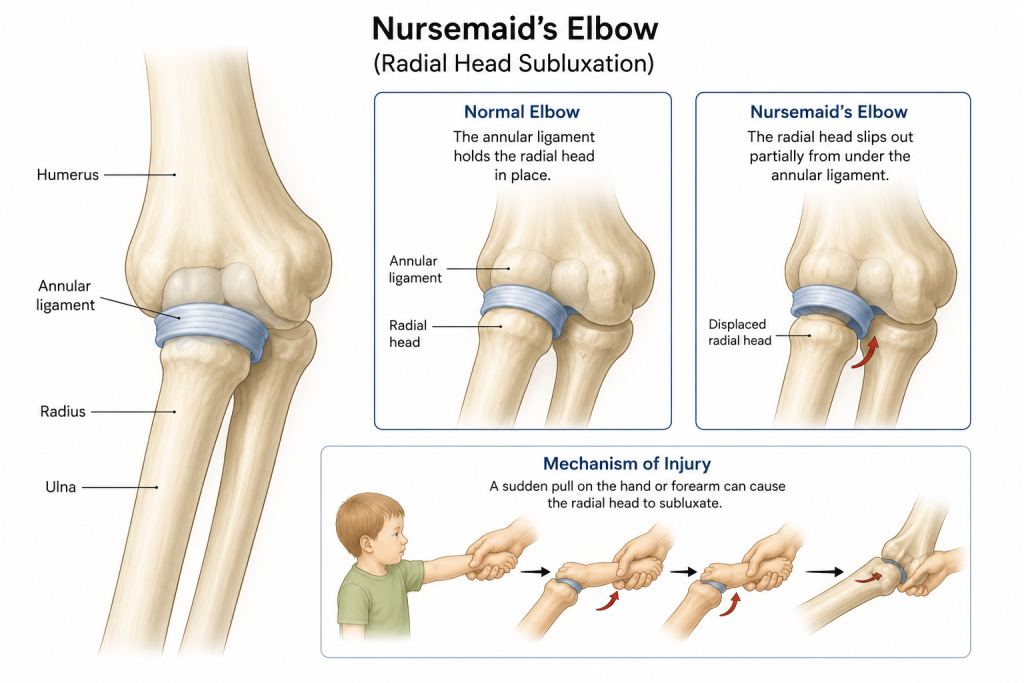
The Symptoms Tend To Look Very Specific
Children with nursemaid’s elbow often hold the affected arm slightly bent and close to the body. They usually avoid reaching for toys or using the hand normally.
One detail that confuses many families is that the elbow often looks almost completely normal.
Unlike fractures or major dislocations, there is usually:
- little or no swelling;
- no obvious deformity;
- minimal bruising.
The child may appear calm as long as nobody touches the arm, but cry or resist when movement is attempted.
Because the physical signs can look subtle, some parents initially believe the child is simply frightened or being overly cautious. In reality, the discomfort can be significant enough that the child instinctively avoids any motion involving the elbow.
How Doctors Tell the Difference Between This and a Fracture
Emergency physicians and pediatricians often recognize nursemaid’s elbow from the child’s age, the story of the injury, and the characteristic position of the arm.
Not every child requires X-rays. When the history and examination strongly fit the diagnosis, doctors may proceed directly with treatment.
However, imaging becomes important if:
- there is severe swelling;
- bruising is present;
- the injury involved a major fall;
- the child has significant tenderness;
- symptoms do not improve afterward;
- the situation does not match the usual pattern.
This distinction matters because some fractures in children can initially appear deceptively mild.
The Quick Medical Maneuver That Often Solves the Problem
Treatment usually involves a brief reduction maneuver performed by a healthcare professional.
Two commonly used techniques involve carefully rotating and repositioning the forearm so the radius returns to its normal alignment. Sometimes a subtle click can be felt during the maneuver.
What surprises many parents is how quickly children often recover afterward.
Some toddlers begin using the arm again within minutes, reaching for toys, snacks, or a parent’s phone almost as if nothing had happened. Others may remain cautious for a short period simply because the experience frightened them.
The procedure itself is fast, but specialists strongly advise against parents attempting reductions at home without proper medical evaluation, since fractures and other injuries can sometimes mimic the same symptoms.
Why Some Children Experience It More Than Once
Recurrence is relatively common in younger children because their ligaments remain flexible as they continue developing.
Medical studies estimate that roughly one in four children who experience nursemaid’s elbow may have another episode before reaching school age.
For that reason, pediatric doctors often recommend avoiding:
- lifting children by the hands or wrists;
- swinging children by the arms;
- sudden pulling motions;
- jerking a child upward by one arm.
Instead, lifting children under the arms is considered much safer for the elbow joint.
Why the Condition Feels So Frightening to Parents
Although the injury is usually minor from a long-term orthopedic perspective, the emotional impact can be intense. Parents frequently blame themselves because the movement that caused the injury often felt completely normal and harmless.
Pediatric specialists repeatedly emphasize that nursemaid’s elbow is extremely common and can happen even in attentive, careful families. The injury is tied more to the natural anatomy of early childhood than to recklessness or neglect.
For many families, the experience becomes a reminder of how differently a small child’s body responds to forces that would barely affect an older child or adult.
The reassuring part is that most children recover fully and quickly, with no lasting damage once the joint returns to its normal position.