
When rescuers removed a group of neglected animals from a California property in 2014, the goal was simple: get them somewhere safe.
For one elderly goat, however, safety did not seem to be enough.
After arriving at a sanctuary, Mr. G withdrew almost completely. He spent much of his time lying down, showed little interest in his surroundings and refused food despite repeated attempts by caregivers to tempt him with treats.
There was no obvious medical explanation.
Then staff learned something important about his previous life: for years, Mr. G had lived beside a small donkey named Jellybean.
During the rescue, the two animals had been sent to different sanctuaries.
When Jellybean was eventually brought to Mr. G, the goat’s behavior changed dramatically. He stood up, followed her outside and soon began eating again.
The reunion became an internet sensation, but the story is more interesting than a simple tale of animal friendship. It also raises a question scientists have spent years investigating: how deeply can social bonds affect an animal’s wellbeing?
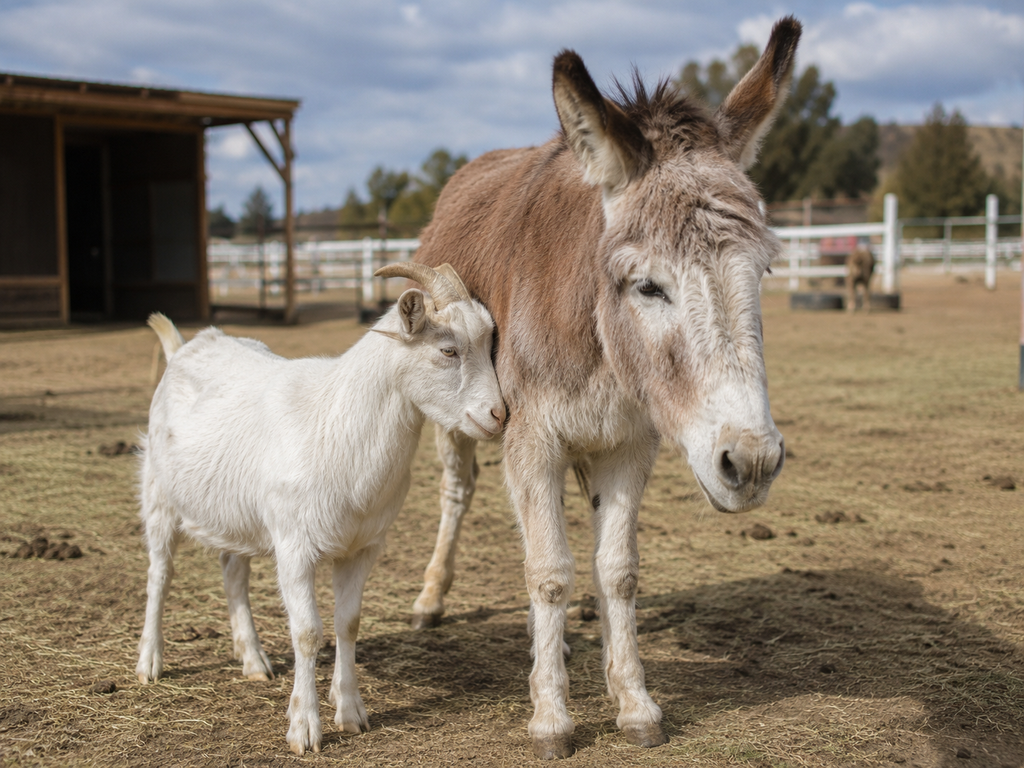
Mr. G and Jellybean Had Shared Most of Their Lives
Mr. G and Jellybean came from a California property where numerous animals were being kept in circumstances that ultimately required intervention.
Animal Place, the sanctuary that later cared for Mr. G, reported that the goat and donkey had lived together for roughly a decade.
When the animals were removed from the property, different rescue organizations stepped in to help. Animal Place was able to take Mr. G, while Jellybean was initially sent elsewhere.
At the time, rescuers did not fully appreciate how important the relationship between the two animals might be.
The separation was therefore not intentional cruelty. It was a practical consequence of trying to place many animals quickly and safely.
Yet Mr. G’s reaction suggested that something significant had been lost.
He Would Barely Eat
After an approximately eight-hour journey, Mr. G arrived at Animal Place’s Rescue Ranch.
A certain amount of stress after transportation would have been unsurprising. Moving livestock into a new environment can temporarily alter appetite and behavior.
But Mr. G did not simply appear unsettled.
He remained withdrawn, spent long periods lying in one area and refused food. Caregivers reportedly offered him apples, molasses, sweetened grain and softened feed in an effort to stimulate his appetite.
Nothing seemed to work.
Animal Place said that veterinary evaluations did not reveal an obvious physical reason for his behavior.
Accounts published at the time generally describe Mr. G as going without food for around six days, although the sanctuary’s own chronology indicates that concern had already become serious after several days.
The exact number of hours is less important than what happened next.
Once caregivers learned about Jellybean, they decided to try reuniting them.
A 14-Hour Trip to Bring Jellybean Back
A volunteer made a journey of roughly 14 hours round trip to collect Jellybean and bring her to the sanctuary where Mr. G was staying.
By then, the goat’s lack of appetite had become a serious concern.
When the donkey arrived, Mr. G’s response was captured on video.
The previously withdrawn goat became alert, got up and went toward Jellybean. Not long afterward, he began eating again.
Contemporary reports said that within roughly 15 to 20 minutes of the reunion, Mr. G was eating alongside his longtime companion.
That rapid reversal is the moment that made the story famous.
It is also the reason people began describing Mr. G as “heartbroken” or “depressed” during the separation.
But those words require some caution.
Was Mr. G Actually Depressed?
Calling an animal “depressed” can be useful in everyday language, but scientifically it is more complicated.
We cannot retrospectively diagnose a goat with human clinical depression based on a video and a behavioral account.
Nor can one individual case prove beyond doubt that separation from Jellybean was the sole cause of Mr. G’s refusal to eat.
What we can say is that his behavior changed sharply after being separated from a long-term social companion, and that it changed again soon after that companion returned.
That pattern is consistent with what researchers know about social stress in animals.
Goats are highly social creatures, and isolation can produce measurable behavioral and physiological effects.
Goats Form Social Preferences
Research on goat behavior shows that individuals do not simply associate randomly with every other member of a herd.
They can develop preferred social partners and maintain stronger relationships with some animals than with others.
Studies of goat social structure have documented stable patterns of association, while experimental research has shown that social isolation can increase distress-related behaviors such as vocalizing, escape attempts and agitation.
Some studies have also found physiological changes associated with isolation, including changes in stress-related hormones.
This does not prove that Mr. G experienced “grief” in precisely the human sense.
It does, however, make the basic explanation entirely plausible: suddenly losing a familiar companion after years together could have been intensely stressful.
Donkeys Can Form Strong Bonds Too
The other half of the story is just as important.
Domestic donkeys are also capable of forming strong, selective social relationships.
In one study involving dozens of donkeys, researchers found that many animals consistently preferred the company of particular individuals rather than interacting equally with every member of the group.
In many cases, those preferences were mutual.
Experimental tests also showed that some donkeys preferred their established companion over another familiar or unfamiliar animal.
Researchers have warned that separating strongly bonded donkeys may therefore have welfare consequences.
This matters in the case of Mr. G and Jellybean because their relationship crossed species lines.
A goat and a donkey may seem like an unusual pair from a human perspective, but animals living together for years can become important parts of one another’s social environment.
Does That Mean Animals Love Each Other?
This is where language becomes difficult.
Scientists can measure proximity, preference, affiliative behavior, vocalizations, stress responses and attempts to regain contact with a companion.
They can demonstrate that one animal seeks out another.
They can show that separation produces distress.
What science cannot easily determine is whether the subjective experience inside an animal’s mind is identical to what humans describe as love, longing or grief.
That distinction matters.
Anthropomorphism can lead us to project human thoughts onto animals without evidence. But being cautious about language does not require us to pretend that animal relationships are meaningless.
The evidence increasingly supports a more balanced view: many social animals form individual bonds, and those bonds can have real consequences for their behavior and wellbeing.
The Part of the Story Most Viral Posts Leave Out
The reunion between Mr. G and Jellybean is usually presented as the perfect ending.
The real story continued.
After they were reunited, Animal Place chose not to separate them again. They were moved to the organization’s permanent sanctuary.
But over time, their social world expanded.
Mr. G gained access to other goats and increasingly spent time with members of his own species. Jellybean eventually formed a close relationship with another donkey named Jujube.
That detail does not weaken the original story.
In some ways, it makes it more credible.
Animals are not frozen in a single relationship forever. Their social preferences can change when they enter new environments and meet new companions.
The fact that Mr. G and Jellybean later formed other relationships does not erase the importance their earlier bond may have had when they had spent years living together.
What Happened to Mr. G?
Mr. G remained at Animal Place for several more years.
As he aged, he developed increasingly serious problems with mobility and balance. The sanctuary reported that caregivers and veterinarians tried different treatments, but his condition continued to deteriorate.
Because he was already more than 15 years old, staff decided against highly invasive diagnostic procedures when a serious underlying illness was suspected.
Eventually, when his quality of life had declined substantially, Mr. G was euthanized.
Animal Place announced his death in January 2020.
Jellybean continued living at the sanctuary and became closely associated with Jujube.
Why the Story Still Matters
Mr. G and Jellybean became famous because their reunion looked immediately understandable to human viewers.
A companion disappears. An animal withdraws. The companion returns. The animal becomes active again.
It is tempting to translate that sequence directly into human emotions.
The more careful interpretation is slightly different, but no less remarkable.
Mr. G had spent years with Jellybean. After being abruptly separated from her and moved into an unfamiliar environment, he became unusually withdrawn and stopped eating. When she returned, his behavior changed rapidly.
Separately, scientific research tells us that goats and donkeys are social animals capable of forming preferred relationships, and that separation from social partners can cause genuine stress.
We may never know exactly what Mr. G experienced internally during those days.
We do not need to.
The most defensible conclusion is also the simplest one: Jellybean mattered to him.
And sometimes animal behavior tells us more about the importance of a relationship than any human label ever could.