
The morning I decided to start packing her lunch began with the simplest intention in the world: I didn’t want her to be hungry.
The kind of intention that doesn’t show up in photos, doesn’t get mentioned at parent meetings, doesn’t make it onto social media. You just do it. You wake up, tape your thoughts together so they don’t scatter in ten different directions, and start the fast-forward routine of a family morning: water bottles, napkins, a hoodie thrown over the back of a chair, one missing shoe, a “Mom, where’s my…?” floating through the house — and, in the middle of it all, the lunchbox.
In my mind, the lunchbox was a guarantee of love. A small, packed version of take care of yourself.
And that’s exactly why it hit me so hard the first time she came home with it untouched.
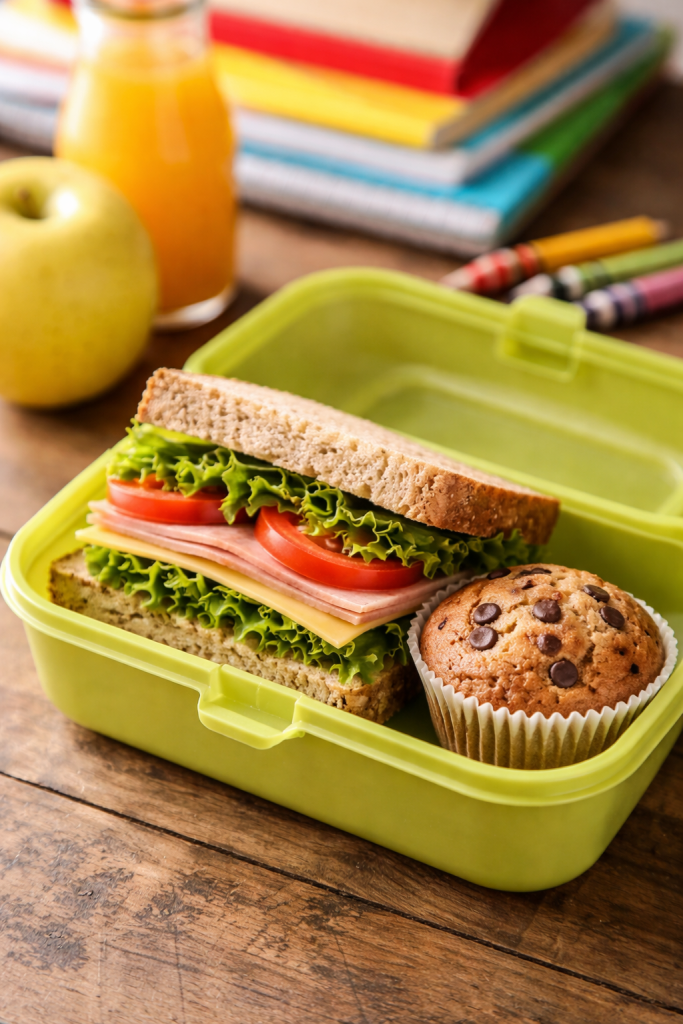
Not just that she hadn’t eaten. But that everything was still there, exactly as I had packed it — like a letter no one had opened.
That day I had made her a ham sandwich. Classic. Safe. “Every kid eats this.” I added something I thought was foolproof: a chocolate muffin. Some days I’d tuck in a croissant, just in case at least the sweet part would disappear.
She came home, pulled the lunchbox out of her backpack quietly, and set it on the counter with a kind of calm that somehow made me both irritated and worried at the same time.
“I didn’t eat it,” she said.
That was it.
And in that second, I wasn’t the calm, wise mom I imagine myself being. I was the mom who felt like her effort had been ignored. The mom who immediately wondered if she had done something wrong. The mom who can turn a slice of bread into an existential crisis — because parents do that.
“Why?” I asked.
And the answers were always small. Never dramatic. Never “Mom, I felt sick” or “My stomach hurt.” Just those disarming, ordinary reasons that somehow make it harder.
“I didn’t have time.”
“I was talking to…”
“I wanted to go outside.”
“I wasn’t hungry.”
“I was watching the others.”
“I didn’t feel like it.”
If you’re a parent, you know what happens next. The internal negotiation begins.
Should I change what I pack?
Is it too much?
Too little?
Is she embarrassed?
Distracted?
Do they not get enough time?
Does she just want to play?
Does she not like eating around other kids?
Over the next few days, I moved into phase two: experimentation.
I made the sandwich smaller. I switched the deli meat. I tried peanut butter and jelly, because I had heard it’s like a magnet for kids. I packed crackers because at least crackers come back half eaten. I added fruit because there should be something “healthy” in there.
The fruit always came back looking perfect. Untouched. Shiny. As if it hadn’t traveled to school and back.
At some point I realized something that made me laugh in that tired, bitter way: I thought the problem was the food. But I was actually fighting the context.
Their elementary school day runs from 8:00 to 12:00. On paper, it’s short. “They won’t even have time to get hungry.” In reality, it’s exactly the window where a child is suspended between “I’m in school” and “I want to be outside.” And when you get a break, what do you choose? Sit with a box and chew? Or run? Eat? Or belong?
Kids don’t think about “nutrition” or “energy levels” or blood sugar. They think, I don’t want to miss anything.
And no matter how much you want it to be different, sometimes food becomes the lowest priority in a day that is new and loud and full of signals.
There was a period when she stayed for aftercare from 12:00 to 3:00. They served a hot lunch — a real meal, soup, a main dish, dessert. I clung to that idea like a solution. Now she’ll eat. It’s warm. They’re sitting down. It’s like home.
And still, there were days she barely touched it.
Two bites. Maybe the dessert. Sometimes nothing.
That’s when the helplessness crept in — and it wasn’t really about hunger. It was the helplessness of realizing I could control what went into the lunchbox, but I couldn’t control the world around my child. I couldn’t control how rushed the break felt. Whether a friend was calling her name. Whether the food seemed “cool” or “weird.” Whether she was nervous, excited, distracted, overwhelmed.
I couldn’t control the fact that a child can be so absorbed in the experience of a day that she forgets to eat.
And yes — they really do forget.
One afternoon, after yet another untouched lunch came back home, I found myself feeling something I don’t think parents admit enough.
I felt rejected.
Not by her. By the situation.
Because the lunchbox isn’t just food. It’s a ritual of care. And when it comes back full, your mind short-circuits: Why isn’t she accepting my care?
I had to tell myself the adult truths other parents whisper to each other to stay steady.
If she eats breakfast, she’s okay.
If she eats when she gets home, she’s okay.
If she’s growing, has energy, sleeps well, she’s okay.
If the pediatrician isn’t concerned, it’s not an emergency.
But that calm logic doesn’t arrive immediately. It comes after many mornings of placing hope inside a sandwich.
It comes after accepting that in early elementary school, lunch is often secondary. A parenthesis. A detail competing with the most valuable currency in a child’s world: play and belonging.
I once read a discussion online where a mother said her son ate only a few cookies all day and then made up for it at 4 p.m. She wasn’t falling apart over the cookies. She was falling apart over the worry. Over the constant question: Does this anxiety ever end?
And that’s when something clicked for me.
We’re not just worried they’re not eating.
We’re worried we’re missing a signal.
We’re afraid something is slipping past us.
And from there, it’s a short slide from a lunchbox to a thousand scenarios.
Maybe she doesn’t have enough time.
Maybe she’s anxious.
Maybe she doesn’t like eating in front of others.
Maybe someone said something.
Maybe she’s afraid to ask to use the restroom.
Maybe she’s overwhelmed.
Maybe, maybe, maybe.
Meanwhile, kids are living in a much simpler reality: it’s recess. I want to go outside. I’m not hungry right now. I’ll eat later.
One afternoon, instead of asking “Why didn’t you eat?” I sat next to her and asked differently.
“When you have time to eat, what stops you?”
She looked at me and said something so simple it made me want to laugh and cry at the same time.
“I’m scared recess will end.”
That was it.
Not “I don’t like it.” Not “I don’t want to.” Just, I’m afraid I’ll miss recess. Afraid I’ll miss the game. Afraid I’ll be the last one back inside.
And I realized my carefully packed lunchbox was competing with something enormous: the rhythm of her classroom.
So I began to shift my thinking.
Not “She has to eat everything.”
But “It has to be easy for her to eat something.”
I tried to lower the pressure — not in a dramatic, rule-making way, but quietly, inside myself.
I began to accept that maybe the lunchbox isn’t about perfection. It’s about being there as an option.
I also accepted something that parents don’t always say out loud: some kids eat better in the evening. Some can’t eat when they’re overstimulated. Some just need time.
I changed my questions.
Not “Why didn’t you eat?”
But:
“Did you have energy today?”
“Did your stomach hurt?”
“Did you get to drink water?”
“Do you want a snack now before you go play?”
Not because I want to micromanage her life. But because I don’t want to turn food into a battlefield.
I’ve seen what happens when it becomes one. Kids start associating lunch with pressure. And pressure, even when it comes from love, is still pressure.
Some days the lunch still comes home full.
And yes, it still stings a little.
But now I understand that most of the time, it isn’t about the sandwich. It’s about recess. About play. About belonging. About the pace of a school day that feels enormous to a small child.
And I know something else, too — something I’m slowly making peace with.
This kind of worry doesn’t disappear.
It just changes shape.
Today it’s an untouched lunchbox.
Tomorrow it will be something else.
Over time, you learn to choose where to spend your energy.
Maybe the real victory isn’t an empty lunch container.
Maybe the real victory is not letting the lunchbox become another source of guilt in a life already full.
To see it for what it is: a gesture of care.
And if that gesture comes back untouched sometimes, it doesn’t mean it wasn’t received.
It just means that, on that day, your child was too busy being a child.