
There are few places on Earth that inspire as much awe—and demand as much respect—as Mount Everest. Every climbing season, hundreds of adventurers travel to Nepal hoping to stand on the world’s highest peak. Many spend years training, invest tens of thousands of dollars, and accept enormous risks for the chance to spend just a few minutes at 8,849 meters (29,032 feet).
Yet behind every successful summit photo lies another story, one that is rarely told. It is the story of the Sherpas who carry heavy loads through dangerous icefalls, secure climbing ropes along nearly vertical slopes, transport oxygen supplies, and often risk their own lives so others can pursue their dream.
In the spring of 2026, one of those Sherpas became the center of an astonishing survival story that captured international attention.
After disappearing during his descent from Everest, veteran guide Dawa Sherpa was presumed dead. Search efforts produced no trace of him, and his family had already begun traditional funeral rites. Nearly a week later, rescuers spotted a lone figure struggling through the snow. Against every expectation, it was Dawa. Weak, severely dehydrated, and suffering from frostbite, he had somehow survived almost six days alone in one of the harshest environments on Earth.
His remarkable return has been described as one of the most extraordinary Everest survival stories in recent years.
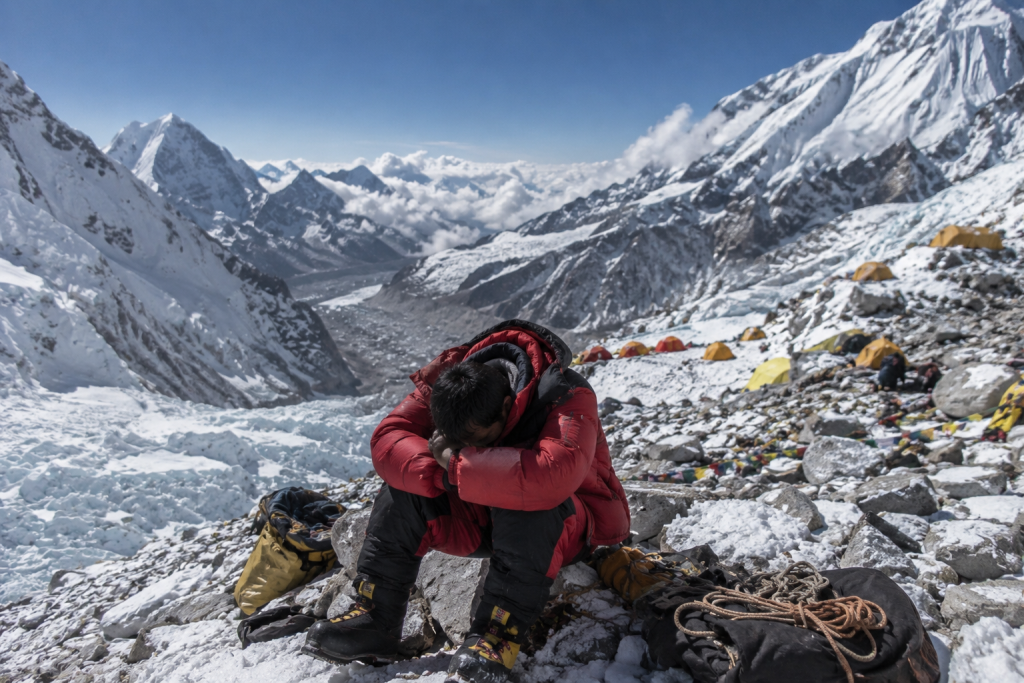
The Invisible Heroes Behind Every Everest Expedition
Although the word “Sherpa” is often used to describe mountain guides, it actually refers to an ethnic group native to the Himalayan region of Nepal. For generations, Sherpas have lived at high altitude, where their bodies have gradually adapted to an environment with significantly lower oxygen levels.
Scientific research has shown that many Sherpas possess genetic adaptations that allow them to use oxygen more efficiently than most people who live at sea level. These differences improve their ability to perform physically demanding work in thin air, but they do not make them immune to the mountain’s dangers.
Every climbing season, Sherpas are usually the first to cross unstable glaciers, fix ropes through dangerous sections, and transport the equipment needed for commercial expeditions. Their work often exposes them to far greater risks than the clients they guide.
Dawa Sherpa was one of these experienced professionals. Having spent years working on Everest, he knew the mountain better than most climbers ever will. That experience would ultimately become one of the reasons he survived.
The Moment Everything Went Wrong
On May 29, 2026, Dawa Sherpa was descending after abandoning a summit attempt with a Polish client. At some point during the descent, the two became separated.
The climber eventually reached safety.
Dawa never arrived.
At those elevations, time quickly becomes an enemy. Temperatures routinely fall well below freezing, powerful winds drain body heat, and every breath delivers far less oxygen than the human body is designed to receive.
Initial search efforts failed to locate him. Helicopter operations at extreme altitude are limited by weather, visibility, and terrain, while rescue teams themselves face life-threatening risks.
As hours turned into days without any sign of life, hope slowly disappeared.
Eventually, his family accepted what seemed inevitable.
Why Climbers Call It the “Death Zone”
Above roughly 8,000 meters, Everest enters what mountaineers call the “Death Zone.”
The name is not dramatic exaggeration—it reflects a biological reality.
At this altitude, atmospheric pressure is so low that every breath contains far less usable oxygen than at sea level. Even while resting, the body begins consuming oxygen faster than it can replace it. Instead of recovering, every organ gradually deteriorates.
Without supplemental oxygen, climbers become increasingly exhausted, confused, and physically weak. Decision-making suffers, coordination declines, and simple tasks can become overwhelming.
High-altitude cerebral edema, a potentially fatal swelling of the brain, may develop as oxygen deprivation worsens. Victims can experience confusion, hallucinations, loss of balance, and eventually unconsciousness.
Another deadly condition, high-altitude pulmonary edema, fills the lungs with fluid, making breathing progressively more difficult.
At the same time, freezing temperatures force the body to redirect blood away from the hands and feet to protect vital organs. This greatly increases the risk of frostbite, and in severe cases, permanent tissue damage may require amputation.
For these reasons, climbers try to spend as little time as possible above 8,000 meters. Even healthy, experienced mountaineers cannot remain there indefinitely.
Surviving Against Nearly Impossible Odds
After being rescued, Dawa Sherpa described how his oxygen supply had run out and how an accident prevented him from continuing his descent normally.
With no reliable source of water, he survived by chewing snow and ice despite the pain it caused. Eventually, he found a few forgotten pieces of chocolate and snacks inside his climbing gear, providing just enough energy to keep moving.
According to his account, he also became trapped inside a crevasse for nearly two days before managing to climb out after accumulated snow partially filled the gap.
From that point onward, he continued descending almost entirely under his own power, often crawling while using fixed climbing ropes for support.
When rescuers finally reached him, he was suffering from severe dehydration, frostbite, and multiple injuries, yet he remained conscious.
Doctors later described his survival as extraordinary given the conditions he had endured.
A Rescue That Sparked Difficult Questions
Dawa Sherpa’s survival quickly became more than an inspiring story.
His family publicly questioned whether enough had been done during the search and criticized the handling of the rescue effort. The case reignited a broader discussion within the mountaineering community about the safety of Nepalese guides and whether Sherpas receive the same level of protection as international clients.
The debate is not new.
Sherpas have long carried the greatest physical burden on Everest while facing many of its most dangerous hazards. In 2014, sixteen Sherpas lost their lives in a devastating avalanche in the Khumbu Icefall, one of the deadliest disasters in Everest’s history. That tragedy highlighted the enormous risks local guides accept every climbing season.
For many observers, Dawa Sherpa’s case once again raised uncomfortable questions about responsibility, safety standards, and the human cost behind commercial mountaineering.
Everest Remains One of the World’s Most Dangerous Mountains
Today, climbing Everest has become a global industry worth millions of dollars. Depending on the operator and level of support provided, an expedition can cost anywhere from $40,000 to well over $100,000.
Modern equipment, satellite communications, detailed weather forecasting, and improved rescue capabilities have made climbing safer than it once was.
Even so, Everest remains unforgiving.
More than 300 people have died on the mountain since modern climbing began, and many of their bodies remain where they fell because recovering them would place additional lives at risk.
Every year brings new accidents caused by avalanches, falls, exhaustion, altitude sickness, or sudden weather changes.
Against that backdrop, Dawa Sherpa’s survival appears almost unbelievable.
Experts agree that very few people could have endured nearly six days under similar circumstances. His years of experience, physical adaptation to high altitude, and extraordinary determination likely combined to make the impossible possible.
More Than an Everest Story
Dawa Sherpa’s experience is ultimately about far more than one mountain.
It is a reminder of the incredible resilience of the human body, the strength of the human spirit, and the often-overlooked people whose work allows others to pursue extraordinary ambitions.
Every climbing season, headlines celebrate those who reach the summit of Everest. Far fewer stories focus on the guides who carry supplies, secure dangerous routes, and repeatedly place themselves in harm’s way so others can stand on the roof of the world.
For a brief moment, one of those guides became impossible to ignore.
The man everyone believed had been lost forever returned alive from one of the most hostile environments on Earth.
His survival may be remembered as one of Everest’s greatest modern miracles, but it also serves as a powerful reminder that behind every successful ascent stand individuals whose courage often remains unseen—and whose sacrifices deserve to be remembered long after the summit photos fade.