
At first glance, the photographs looked almost unbelievable. A man stood calmly beside a fully grown hippopotamus, feeding it, swimming with it, and treating it as if it were an old friend. To many people, the images seemed to prove that trust and compassion could overcome even the wildest instincts.
Years later, those same photographs would be remembered for a very different reason.
The story of South African farmer Marius Els and his hippo, Humphrey, remains one of the most widely discussed examples of why wild animals should never be mistaken for domesticated pets, no matter how strong the bond may appear.
An Unusual Beginning
Humphrey entered Marius Els’ life after being rescued as a young calf that had become separated from its mother during severe flooding in South Africa.
Rather than sending the animal away, Els chose to raise him on his farm. As the years passed, Humphrey grew from a vulnerable youngster into one of the largest land mammals on Earth.
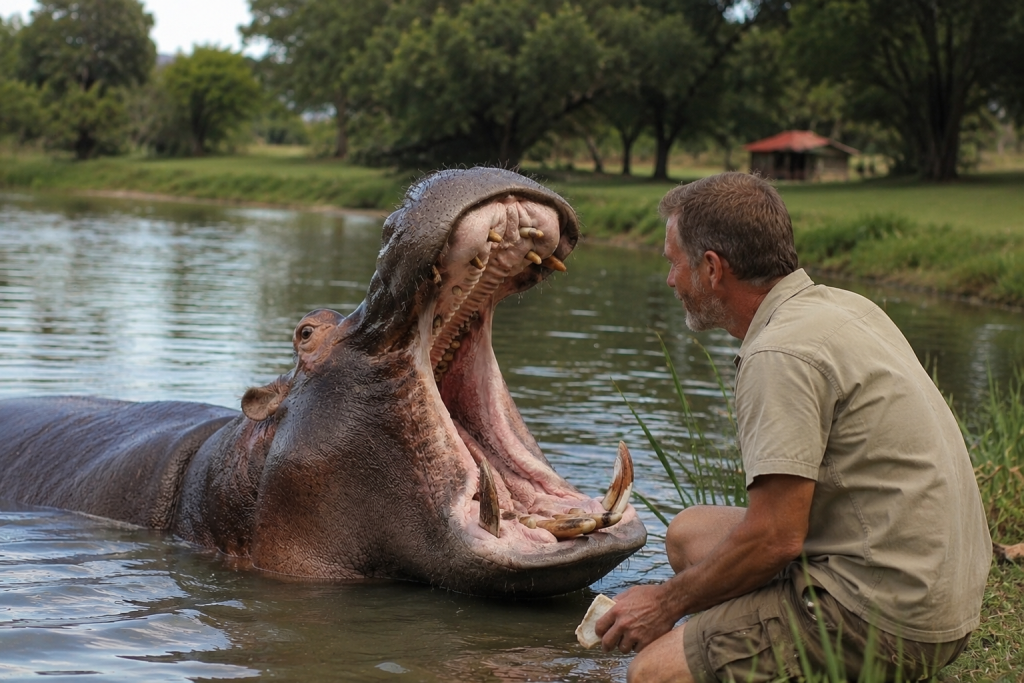
Despite his enormous size, the farmer treated him like part of the family. He often fed him by hand, spent time with him in the water, and spoke publicly about the trust they had built together.
Television features and newspaper stories soon turned the pair into an international curiosity. Many people admired what appeared to be an extraordinary friendship between a man and a wild animal.
A Gentle Giant That Never Truly Lost Its Wild Nature
Although hippos often look slow and peaceful, wildlife experts have long warned that appearances can be deceptive.
Adult males can weigh more than three metric tons, move surprisingly fast over short distances, and become highly aggressive when defending their territory. Their powerful jaws and long tusk-like teeth make them one of Africa’s most dangerous large mammals.
Unlike predators that hunt for food, hippos usually attack because they feel threatened or believe their space has been invaded, particularly around rivers and lakes.
For this reason, conservationists have always stressed that they cannot be considered domesticated animals, even when they have spent years around humans.
Warning Signs Were Already There
As Humphrey matured, there were several incidents that caused concern.
The hippo reportedly wandered onto neighboring properties and frightened local residents. These events led many people to question whether it was still safe for such a powerful wild animal to live so closely with humans.
Marius Els, however, remained convinced that the relationship they had built over the years made their situation different.
The Day Everything Changed
In November 2011, that belief came to a heartbreaking end.
Humphrey attacked the man who had cared for him since he was young, dragging Els into the water. The farmer did not survive the encounter.
The tragedy quickly made headlines around the world and reignited an important discussion about the risks of keeping wild animals outside their natural environment.
Why Experts Weren’t Surprised
The incident was never viewed by wildlife specialists as an act of betrayal.
Instead, they pointed to something far more fundamental: wild animals continue to rely on instincts that have evolved over millions of years. Hormonal changes, territorial behavior, stress, or environmental triggers can produce reactions that humans may neither anticipate nor fully understand.
Years of familiarity cannot erase those deeply rooted survival instincts.
A Story That Still Carries an Important Lesson
More than a decade later, the story of Marius Els and Humphrey continues to be shared because it highlights an uncomfortable reality.
Love, patience, and daily care can build remarkable relationships between humans and animals, but they do not change the essential nature of wildlife.
Perhaps the greatest respect we can show these magnificent creatures is not by trying to make them part of our homes, but by protecting the places where they truly belong. Sometimes, the kindest thing we can do for a wild animal is simply allow it to remain wild.