
Few people leave a lasting mark on medical history without ever intending to. Jérôme Hamon was not a scientist, a surgeon, or a public figure. He was an ordinary Frenchman born with a rare genetic disorder whose extraordinary journey would eventually redefine what doctors believed was possible. By becoming the first person in the world to undergo two successful full face transplants, he transformed not only his own life but also the future of reconstructive surgery.
His story is about far more than groundbreaking operations. It is about identity, resilience, and the remarkable determination of a man who refused to give up even when medicine itself had few answers.
A Rare Genetic Disorder That Gradually Took Away His Face
Jérôme Hamon was born in France in 1974 with Neurofibromatosis Type 1 (NF1), an inherited genetic condition that affects roughly one in every 3,000 people worldwide. The disorder causes tumors to grow along nerves throughout the body, although its severity varies greatly from one patient to another.
Some individuals experience only mild skin changes, while others develop extensive tumors that distort bones, muscles, and facial structures. There is currently no cure for NF1, and treatment focuses on managing symptoms and removing tumors when they threaten a patient’s health or quality of life.
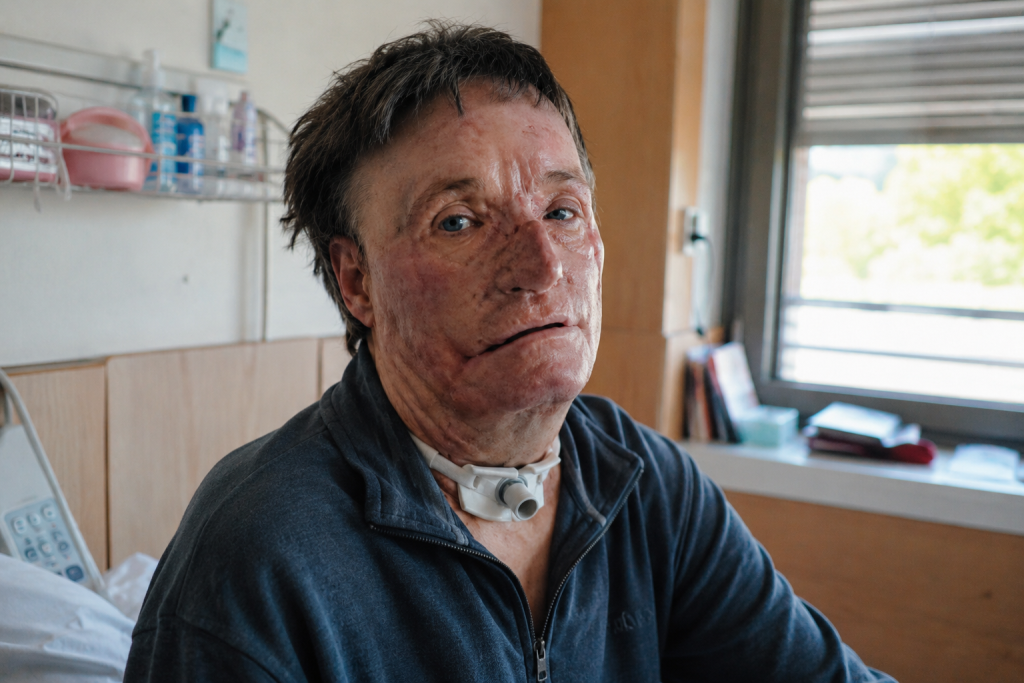
For Hamon, the disease became increasingly aggressive. Over the years, tumors severely altered the structure of his face until conventional reconstructive surgery could no longer restore either appearance or normal function. Eating, breathing, speaking, and interacting with others became progressively more difficult. Beyond the physical challenges, the emotional burden of watching his appearance change year after year was impossible to ignore.
When Face Transplants Were Still Considered Experimental
Today, face transplantation is recognized as one of modern medicine’s greatest achievements. Two decades ago, however, the concept seemed almost impossible.
Everything changed in 2005 when French surgeons performed the world’s first partial face transplant. That operation proved such procedures could succeed, but it also revealed enormous challenges. Every transplant required lifelong immune-suppressing medication, and doctors still knew very little about long-term survival, nerve recovery, or chronic rejection.
By 2010, only a handful of face transplants had been attempted worldwide. Every new patient represented an opportunity to expand scientific knowledge while facing risks unlike those associated with almost any other surgical procedure.
A Historic Operation
In July 2010, Professor Laurent Lantieri and his surgical team at Henri-Mondor Hospital near Paris performed a full face transplant on Jérôme Hamon.
The procedure demanded extraordinary precision. Surgeons transplanted skin, muscles, blood vessels, connective tissue, and nerves while reconnecting microscopic vessels only a few millimeters wide. Every successful connection restored circulation to the transplanted tissue, and every minute counted.
The operation was successful.
Over the following months, Hamon’s new face gradually became part of him. Sensation slowly returned as nerves regenerated, facial muscles became more responsive, and everyday activities such as speaking, eating, and smiling became possible again.
To the medical community, the surgery represented a remarkable scientific achievement. To Hamon, it offered something much simpler but infinitely more valuable: the opportunity to rebuild his life.
Why a Successful Transplant Is Only the Beginning
Unlike many surgical procedures, transplantation is never truly finished once the operation ends.
The immune system is designed to recognize and attack anything it identifies as foreign. Without lifelong immunosuppressive medication, the body will attempt to destroy transplanted tissue.
These medications make transplantation possible, but they also increase the risk of infection, require constant monitoring, and may produce serious long-term side effects. Even patients who carefully follow treatment plans can eventually develop chronic rejection, one of the greatest challenges in transplant medicine.
For several years, Hamon’s recovery appeared encouraging. His case became an important source of information for specialists studying facial transplantation, and his progress gave hope to other patients facing severe facial disfigurement.
When Everything Changed Again
Years after his first transplant, Hamon developed a respiratory infection that required antibiotic treatment. Unfortunately, the medication interfered with his immunosuppressive therapy, contributing to a chain of events that ultimately triggered chronic rejection of the transplanted face.
Doctors tried to preserve the graft, but the damage continued to worsen. As blood supply failed and tissue death spread, they reached an agonizing conclusion.
Removing the transplanted face was the only way to save his life.
Living Without a Face
The months that followed became one of the most extraordinary chapters in modern medical history.
After the first transplant was removed, Hamon spent nearly two months in hospital waiting for another compatible donor. During that period, he lived without a functioning face, relying entirely on intensive medical care while specialists worked tirelessly to keep him stable.
Finding a suitable donor for any facial transplant is extraordinarily difficult. Blood type, tissue compatibility, skin tone, facial size, and numerous immunological factors must align before surgery can even be considered.
Finding a donor for a second full face transplant was considered even more challenging.
A World First
In early 2018, doctors finally received the news they had been hoping for.
A compatible donor had been found.
Before surgery, Hamon’s medical team carried out complex treatments to remove antibodies produced after the first transplant, reducing the likelihood that his immune system would immediately attack the second graft.
Only then did surgeons proceed with another marathon operation.
The surgery succeeded.
Jérôme Hamon became the first person in medical history to receive two successful full face transplants.
Months later, he joked that receiving the face of a 22-year-old donor had made him look twenty years younger. Behind the humor, however, was something much more meaningful. He explained that, despite everything he had endured, he finally felt like himself again.
A Legacy That Continues to Shape Modern Medicine
Fewer than fifty face transplants have been performed worldwide since the first procedure in 2005, making each case an invaluable source of scientific knowledge.
Hamon’s experience demonstrated that a second facial transplant, once thought nearly impossible, could become a life-saving option for carefully selected patients. His case also provided researchers with critical insights into chronic rejection, immune management, and retransplantation strategies that continue to influence transplant medicine today.
Future patients may benefit from lessons learned because one man chose to face extraordinary uncertainty with remarkable courage.
Remembering the Man Behind the Medical Milestone
Jérôme Hamon passed away in April 2024 at the age of forty-nine after years of intensive medical treatment and multiple complex surgeries.
Although his life came to an end, his contribution to medicine continues.
His journey reminds us that identity cannot be measured only by appearance. Modern surgery can replace skin, reconnect blood vessels, and restore facial movement in ways that once seemed unimaginable. Yet resilience, hope, and the determination to keep moving forward cannot be transplanted.
Those qualities belonged entirely to Jérôme Hamon.
History may remember him as the man who lived with three different faces.
But the world will remember him even more for the strength that never changed, no matter which face he wore.