
Imagine swimming through warm tropical waters when you suddenly feel something attach itself to your leg. It doesn’t sting, bite, or struggle. It simply stays there as if it has decided you’re the perfect ride.
For many divers, this isn’t a scene from a movie—it’s a real encounter with one of the ocean’s most unusual fish: the remora.
Unlike predators that rely on speed or strength, the remora has survived for millions of years by following a completely different strategy. Instead of chasing everything it needs, it lets larger marine animals do the traveling.
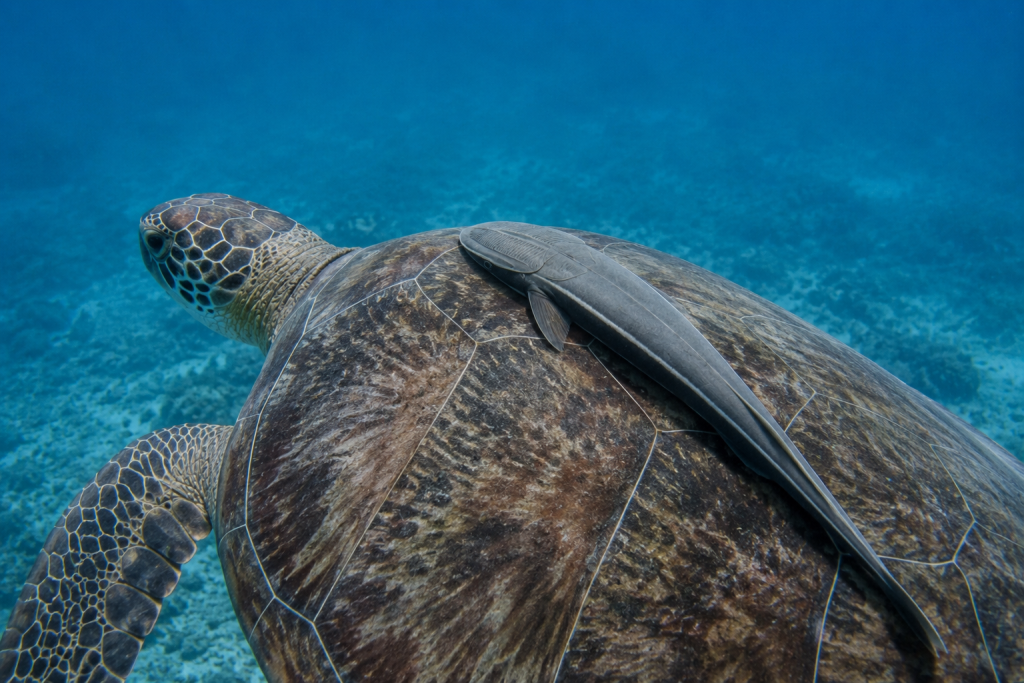
A fish with an extraordinary design
At first glance, a remora doesn’t look particularly remarkable. Its long, streamlined body blends easily into the open ocean.
Its true secret, however, is hidden on top of its head.
Where most fish have a dorsal fin, the remora has evolved a remarkable adhesive disc. This structure, made up of movable plates called lamellae, allows it to grip smooth surfaces with impressive force while still releasing instantly whenever it chooses.
Rather than functioning like an ordinary suction cup, the disc combines pressure and friction to create a secure attachment. Even when a shark suddenly accelerates or changes direction, the remora can remain firmly in place without constantly using its muscles.
Scientists consider it one of the most fascinating examples of evolutionary engineering found in marine life.
A free ride across the world’s oceans
Life in the open ocean demands enormous amounts of energy.
Small fish must swim continuously to search for food and avoid predators. Every kilometer traveled comes at a cost.
The remora solved this challenge in an ingenious way.
It attaches itself to sharks, whales, dolphins, sea turtles, rays, tuna and other large marine animals, allowing them to provide transportation while it conserves energy. Some individuals may remain attached for hours, while others switch hosts several times during a single day depending on where food is available.
For the remora, every large animal passing through the ocean can become a moving platform.
More than just a passenger
Transportation is only part of the story.
Traveling alongside a much larger animal also gives the remora access to food that would otherwise be difficult to obtain. It feeds on scraps left behind after its host has eaten, small drifting organisms and, in some species, external parasites found on the host’s skin.
Because of this behavior, many people mistakenly assume the remora is a parasite.
In reality, marine biologists usually describe the relationship as commensalism. The remora clearly benefits, while the host experiences little or no measurable effect. When parasites are removed, both animals may actually benefit, turning the relationship into mutualism.
Why does it sometimes attach to humans?
Videos of remoras clinging to divers often leave viewers wondering whether the fish is attacking.
It isn’t.
To a remora, a diver wearing a wetsuit can simply resemble another large object moving steadily through the water. The fish may briefly attach to a wetsuit, scuba tank, swim fin or even bare skin before swimming away on its own.
Although the attachment can feel surprisingly strong, remoras are not considered dangerous to people. They are not trying to bite or feed on humans—they are simply behaving as they would with many other large creatures in the sea.
The fish that inspired ancient legends
Long before scientists understood how remoras worked, people created stories to explain them.
Ancient Romans believed these fish possessed mysterious powers capable of slowing or even stopping ships at sea. In fact, the name remora comes from the Latin word meaning “delay.”
Today we know that no fish of this size could possibly halt a vessel. The legend survived for centuries, however, becoming one of history’s more unusual maritime myths.
An unexpected fishing partner
Perhaps the most remarkable chapter in the remora’s story comes from traditional fishing communities.
In parts of the Indian Ocean, the Caribbean and along sections of the African coast, fishermen once used live remoras to help capture sea turtles.
A line was carefully tied to the fish before it was released into the water. Following its natural instinct, the remora attached itself to a turtle, allowing fishermen to slowly retrieve both the fish and its much larger companion.
To early European explorers, the technique seemed almost unbelievable, yet it demonstrated an impressive understanding of animal behavior long before modern fishing technology existed.
A source of inspiration for modern engineers
The remora’s remarkable adhesive system has attracted attention far beyond marine biology.
Engineers studying biomimetics have examined its attachment mechanism while developing reusable gripping devices, underwater robots and medical technologies that require secure yet easily reversible adhesion.
Once again, nature proved it had solved a complex engineering problem millions of years before humans even recognized it.
Evolution doesn’t always reward the strongest
When people think about survival in nature, they often imagine speed, strength or powerful predators.
The remora tells a different story.
Instead of becoming faster than every other fish, it evolved a completely unique solution: let someone else provide the power while focusing on efficiency.
That simple strategy has allowed these remarkable fish to thrive in oceans around the world for millions of years.
The next time you spot a shark with several small fish attached beneath its body—or watch a diver gently removing an unexpected passenger—you’ll be witnessing one of evolution’s most creative solutions. Sometimes survival isn’t about being the biggest or the fastest. Sometimes it’s about finding the smartest ride.