
I spent a few minutes watching an octopus, and honestly, my first thought wasn’t that I was looking at an animal, but at something that didn’t quite belong in the world I know. It doesn’t have a fixed shape, it doesn’t move in a way that feels familiar, and the longer you watch it, the more you realize you don’t fully understand what you’re seeing.
If it suddenly appeared on land, you might assume it came from somewhere else entirely. Not because it’s frightening, but because it’s so different that it doesn’t fit into anything we recognize. It has no skeleton, it can reshape its body as needed, it can instantly change both the color and texture of its skin, and its eight arms seem to operate with a kind of independence that feels almost unsettling.
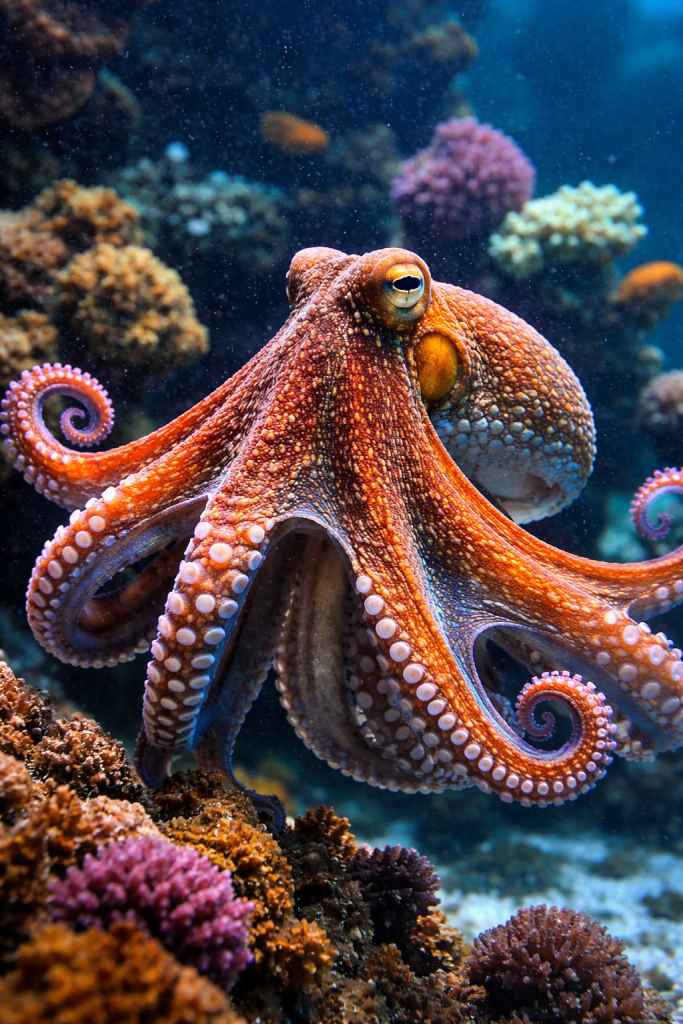
And yet, this isn’t science fiction. It’s the octopus—and it has existed on Earth for millions of years.
Even its name tells part of the story. In English, “octopus” comes from the Greek word októpus, which literally means “eight feet.” It is one of those rare cases where the name itself directly reflects the animal’s biology.
What makes the octopus so fascinating is not just how it looks, but how differently it functions compared to most animals. For example, it has three hearts. Two of them pump blood to the gills, where it becomes oxygenated, while the third pumps it to the rest of the body. Interestingly, this main heart becomes less effective when the octopus swims, which is why these animals often prefer to crawl along the ocean floor rather than swim, conserving energy.
Their blood is blue, not red, because it contains hemocyanin—a copper-based molecule that transports oxygen more efficiently in cold, low-oxygen water. It’s another detail that makes them seem almost “alien,” even though it is simply a highly effective adaptation.
Perhaps the most remarkable feature of an octopus is how it controls its body. Around two-thirds of its neurons are not located in its central brain, but in its arms. Each arm has a level of autonomy, able to explore, touch, and respond to its surroundings without waiting for direct instructions. In a way, each arm can make decisions in real time, interacting with the environment independently.
And those arms do more than just move and grab. The suckers along them can “taste” what they touch, thanks to specialized chemical receptors. This means an octopus experiences the world in a way that is very different from ours, combining multiple senses into one.
Despite this unusual structure, octopuses are considered some of the most intelligent invertebrates. They have been observed opening jars, solving problems, using objects as tools, and remembering solutions. In controlled environments, some have escaped from tanks, navigated complex spaces, and even recognized individual people.
There are even real-life cases that seem almost unbelievable. One of the most well-known involved an octopus named Inky, in New Zealand. During the night, it managed to leave its tank, move across the floor, and find a drainage pipe that led back to the ocean. Without being noticed, it disappeared. It sounds like a story, but it highlights just how adaptable and capable these animals are.
This ability is closely linked to their physical structure. Because they have no skeleton, octopuses can compress their bodies and squeeze through extremely small openings. As long as their central body can fit through a space, the rest of them can follow.
Their intelligence is only part of what makes them unique. Octopuses are also masters of camouflage. They can change their color in fractions of a second, but also the texture of their skin, blending into sand, rocks, coral, or even mimicking other sea creatures. Some species go even further, imitating the behavior of other animals to avoid predators.
These changes are not only about hiding—they can also reflect the animal’s state, from calm to stress or warning.
Another fascinating ability is regeneration. If an octopus loses an arm, it can grow it back over time, gradually restoring its function. This process is not as complex as the regeneration seen in animals like the axolotl, but it is still effective enough to help them survive in a challenging environment.
Octopuses also vary greatly in size. Some species are very small, only a few centimeters long, living hidden in shells or crevices. Others can grow much larger. The giant Pacific octopus, for example, can reach arm spans of over 13–16 feet (4–5 meters) and weigh tens of kilograms.
However, even the largest octopuses are nothing like the giant sea creatures described in classic literature. The idea of massive animals capable of destroying ships, as imagined in stories by Jules Verne, does not reflect reality. Those stories were more likely inspired by giant squid, which are different animals altogether. In reality, octopuses tend to avoid conflict and prefer to hide or escape.
In terms of diet, octopuses are predators. They feed on crabs, shellfish, small fish, and other marine animals. They use their arms to capture prey and a hard, beak-like structure to break it apart. It is an efficient system, perfectly adapted to their environment.
As for humans, octopuses are generally not dangerous. Most species are shy and avoid interaction. There are a few exceptions, such as the blue-ringed octopus, which is highly venomous, but encounters are rare and typically occur only if the animal is disturbed.
And yet, despite all these extraordinary abilities, an octopus’s life is surprisingly short. Many species live only one or two years. After reproduction, the female dedicates the final stage of her life to protecting her eggs, often without feeding, carefully tending to them until they hatch.
What makes octopuses truly fascinating is not just how different they are, but how complex they are at the same time. They do not resemble us, they do not think like us, and their bodies are built in a completely different way, yet they display intelligence, adaptability, and behaviors that challenge how we understand life.
We like to believe we would recognize intelligent life if we saw it. But the octopus quietly challenges that assumption.
The octopus is not an alien in the literal sense. But it may be one of the closest examples we have of a form of life that feels entirely different from anything we know—and it exists right here, in the oceans of our own planet.
And perhaps the most important realization is this: the world is far more diverse and harder to fully understand than we tend to believe, and what we consider “normal” is only a small part of what life can truly be.