
A Race That Looked Lost Before It Had Really Begun
During the 1972 Summer Olympics in Munich, spectators gathered along the regatta course to watch some of the world’s best canoeists compete for a place in the next round. Among them was a Romanian athlete who had already earned Olympic gold and was widely regarded as one of the strongest competitors in the sport.
Only moments after the race began, disaster struck.
His paddle snapped.
In sprint canoeing, a broken paddle is more than an inconvenience. It is the athlete’s primary connection to the water, the tool that generates speed, balance, and control. Without it, finishing a race becomes nearly impossible.
Most competitors would have stopped immediately.
Instead, Ivan Patzaichin kept going.
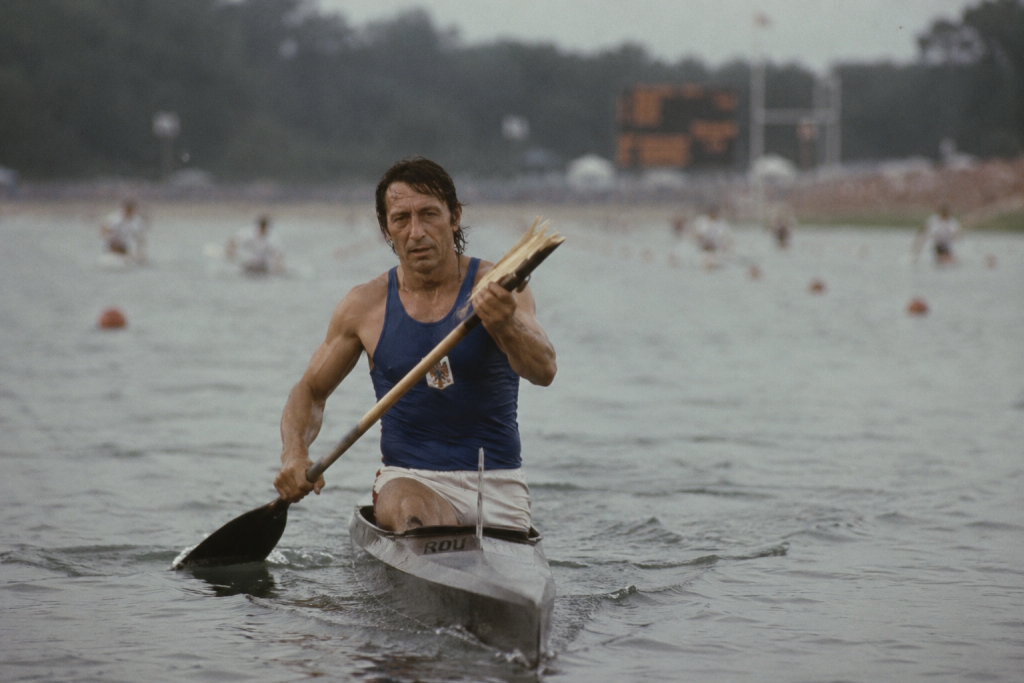
Holding what remained of the paddle, he continued moving forward while the rest of the field disappeared into the distance. Spectators watched in confusion as the Romanian athlete stubbornly stayed on course. He had no realistic chance of qualifying, yet he refused to leave the race unfinished.
By the time he crossed the finish line, he was far behind everyone else. To many observers, it looked like the end of his Olympic campaign.
It wasn’t.
A few days later, he would return to the water and capture Olympic gold.
The remarkable scene became one of the most memorable moments in canoeing history, but it was only a small part of a much larger story.
Growing Up Where Boats Were Part of Everyday Life
Ivan Patzaichin was born on November 26, 1949, in Mila 23, a remote village deep inside Romania’s Danube Delta.
Unlike most communities, roads played only a minor role in daily life there. Waterways connected homes, schools, fishing grounds, and neighboring settlements. Boats were not recreational vehicles; they were essential tools for transportation and survival.
Patzaichin grew up in a Lipovan Russian community, descendants of religious groups who settled in the region centuries earlier. The village preserved traditions, customs, and a way of life closely tied to the surrounding wetlands.
For a child raised in Mila 23, learning to handle a boat was as natural as learning to ride a bicycle elsewhere.
Long before he became an athlete, he was already spending countless hours on the water.
Why the Delta Helped Shape a Champion
Sports scientists often point out that early exposure to physical activity can play a major role in developing coordination, endurance, and movement efficiency.
Patzaichin’s childhood provided exactly that.
Paddling was not something he practiced during scheduled training sessions. It was woven into everyday life. Moving through canals, navigating changing water conditions, and spending long hours in boats helped build skills that would later become invaluable in competition.
Coaches who worked with him frequently noted his exceptional boat control and his ability to transfer power efficiently through each stroke.
In high-level canoeing, raw strength alone is not enough. Success depends on technique, balance, rhythm, and the ability to maintain speed while conserving energy. Patzaichin possessed all of those qualities.
From a Remote Village to the Olympic Stage
His talent was eventually noticed by coaches, and in 1967 he was recruited to join Dinamo Bucharest, one of Romania’s leading sports clubs.
The transition was significant.
A teenager from a secluded Delta village suddenly found himself immersed in the demanding environment of elite sport. Training schedules were rigorous, competition for places on national teams was intense, and expectations were high.
Patzaichin adapted quickly.
Just one year after arriving in Bucharest, he represented Romania at the 1968 Olympic Games in Mexico City.
At only eighteen years old, he won his first Olympic gold medal.
It marked the beginning of one of the most successful careers in canoeing history.
A Career Defined by Consistency and Excellence
Many athletes experience a brief period of success before fading from the international stage.
Patzaichin did the opposite.
For nearly two decades, he remained among the world’s elite competitors, a remarkable achievement in a physically demanding sport.
Across five Olympic Games, he collected seven Olympic medals: four gold and three silver.
He also earned twenty-two medals at World Championships, establishing himself as one of the dominant figures in international canoeing.
Maintaining that level of performance required extraordinary discipline. Sprint canoeing places heavy demands on the shoulders, back, core muscles, cardiovascular system, and overall endurance. Every race requires a combination of explosive power and technical precision.
Patzaichin consistently delivered both.
The Broken Paddle That Became Olympic History
The Munich incident remains the defining image of his athletic career.
After his paddle broke during the qualifying race, Romanian officials challenged the decision that had initially removed him from contention.
Their appeal succeeded.
Patzaichin was allowed to continue competing through the repechage rounds.
What followed seemed almost unbelievable.
He advanced.
He won again.
Then he won the final.
The athlete who appeared finished after a catastrophic equipment failure became Olympic champion.
Sports psychologists often describe resilience as the ability to recover from major setbacks without losing focus on long-term goals. Patzaichin’s performance in Munich remains a textbook example of that principle in action.
Turning Olympic Fame Into a Mission
After retiring from competition, Patzaichin could easily have remained known only as a sporting legend.
Instead, he dedicated much of his energy to protecting the region that had shaped him.
The Danube Delta is one of Europe’s most important wetland ecosystems and a UNESCO World Heritage Site. It supports an extraordinary range of wildlife, including hundreds of bird species and diverse aquatic habitats.
Over time, however, the area faced increasing environmental pressures from pollution, unsustainable development, and other human activities.
Patzaichin became one of Romania’s most visible advocates for responsible tourism and environmental protection.
The Boat Designed to Slow People Down
One of his most recognized projects was the creation and promotion of the canotca, a boat inspired by both racing canoes and traditional Delta fishing vessels.
The idea was simple but powerful.
Rather than encouraging fast motorized travel, the canotca offered visitors a quieter way to experience the Delta. Moving slowly through the waterways allowed people to observe wildlife, appreciate local culture, and connect more deeply with the environment.
Patzaichin believed that preserving the character of the Delta required balancing economic development with environmental responsibility.
Through various projects and initiatives, he promoted sustainable tourism, cultural heritage, and community involvement throughout the region.
A Legacy That Extends Beyond Sport
In his later years, Patzaichin remained deeply involved in educational, cultural, and environmental projects connected to the Danube Delta.
Among the initiatives closest to his heart were efforts to support local communities and preserve traditional knowledge for future generations.
He passed away on September 5, 2021, at the age of 71.
His death prompted tributes from athletes, coaches, environmental advocates, and public figures across Romania and beyond.
Yet his legacy cannot be measured solely by medals.
Many champions are remembered for winning.
Far fewer are remembered for what they chose to do after the victories ended.
More Than an Olympic Champion
Today, Ivan Patzaichin’s name is still closely associated with the race in which he continued paddling after his equipment failed.
It is an unforgettable story of determination.
But perhaps the most remarkable aspect of his life is what happened afterward.
After reaching the highest levels of international sport, he used his reputation to support the place where his journey began. Rather than distancing himself from his roots, he spent decades helping protect the landscapes, traditions, and communities that had shaped him.
His story is not only about athletic achievement.
It is about perseverance, humility, and the idea that success becomes far more meaningful when it is used to benefit something larger than oneself.