
At first glance, it seems impossible.
Watch the footage captured by a camera mounted on a paraglider’s helmet, and you see what appears to be one of the safest places on Earth: open sky.
There are no intersections. No traffic lights. No crowded highways.
Just air, sunlight, and an expanse of space stretching in every direction.
Yet on May 23, 2026, high above the Austrian Alps, two aircraft arrived at exactly the same point in that seemingly limitless environment.
What followed was a collision so unusual that even aviation professionals described it as an exceptionally rare event.
A paraglider’s wing was ripped apart in midair by a passing airplane.
The pilot lost control and began falling.
Minutes later, against all odds, she was still alive.
To millions of viewers, the incident became a viral video. To aviation investigators, however, it highlighted something far more significant: the limitations of human perception and the uncomfortable reality that even an open sky can become dangerously crowded.
The Hidden Traffic Lanes of the Alps
Most people imagine free flight as a solitary experience.
A pilot launches from a mountain slope, catches a thermal, and drifts peacefully through an empty sky.
The reality is far more complicated.
The Alpine regions of Austria, Switzerland, France, and Italy are among the world’s busiest destinations for recreational aviation. On favorable days, paragliders, hang gliders, sailplanes, sightseeing helicopters, and small private aircraft often share the same airspace.
Ironically, they are all searching for similar conditions.
The same rising air currents.
The same valleys.
The same mountain passes.
The same weather windows.
While the sky appears limitless from the ground, geography naturally funnels aircraft into common routes. Much like roads concentrate vehicle traffic on the ground, mountains create invisible aerial corridors overhead.
Near Zell am See, one of Europe’s most popular paragliding destinations, this phenomenon has been part of everyday flying for decades.
A Mountain Built for Flight
The accident occurred near Schmittenhöhe, the mountain that overlooks the resort town of Zell am See.
Today, thousands of pilots visit the area each year. During peak flying conditions, colorful wings fill the sky above the valleys below, creating a scene that has become almost synonymous with Alpine adventure sports.
Few people realize how young the sport actually is.
Modern paragliding emerged only in the late twentieth century, when French mountaineers began experimenting with modified parachutes as a faster way to descend from high peaks. What started as a practical solution gradually evolved into an international sport.
Over the decades, equipment became lighter, safer, and more efficient. Modern pilots can remain airborne for hours and travel remarkable distances using nothing but naturally occurring atmospheric energy.
But as participation increased, so did the number of people sharing the same skies.
And whenever more aircraft occupy the same airspace, opportunities for error inevitably increase.
A Day That Offered No Warning
Nothing about May 23 suggested an accident was about to happen.
The weather was favorable. Visibility was good. Conditions were ideal for flying.
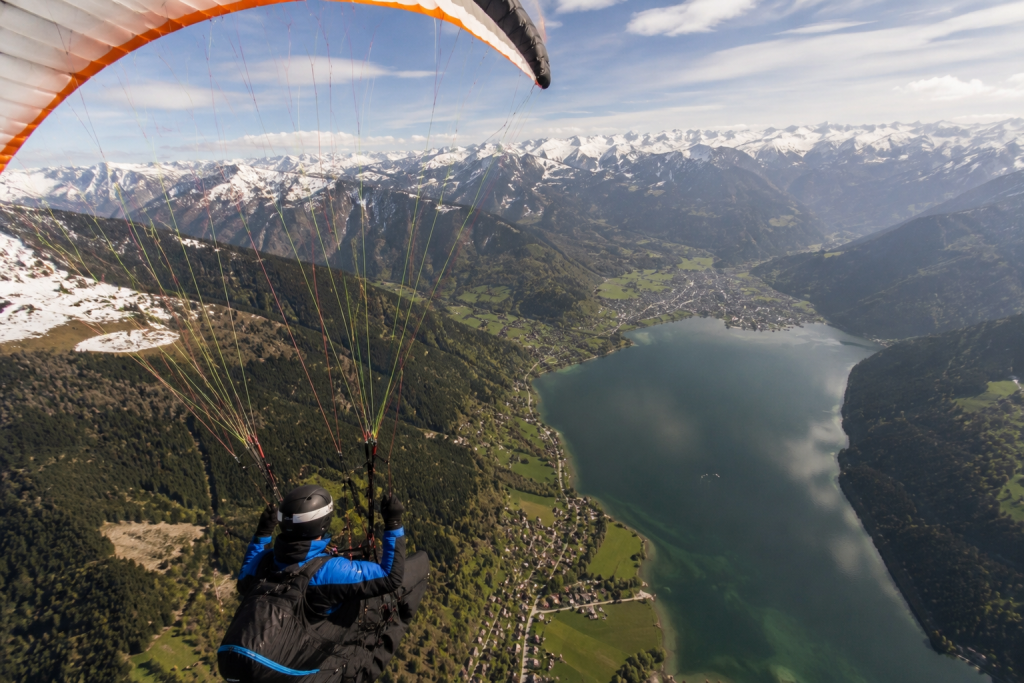
Sabrina, a 44-year-old Austrian paraglider pilot, launched from Schmittenhöhe and settled into what appeared to be a routine flight.
The camera she carried recorded the landscape unfolding beneath her.
Dense forests covered the mountainsides. Green meadows stretched across the valleys. Snow-capped peaks stood in the distance.
There was no sign of danger.
No severe turbulence.
No approaching storm.
No obvious threat.
Just silence.
Then the airplane appeared.
The Seconds That Changed Everything
The aircraft enters the video almost unexpectedly.
It was a Cessna 172, one of the most widely used light aircraft ever built.
For generations, the model has served as a training aircraft, a recreational airplane, and a trusted workhorse of general aviation. Tens of thousands have flown safely around the world.
In most circumstances, a meeting between a paraglider and a small airplane amounts to nothing more than a brief sighting.
This encounter was different.
The two aircraft were converging.
Within moments, their flight paths intersected.
The impact damaged the paraglider’s wing, tearing fabric and affecting critical suspension lines.
A stable flight instantly became a life-threatening emergency.
When a Wing Stops Being a Wing
To an observer on the ground, a paraglider may look like little more than fabric stretched across the sky.
To an aerodynamicist, it is an aircraft wing.
Like the wing of an airplane, it generates lift through a carefully maintained shape that allows air to flow around it in a specific way.
Damage that shape, and the physics of flight changes immediately.
That is precisely what happened after the collision.
The wing lost structural integrity. Stability disappeared. The paraglider began rotating violently.
For a pilot, this is one of the most dangerous situations imaginable.
Disorientation can occur within seconds. Altitude can be lost rapidly. The window for making the correct decision becomes extremely small.
There is a reason emergency procedures are practiced repeatedly during training.
In a crisis, people rarely rise to the level of their expectations.
They fall back on the level of their preparation.
A Problem Aviation Has Faced for Nearly a Century
After the footage was released, one question dominated public discussion.
How could two aircraft collide in such an enormous sky?
The answer lies in a challenge that aviation has been grappling with since its earliest days.
For decades, pilots operating under visual flight rules have relied on a principle known as “see and avoid.” The concept is simple: pilots scan the airspace around them, identify potential conflicts, and take action before a collision occurs.
In theory, it sounds straightforward.
In practice, it depends entirely on human perception.
Researchers have spent years studying why pilots sometimes fail to detect other aircraft even when they are technically visible. Human vision is remarkably powerful, but it is not infallible.
An aircraft approaching directly head-on may appear almost stationary against the background.
A paraglider can blend into mountainous terrain.
The brain constantly filters incoming information, prioritizing some details while overlooking others.
Psychologists refer to this phenomenon as inattentional blindness.
People are not necessarily failing to look.
They are failing to recognize what they are seeing quickly enough.
This limitation has played a role in numerous aviation accidents throughout history and remains one of the industry’s most persistent safety challenges.
When Multiple Factors Align
Accident investigators have long understood that serious incidents rarely result from a single mistake.
Instead, they emerge when several conditions overlap at precisely the wrong moment.
Shared airspace.
Converging flight paths.
Human limitations.
A few lost seconds.
On that afternoon above the Austrian Alps, those factors appear to have aligned.
The official investigation would later examine the details, but the footage itself already provided a powerful lesson about the complexity of aviation safety.
The Decision That Saved Her Life
After the collision, Sabrina could not change what had happened.
She could not repair the damaged wing.
She could not undo the impact.
All she could do was react.
And she did.
Recognizing that her paraglider was no longer capable of sustaining safe flight, she deployed her reserve parachute.
For paraglider pilots, the reserve is the final safeguard when everything else fails.
In many emergencies, it is the difference between a fatal accident and a survivable one.
In Sabrina’s case, it worked exactly as intended.
The uncontrolled descent stabilized.
The chaos subsided.
For the first time since the collision, survival became a realistic possibility.
She eventually reached the ground and was later recovered by emergency responders.
Remarkably, despite the severity of the accident, she escaped with only minor injuries.
The Illusion of Empty Skies
Perhaps the most striking lesson from the incident is how deceptive open space can be.
The video shows mountains, clouds, and vast stretches of apparently empty sky.
Aviation specialists see something else.
They see trajectories.
Closing speeds.
Altitude differences.
Decision-making windows measured in seconds.
To millions of viewers, the collision appeared almost unimaginable.
To safety experts, it served as a reminder of a reality that aviation has known for generations.
The sky is never truly empty.
Even in a space that appears limitless, only a few meters and a few seconds may separate an ordinary flight from a disaster.
On May 23, 2026, above the Austrian Alps, that margin disappeared.
What remained was one of the most extraordinary aerial survival stories of recent years—and a powerful reminder that in aviation, preparation often matters just as much as luck.