
In an era dominated by dating apps, endless swiping, and algorithm-driven matchmaking, one of the most unusual relationship success stories has emerged from Spain. It does not involve artificial intelligence, sophisticated compatibility software, or a billion-dollar startup. Instead, it centers on a Catholic priest, a smartphone, and a series of thoughtful questions designed to uncover what truly matters in a long-term relationship.
Over the past decade, Father Fernando Cuevas Raposo has become known for helping hundreds of people meet future spouses through a remarkably simple process. His approach has attracted attention not only within Catholic communities but also among those interested in the broader question of what makes relationships succeed in the long run.
A Chance Encounter That Started Everything
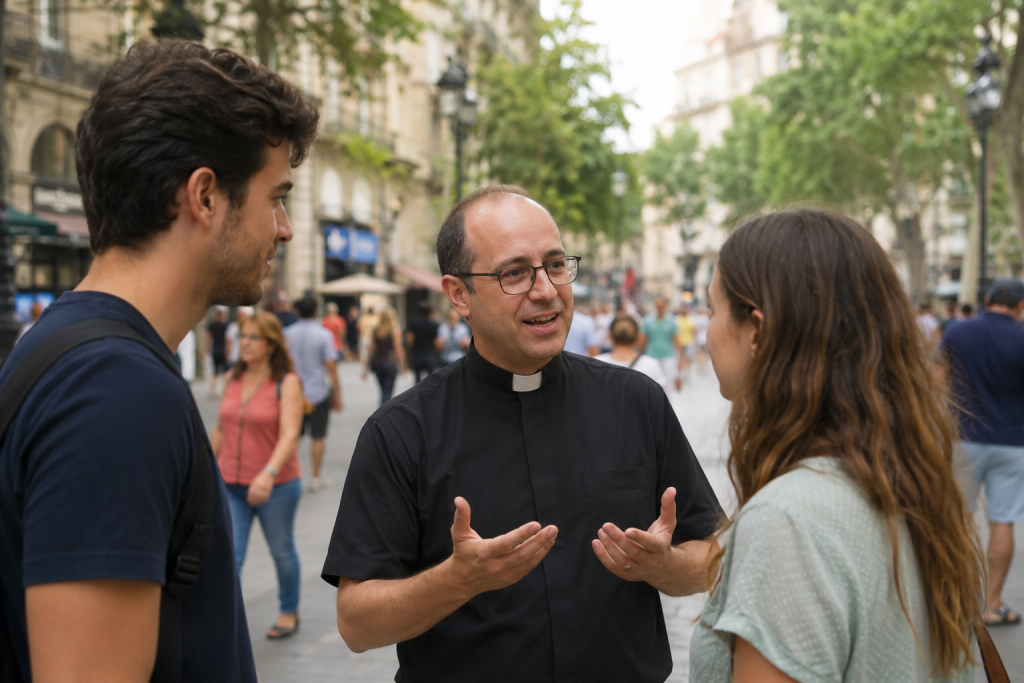
The story began in Valencia, where Father Fernando was walking through the city with a young man named Salva.
As they passed a café, Salva noticed a woman he recognized from church activities. He knew very little about her, yet he was drawn to the fact that she appeared to share the same faith and values that were important in his own life.
Like many people, he found it difficult to approach a stranger.
Instead, he turned to the priest beside him and asked if he could introduce them.
What seemed like a small favor would have unexpected consequences. The introduction led to conversations, the conversations led to a relationship, and several months later Father Fernando officiated their wedding.
For most people, the story would have ended there. Instead, it became the starting point for something much larger.
A Growing Challenge for Young Believers
As Spain has become increasingly secular over recent decades, many practicing Catholics have found it harder to meet partners who share their beliefs and long-term goals.
Traditional community networks that once played an important role in bringing people together have weakened. Younger generations often rely on online platforms, social media, or dating applications to meet potential partners.
While these tools create access to a larger number of people, they do not necessarily make it easier to find someone with deeply compatible values.
Father Fernando repeatedly heard the same concern from young adults in his community. Many wanted marriage, family, and a shared spiritual life, but struggled to find others looking for the same things.
Recognizing this need, he began helping people connect in a more intentional way.
Building a Matchmaking System Around Values
What started as occasional introductions gradually evolved into a structured process.
Interested participants complete a questionnaire and send it directly through WhatsApp. The form includes basic information such as age, occupation, interests, and background, but its primary focus is not appearance or lifestyle preferences.
Instead, it explores questions about character, priorities, personal strengths, weaknesses, and expectations for marriage.
One of the most significant questions asks applicants to describe the role faith plays in their everyday lives.
Rather than focusing on superficial compatibility, Father Fernando attempts to identify people whose fundamental values align.
When he believes two individuals may be a good match, he shares limited profile information with each of them. If both express interest, they receive contact details and are free to continue the relationship independently.
His role is simply to create the introduction.
Why Shared Values Matter
Relationship researchers have long studied the factors that contribute to marital stability and satisfaction.
While no formula can guarantee a successful relationship, numerous studies suggest that couples who share core beliefs, life goals, and expectations often experience fewer conflicts regarding major life decisions.
Psychologists frequently point to areas such as attitudes toward family, finances, children, religion, and personal responsibility as important predictors of long-term compatibility.
This concept is sometimes referred to as value congruence—the degree to which partners view the world through similar lenses.
When two people enter a relationship with comparable expectations about commitment and the future, they may be better equipped to navigate challenges together.
Father Fernando’s approach appears to rely heavily on this principle.
Hundreds of Marriages and International Attention
Over time, word of the initiative spread beyond Valencia.
People from across Spain began reaching out for assistance. Eventually, inquiries arrived from other countries as well, including nations throughout Latin America and beyond.
According to public interviews, hundreds of marriages have resulted from introductions made through the program.
The reported number surpassed 340 marriages by early 2024, turning what began as a local effort into an internationally recognized initiative.
The project has attracted interest from religious communities seeking ways to support young adults who hope to build families based on shared convictions and long-term commitment.
Despite its growing popularity, the service remains remarkably simple and continues to operate without charging participants.
Looking Beyond Modern Dating Trends
The popularity of this initiative highlights a broader cultural conversation about relationships.
Many people today have access to more potential partners than at any point in history. Yet surveys across multiple countries continue to show concerns about loneliness, relationship instability, and difficulty forming lasting connections.
Some researchers suggest that having countless options can sometimes make decision-making more complicated rather than easier. Others argue that modern dating environments often encourage quick judgments based on limited information.
By contrast, Father Fernando’s method starts with deeper questions before any romantic connection begins.
Rather than asking whether two people enjoy the same music, favorite movies, or weekend activities, the process focuses on how they view commitment, responsibility, sacrifice, family life, and personal purpose.
A Simple Idea With a Powerful Message
Whether viewed from a religious perspective or a secular one, the story offers an interesting lesson about human relationships.
Its success does not appear to stem from technology, marketing, or sophisticated data analysis. Instead, it reflects the enduring importance of clarity, intention, and shared values.
In a world increasingly shaped by algorithms, the experience of Father Fernando Cuevas Raposo suggests that meaningful connections may begin with something surprisingly simple: understanding what matters most before searching for someone with whom to share a future.
For many observers, that may be the most compelling part of the story. Not that a priest helped hundreds of couples meet through WhatsApp, but that he reminded people to ask deeper questions before looking for lasting answers.