
A butterfly lands on a windowsill and most of us instinctively try to help it find its way outside. A ladybug crawling across a hand might even be welcomed.
Replace either of them with a dark beetle, an unfamiliar insect or a spider, however, and the reaction can change instantly.
We tend to divide small creatures into categories: beautiful, harmless, annoying, frightening or disgusting. Nature makes no such distinction. An animal does not need colorful wings or a charming appearance to perform work that matters.
Some pollinate plants. Others hunt agricultural pests, recycle dead material, move nutrients through soil or become food for other animals. Many of these ecological jobs happen almost invisibly around us.
Perhaps the more useful question isn’t whether we like a particular creature.
It’s what would happen if it were no longer there.
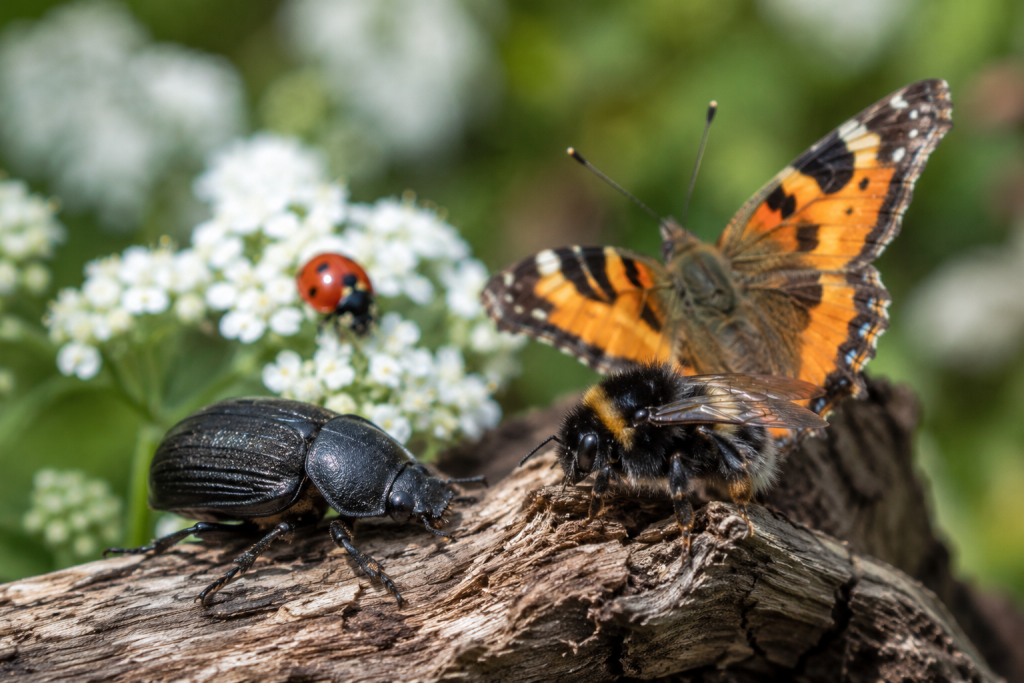
Pollinators influence far more than the honey on our table
When people hear the word “pollinator,” honey bees are usually the first animals that come to mind. They are enormously important, but they are only part of a much larger story.
Wild bees, butterflies, moths, hoverflies, beetles and other animals can carry pollen between flowers, allowing plants to reproduce and eventually produce fruits and seeds.
The scale of this relationship is remarkable.
According to the European Commission, roughly four out of five crop and wild flowering plant species in Europe depend, at least to some degree, on animal pollination.
On a global scale, the landmark assessment by the Intergovernmental Science-Policy Platform on Biodiversity and Ecosystem Services (IPBES) found that more than three-quarters of the world’s leading food crop types benefit from animal pollination to some extent.
That statistic is often repeated online in a much more dramatic form: “75% of our food depends on bees.”
That’s not what the evidence says.
No, losing pollinators would not make 75% of our food disappear
This distinction matters because several of humanity’s most important staple crops are not dependent on insects in the same way.
Wheat, rice and maize, for example, account for an enormous share of global calorie consumption and do not require animal pollination for their basic production.
IPBES estimated that about 60% of global crop production volume comes from crops that do not depend on animal pollination. Approximately 35% comes from crops that depend on pollinators to varying degrees, while the portion of global crop production directly attributable to animal pollination is estimated at roughly 5–8%.
That may sound less dramatic than the viral version, but it certainly doesn’t make pollinators unimportant.
Pollinator-dependent crops include an extraordinary variety of fruits, vegetables, nuts and seeds. These foods also contribute important micronutrients to human diets.
So a world with severely depleted pollinator populations wouldn’t necessarily be a world without calories. It could, however, become a world with less dietary diversity, reduced yields for certain crops and more fragile agricultural systems.
And agriculture is only part of the problem.
Most wild flowering plants have pollinators in their story too
IPBES estimates that nearly 90% of wild flowering plant species depend, at least partly, on animal pollination.
Those plants don’t exist in isolation.
Their fruits and seeds may feed birds and mammals. Their flowers provide resources for insects. Their leaves, stems and roots become parts of habitats used by countless organisms.
This is why biodiversity is better imagined as a network than as a collection of individual species.
Removing one strand doesn’t necessarily cause the entire network to collapse. Ecosystems often have considerable resilience. But repeatedly losing species and ecological relationships can make that network poorer and potentially less resilient.
The consequences therefore extend far beyond whether humans still have apples or almonds in supermarkets.
The ladybug we find adorable is a formidable predator
Ladybugs have somehow managed to escape much of humanity’s general dislike of insects. They appear in children’s books, on clothes and toys, and people often happily allow one to walk across their hands.
To an aphid, however, the ladybug is considerably less charming.
Many ladybird beetles are predators, and aphids are among their best-known prey. Aphids feed on plant fluids and can become serious agricultural and garden pests when their populations grow.
Ladybugs and other predatory insects form part of the natural biological control operating constantly around us.
It is an elegant reminder that ecosystems already contain countless mechanisms for keeping populations in check.
The cute little red insect isn’t simply decorating the garden.
It may be hunting.
Some of nature’s best recyclers aren’t particularly photogenic
Beetles provide an even better example of how misleading appearance can be.
Coleoptera, the biological order containing beetles, is extraordinarily diverse. Consequently, it would be wrong to describe all beetles as beneficial. Some damage crops, stored food or trees. Others are predators, herbivores, scavengers or decomposers.
But many species participate in one of nature’s most essential processes: recycling.
Dead wood, fallen vegetation, animal remains and waste do not simply vanish. They are gradually processed by communities of organisms that include fungi, bacteria and numerous invertebrates.
Dung beetles provide a particularly striking example. By feeding on and moving animal dung, different species can contribute to nutrient cycling and the incorporation of organic material into soil.
To a person, a beetle moving through waste may hardly seem like an inspiring example of wildlife.
Ecologically, however, decomposition and nutrient recycling are indispensable.
Without organisms performing these jobs, ecosystems couldn’t function as they do.
And that frightening spider isn’t actually an insect
Spiders often appear in conversations about “bugs,” although biologically they belong to the class Arachnida rather than Insecta.
They also illustrate our appearance bias exceptionally well.
A spider on a wall can trigger an immediate desire to kill it. Outdoors, meanwhile, spiders are part of enormous predatory networks, consuming insects and other small animals and contributing to the regulation of invertebrate populations.
Recognizing their ecological importance doesn’t mean people need to welcome potentially dangerous animals into their homes.
The same principle applies to insects.
Protecting biodiversity does not require pretending that every interaction between humans and wildlife is desirable. Mosquitoes capable of transmitting disease need to be taken seriously. A cockroach infestation in a kitchen is a sanitation problem. Agricultural pests sometimes require control.
An organism can be undesirable in one particular setting while still having an ecological role elsewhere.
Those two ideas are not contradictory.
Even ants are doing more than invading picnics
Our relationship with ants is similarly distorted by where we encounter them.
When they’re marching toward food in a kitchen, their ecological value probably isn’t the first thing anyone considers.
Outside our homes, different ant species perform a remarkable range of functions. Their underground activity can alter soil structure, some species disperse seeds, many prey upon other invertebrates, and others participate in the movement and processing of organic material.
There are thousands of ant species with very different lifestyles, so broad claims about “what ants do” always need qualification.
Still, their enormous presence across terrestrial ecosystems tells us something important.
The creatures we notice primarily when they inconvenience us may be performing entirely different roles when we encounter them in their natural environment.
Europe’s pollinators are facing serious pressure
Concern about pollinators isn’t based simply on affection for bees and butterflies.
European assessments show genuine conservation problems.
Older European figures commonly cited around this subject suggested that roughly one in ten bee and butterfly species faced extinction risk. More recent assessments provide a clearer and, in some cases, more troubling picture.
In 2025, the International Union for Conservation of Nature (IUCN) reported updated European Red List assessments indicating that approximately 10% of wild bee species assessed in Europe are threatened with extinction. Among European butterflies, approximately 15% of assessed species were classified as threatened, compared with about 9% in the previous assessment.
There isn’t one single explanation for these declines.
Habitat loss and degradation are major pressures, while intensive land use, changes to flower-rich grasslands, pesticides and herbicides, nutrient pollution and climate change can affect species in different combinations and to different degrees.
Climate change is already emerging as an especially important threat for some European butterflies.
This doesn’t mean every insect everywhere is disappearing at the same rate. Insect populations vary enormously among species, regions and habitats, and sweeping claims about an approaching universal “insect apocalypse” can oversimplify a complicated scientific picture.
The conservation concern, however, is very real.
Our idea of a perfect garden may be part of the problem
There’s an interesting contradiction in the way humans design outdoor spaces.
We say we want butterflies and bees, but we often create landscapes with little to offer them.
Perfectly trimmed lawns, ornamental plants that provide limited resources, the removal of dead material and intensive pesticide use can produce spaces that look exceptionally tidy to us while offering fewer opportunities for wildlife.
A more insect-friendly garden doesn’t need to look abandoned.
Flowering plants appropriate to the local environment can provide pollen and nectar. Avoiding unnecessary pesticide use can reduce harm to non-target organisms. Allowing selected corners to remain slightly less manicured can provide shelter and habitat that a completely sterile-looking landscape cannot.
Even small spaces can contribute.
A balcony cannot replace a meadow, and a backyard cannot compensate for large-scale habitat destruction. But collectively, gardens, balconies, parks, roadside vegetation and other urban green spaces can provide resources and connections for some species.
“Is it beautiful?” may be the wrong question
Humans are naturally drawn to certain animals.
Butterflies have delicate wings. Ladybugs are colorful and familiar. Bees have become powerful symbols of environmental protection.
Beetles, ants and spiders rarely receive the same affection.
But ecosystems were not assembled according to human aesthetics.
Some of their least glamorous inhabitants are predators. Others are pollinators, decomposers, seed dispersers or recyclers. Some become prey that supports animals higher in food webs. And many participate in several ecological relationships during their lives.
We don’t have to love every insect. We don’t have to ignore legitimate health risks, infestations or agricultural problems either.
What may need changing is the assumption that an animal we find ugly, frightening or inconvenient must therefore be worthless.
The next butterfly we see will probably still seem beautiful.
But perhaps the next strange beetle crossing the garden deserves something different from an automatic stomp: a moment of curiosity about what it’s doing there.
Because nature has never cared which of its workers we find attractive.