
A humanoid robot lies in what looks like a hospital bed. Its hands rest beside a transparent abdomen, where a fully formed fetus appears to be developing. Behind it, medical monitors glow. The accompanying claim is even more striking: China is preparing to launch the world’s first pregnancy robot in 2026, a machine capable of carrying and eventually delivering a living baby.
It is the kind of image that makes people stop scrolling.
It also illustrates a growing problem with extraordinary technology stories: an image can look like photographic evidence even when the technology depicted in it does not exist.
The Chinese “pregnancy robot” story spread widely online and was repeated by international outlets, often with remarkably specific details. There was a researcher’s name, an alleged academic background, a robotics company, an estimated price and even a projected launch date.
Once journalists began checking those details, however, the story started falling apart.
What makes this case particularly interesting is that the underlying scientific concept is not entirely fictional. Researchers really are developing technologies sometimes described as artificial wombs or artificial placenta systems.
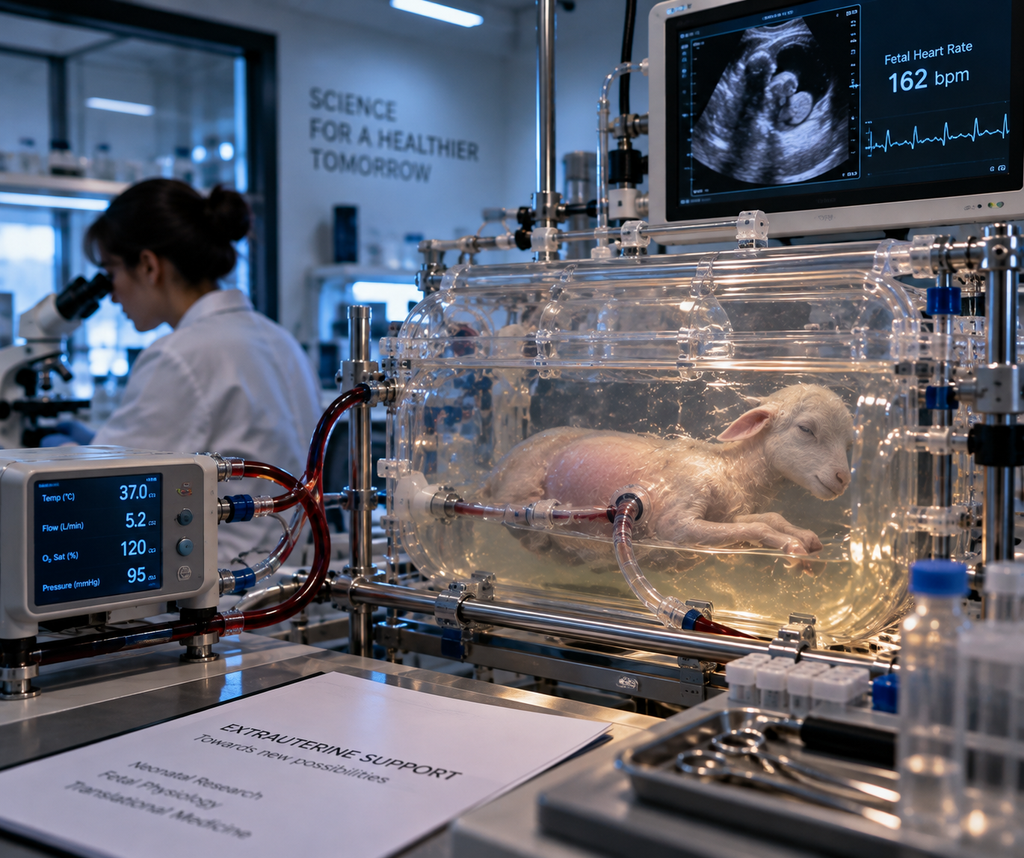
They simply look nothing like the pregnant robot circulating on social media — and their purpose is very different.
How a futuristic idea became an international story
Reports that emerged in 2025 centered on a man named Zhang Qifeng, who was described in some accounts as a researcher involved in developing a humanoid robot containing an artificial womb.
The proposed machine was portrayed as something far more ambitious than an incubator. According to versions of the story, it could potentially reproduce the conditions of human pregnancy and support development until birth.
Some reports attached an estimated price of around 100,000 yuan to the technology and suggested that a prototype could arrive in 2026.
Those details gave the claim an unusual degree of credibility.
There was only one problem: the evidence behind them did not match the certainty of the headlines.
The academic story did not check out
Some versions of the story described Zhang as having earned a doctorate from Singapore’s Nanyang Technological University and linked the institution to research on so-called gestation robots.
When journalists investigated, NTU disputed those claims. The university said it could not find a PhD graduate matching the academic identity presented in the reports and denied conducting the gestation-robot research attributed to it.
Questions also emerged around reports connecting the supposed invention with the 2025 World Robot Conference in Beijing. Checks of conference information failed to establish the presentation of a functioning pregnancy robot matching the viral descriptions.
That might suggest the entire story was fabricated from nothing.
The reality appears to be more complicated.
There really is a robotics entrepreneur named Zhang Qifeng
Investigations traced the name to a real entrepreneur associated with Kayiwa Robotics in Guangzhou.
Zhang had discussed futuristic possibilities involving artificial womb technology and humanoid robots during an interview, and clips related to those comments subsequently circulated online.
But discussing what technology might eventually make possible is not the same as announcing a working biomedical device.
After the story exploded internationally, Zhang and the company denied that they were developing a robot capable of carrying a human pregnancy. Reports on the clarification indicated that references to a roughly 100,000-yuan product and an upcoming prototype concerned a humanoid robot, not a machine capable of gestating a baby.
That distinction largely disappeared as the story traveled across the internet.
What remained was a much more dramatic version: China was building a robot that would soon give birth.
The pictures made the claim far easier to believe
The visual component of the story was arguably even more powerful than the text.
Images showed sleek humanoid machines with transparent artificial abdomens containing recognizable human fetuses. Without context, they looked like photographs from a laboratory several years ahead of anything most people had seen.
They were not evidence of such a laboratory.
Fact-checking investigations found that imagery circulated alongside the story included conceptual or AI-generated visuals rather than photographs documenting a functioning medical prototype.
This is increasingly important when evaluating extraordinary scientific claims.
A photograph once served as a relatively strong psychological signal that something existed. Generative AI has weakened that assumption dramatically. A convincing photograph of a nonexistent machine can now be produced before anyone has solved even the most basic engineering problems required to build it.
Give that image a scientist’s name, a university, a price and a date, and fiction can begin to resemble a press release.
The surprising part: artificial womb research is real
Remove the humanoid robot from the story and something genuinely remarkable remains.
Scientists have spent years investigating ways to reproduce parts of the environment normally provided by the uterus, particularly for extremely premature fetuses.
One of the landmark demonstrations came from researchers at the Children’s Hospital of Philadelphia and was published in Nature Communications in 2017.
The team developed an extrauterine support system for premature lamb fetuses. Rather than placing them in a conventional incubator and forcing their immature lungs to immediately function as they would after birth, the researchers maintained them in a sealed, fluid-filled environment.
The umbilical cord was connected to a circuit incorporating an oxygenator, allowing fetal circulation to continue in a way designed to preserve important aspects of fetal physiology.
The device looked nothing like a humanoid robot.
In photographs, it resembled a transparent fluid-filled bag connected to medical equipment.
Scientifically, however, it was far more significant than the viral robot.
Lamb fetuses continued developing outside the uterus
In the experiments, premature lamb fetuses were maintained in the system for periods extending to roughly four weeks, with researchers reporting continued growth and organ maturation.
That achievement helps explain what artificial-womb research is actually trying to accomplish.
Before birth, fetal lungs do not perform the same job they perform after birth. Oxygen reaches the fetus through the placenta and umbilical circulation. Birth therefore requires an enormous physiological transition.
For an extremely premature infant, that transition can happen when organs — particularly the lungs — are not yet sufficiently developed.
Modern neonatal intensive care can save remarkably premature babies, but treatment itself can present difficult challenges for an extremely immature body.
Artificial-womb technology approaches the problem from a different direction: what if, instead of forcing fetal physiology to become neonatal physiology immediately, doctors could preserve a womb-like environment for a little longer?
That is the real medical question.
Researchers are not trying to manufacture babies from embryos
This distinction is essential.
The near-term medical goal of artificial-womb research is not to replace pregnancy from conception to birth.
It is to investigate whether extremely premature infants might someday be supported in conditions that more closely resemble fetal life while their organs continue developing.
Terms such as artificial womb technology, artificial placenta and extrauterine life support are sometimes used for related approaches, although the technologies and definitions are not always identical.
Recent scientific literature has continued examining the possibility of eventually translating these systems toward human medicine, alongside the substantial technical, regulatory and ethical questions that would have to be resolved first.
That is radically different from placing an embryo inside a machine and returning nine months later to collect a newborn.
Why can’t we simply grow an embryo in an artificial womb?
Because pregnancy is not just a fetus floating in warm fluid.
Very early in development, an embryo must implant, and a remarkably complicated biological relationship begins to form between fetal tissues and the pregnant body.
The placenta is central to this process.
It participates in gas exchange, nutrient transport and waste handling, but its role extends much further. Pregnancy involves intricate hormonal signaling, immune regulation, changes in blood flow and continuous adaptations within the maternal body.
Reproducing enough of those interactions to support a fetus already at an advanced developmental stage is difficult.
Recreating the entire process from the earliest embryonic stages to full-term development is an entirely different scientific challenge.
This is why an important distinction exists between partial and complete ectogenesis.
Partial ectogenesis is not complete ectogenesis
Partial ectogenesis broadly refers to continuing part of fetal development outside the body after pregnancy has already progressed to a certain stage.
That concept is closest to current research aimed at extreme prematurity.
Complete ectogenesis would mean supporting development outside the human body from very early embryonic stages through the equivalent of an entire pregnancy.
The first is the subject of serious biomedical research.
The second remains far more speculative.
Collapsing those two concepts into one is how a genuine experiment involving premature lambs can eventually become an online headline announcing that robots are about to start giving birth.
There is another clue hidden in the viral image
Suppose scientists eventually become capable of supporting much longer periods of human development outside the uterus.
Why would the artificial womb need to be placed inside a walking humanoid robot?
Medically, there is no obvious requirement for it.
A stationary clinical system could regulate temperature, fluid composition, circulation, oxygen exchange and monitoring without possessing a face, arms, legs or mechanical fingers.
A humanoid body does something else exceptionally well, however.
It gets attention.
A photograph of a transparent medical chamber surrounded by tubes looks like neonatal research. A photograph of a female-shaped robot with a fetus inside its abdomen looks like the beginning of a new era for humanity.
The second image is infinitely more shareable.
The real technology raises difficult questions of its own
Artificial-womb research does not need a fictional robot to become ethically complicated.
A 2026 review in the Journal of Perinatology examined hundreds of publications discussing ethical issues surrounding artificial-womb technology. Researchers identified recurring questions involving risks and benefits, decision-making, moral and legal status, equitable access, social consequences and research ethics.
Some questions that currently sound philosophical could become practical clinical problems.
Consider a fetus removed from a pregnant body but maintained using technology that preserves fetal-like physiology.
Has birth occurred in the conventional medical sense?
How should such a patient be classified?
Who makes decisions if treatment becomes futile or dangerous?
How should doctors measure success — survival at discharge, neurological development years later, or both?
And if the technology initially costs enormous amounts of money, who gets access to it?
These questions matter precisely because artificial-womb technology is being discussed as medicine rather than merely as science fiction.
Complete ectogenesis would change the debate entirely
The ethical consequences would become much broader if science eventually moved beyond treating extreme prematurity and achieved complete ectogenesis.
Such technology could theoretically provide new reproductive possibilities for people unable to safely carry a pregnancy.
It could also force societies to confront questions for which current laws and cultural norms were never designed.
How would access be regulated? What would parental responsibility look like in unusual circumstances? How would commercialization be controlled? Could access to advanced reproductive technologies deepen existing inequalities?
And perhaps most importantly, would a technology originally developed to save extremely premature infants gradually acquire purposes its inventors never intended?
There is no need to pretend those questions have answers yet.
The technology that would force society to answer many of them does not currently exist.
But researchers and bioethicists are already discussing them because technological progress often arrives before social consensus does.
So, is China launching a baby-carrying robot in 2026?
There is no verified evidence supporting that claim.
No functioning prototype matching the viral descriptions has been demonstrated. There is no published scientific evidence showing a humanoid robot capable of sustaining a complete human pregnancy. The robotics company connected with the story denied that it was developing such a machine, and important claims about the alleged inventor’s academic background were challenged when journalists investigated them.
The spectacular robot with a fetus visible inside its abdomen should therefore not be understood as a photograph of where reproductive medicine stands today.
But dismissing everything behind the story as fantasy would be equally misleading.
The pregnancy robot is the fiction. The artificial womb is the real story.
Researchers are not currently building robotic mothers designed to replace human pregnancy. They are trying to answer a far more immediate medical question: whether a baby born at the very edge of viability might someday be given additional time to develop in an environment that behaves more like the womb it left too soon.
If artificial-womb technology eventually reaches human medicine, its first major breakthrough is unlikely to look like the futuristic images spreading across social media.
It may look like a neonatal intensive care unit: physicians, monitors, pumps, tubes and a carefully controlled fluid-filled system surrounding an extraordinarily fragile patient.
That image is less sensational.
But if the technology succeeds, its consequences could be far more profound.
And if science ever moves from supporting a premature fetus for several weeks to sustaining an entire human pregnancy outside the body, the biggest question will no longer be whether the viral photograph was real.
It will be what happens when reality finally catches up with an idea that once looked like science fiction.