
For most people, sunshine is something to enjoy. It means morning walks, family vacations, afternoons at the beach, or simply opening the curtains to let natural light fill the room.
For Karine de Souza, sunlight has always meant something entirely different.
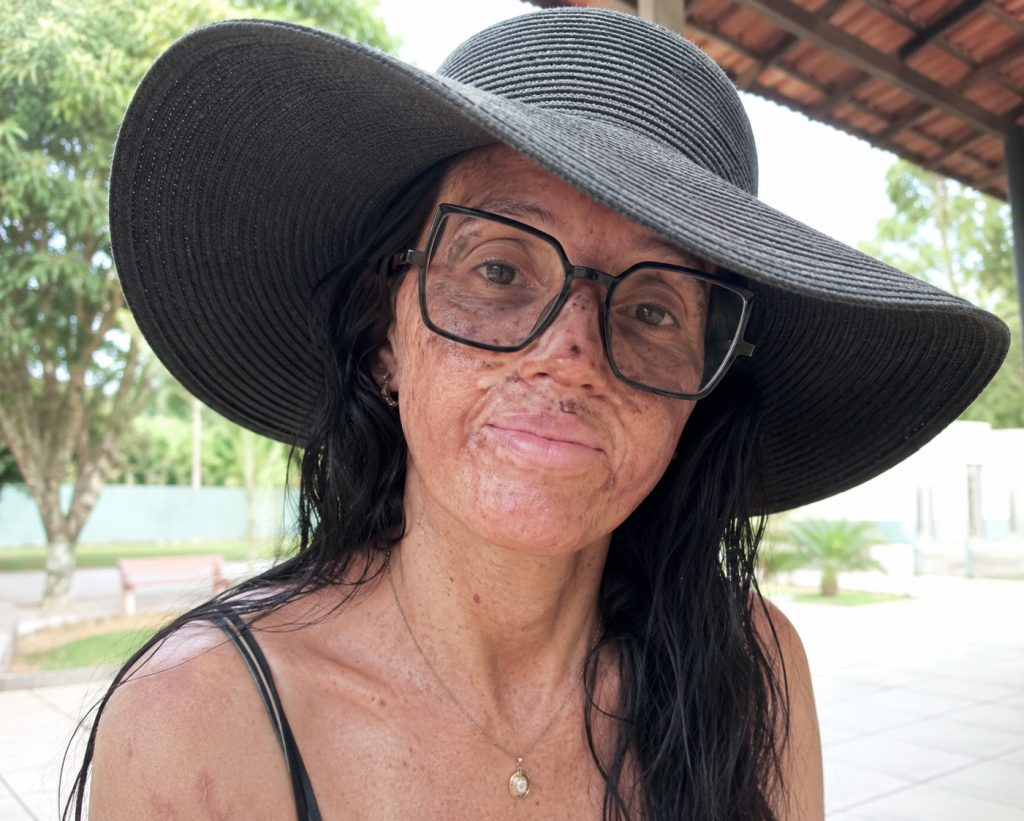
Every moment spent outdoors requires careful planning because the same rays that most of us barely think about can cause irreversible damage to her body. Living with an exceptionally rare genetic condition called xeroderma pigmentosum (XP), Karine has spent her life avoiding what many of us take for granted.
Her story has reached millions of people online, not because she wants sympathy, but because she has chosen to show the reality of living with a disease that few people have ever heard of.
When the Body Can No Longer Protect Itself
Human skin is remarkably resilient.
Every day, ultraviolet radiation damages tiny sections of DNA inside our skin cells. Fortunately, our bodies are equipped with sophisticated repair systems that identify those damaged areas and fix them before lasting harm occurs.
People with xeroderma pigmentosum don’t have that protection.
Because of inherited mutations in genes responsible for DNA repair, their cells cannot properly correct the damage caused by ultraviolet light. Instead, the genetic errors accumulate over time, dramatically increasing the likelihood of developing skin cancer at an unusually young age.
XP is incredibly uncommon, affecting roughly one person in a million in many parts of the world. Its rarity means that many physicians may never encounter a patient with the condition during their careers.
A Childhood Unlike Any Other
Karine was diagnosed while she was still very young.
As other children spent hours playing outside, she had to learn that even brief exposure to sunlight could have serious consequences. Ordinary childhood experiences suddenly became complicated.
A walk through the neighborhood, a school activity outdoors, or a family outing all required precautions that most people never have to consider.
Protective clothing became part of everyday life. Wide-brimmed hats, UV-blocking sunglasses, high-SPF sunscreen, and carefully planned schedules replaced the carefree spontaneity many children experience.
For some people living with XP, outdoor activities are safest after sunset, which is why the condition has occasionally been nicknamed “the children of the night.” While not a medical term, it reflects how dramatically the disease reshapes daily life.
More Than Scars
Many people first notice the visible scars on Karine’s face.
What they don’t immediately see are the years behind them.
Over time, she has undergone numerous surgeries to remove skin cancers and precancerous lesions. Each procedure represents another chapter in a lifelong battle against a disease that never truly disappears.
Living with XP means regular examinations, biopsies, and constant vigilance. A tiny spot on the skin that another person might ignore could require immediate medical attention.
Instead of living from one doctor’s appointment to the next, however, Karine has chosen to focus on something else: helping people understand what this condition actually is.
Turning Social Media Into a Place for Education
The internet can often be an unforgiving place, especially for people who look different.
Rather than hiding from public attention, Karine decided to embrace it.
Through social media, she shares moments from her daily life, explains the realities of xeroderma pigmentosum, and answers questions from people who have never encountered the condition before.
Many followers admit they discovered XP only because of her videos.
That educational impact may be one of her greatest achievements. A disease that once existed almost entirely outside public awareness is now being discussed by people around the world.
Becoming a Mother—and Facing Public Judgment
One of the most talked-about moments in Karine’s life came when she announced that she was expecting a child.
Support poured in from many followers, but criticism arrived just as quickly.
Some questioned whether someone living with a serious genetic condition should become a parent, often without understanding how the disease is inherited.
The reality is more complex than many online comments suggest.
Xeroderma pigmentosum follows an autosomal recessive inheritance pattern. For a child to develop the disease, both parents must pass on a mutated copy of the same gene. If only one parent carries the mutation while the other does not, the child will not have XP, although they may become a healthy carrier.
These are deeply personal decisions guided by genetic counseling and medical advice—not by assumptions made on social media.
A Reminder of How Much We Take for Granted
It’s easy to overlook how many ordinary moments depend on something as simple as sunlight.
Walking the dog.
Watching children play outside.
Driving with the windows down.
Sitting on a park bench.
For Karine, each of those moments requires preparation and careful risk assessment.
Yet despite the countless medical appointments, surgeries, and limitations imposed by her condition, she has refused to let XP define every part of her identity.
She continues to share her experiences, educate others, and remind millions of people that behind every rare disease is a person whose life cannot be reduced to a diagnosis.
Perhaps that is the most powerful lesson her story offers.
The scars people notice first tell only a fraction of her journey. The greater story is one of resilience, adaptation, and the determination to build a meaningful life despite challenges that most of us will never have to face.
For the rest of us, sunlight may simply brighten the day.
For Karine de Souza, every sunrise is a reminder of both life’s fragility and the remarkable strength of the human spirit.