
For decades, visitors traveled to a small Bavarian village to see a woman whose story seemed to defy both medicine and common sense.
She reportedly developed wounds associated with the crucifixion of Jesus. Witnesses described bleeding from her hands, feet, chest, and around her eyes. On certain days, she appeared to enter altered states in which she experienced scenes from the Passion of Christ.
But none of those claims became as famous as this one:
Therese Neumann was said to have spent roughly 35 to 36 years without ordinary food, receiving only the Eucharist.
Modern retellings sometimes go further, claiming that she did not even drink water, that doctors proved her extraordinary fast, and that the Nazi regime eventually stopped issuing her food rations because she had no use for them.
Neumann was not an internet legend created decades after the supposed events. She was a real woman whose case attracted physicians, journalists, clergy, skeptics, and pilgrims while she was still alive.
The difficulty begins when we try to separate what was reported from what was actually demonstrated.
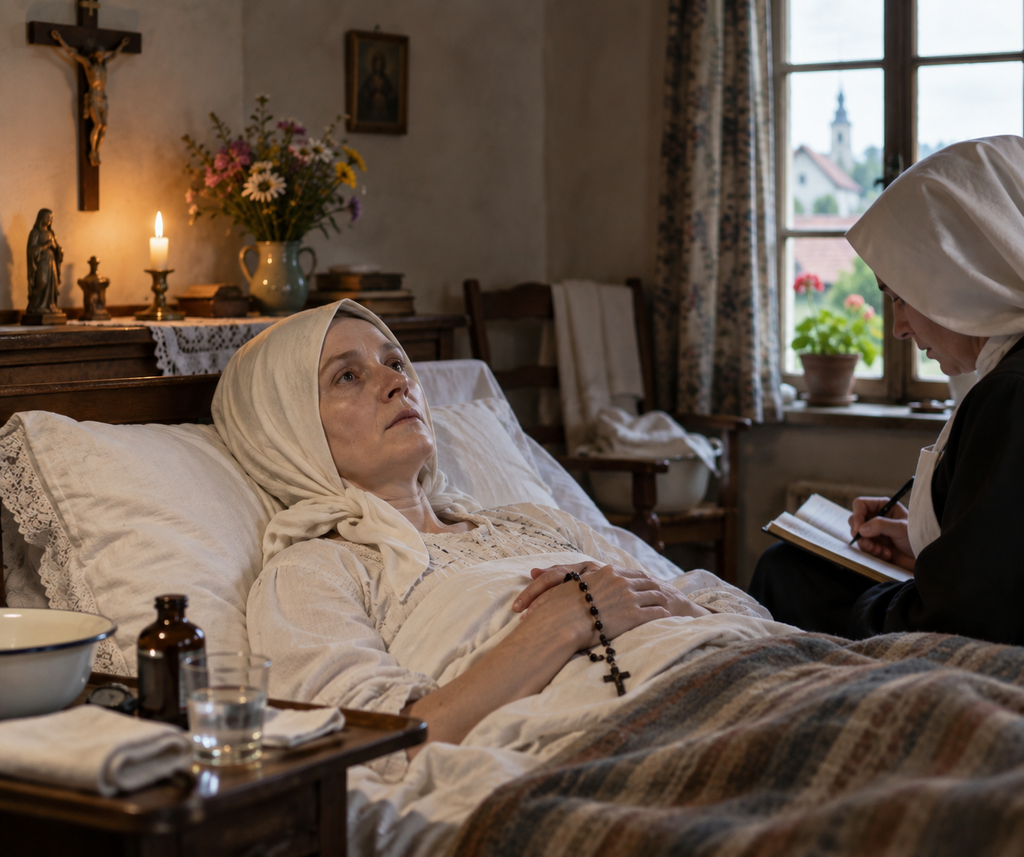
From a Bavarian Farm Worker to a Religious Phenomenon
Therese Neumann was born on April 9, 1898, in Konnersreuth, Bavaria, and died there on September 18, 1962. German biographical records document her life and the extraordinary attention that eventually surrounded her.
As a young woman, she worked on a farm. After an accident associated with a fire in 1918 and subsequent health problems, her physical condition deteriorated dramatically.
Accounts from the period describe severe mobility problems and eventual blindness.
Then came an unexpected reversal.
Neumann reported regaining her sight in 1923, on the day Thérèse of Lisieux was beatified. A further recovery was reported in 1925, around the time of the French nun’s canonization, when Neumann was said to have regained the ability to walk.
For Neumann and many of those around her, the timing had profound religious significance.
From a historical perspective, however, two different questions need to remain separate. We can investigate reports that a recovery occurred. Determining that a supernatural intervention caused it is a different matter entirely.
That distinction becomes increasingly important as her story develops.
The Wounds That Drew Crowds to Konnersreuth
Beginning in 1926, reports emerged of wounds and bleeding on Neumann’s body.
They were interpreted by her followers as stigmata: physical manifestations resembling wounds associated with the Passion and crucifixion of Jesus.
Neumann was also reported to experience unusual states, particularly on Fridays, during which she appeared to relive episodes from Christ’s Passion.
Her reputation spread rapidly. Konnersreuth became a destination for thousands of curious visitors and religious pilgrims.
Physicians also became interested.
A later medical reassessment published in the German journal Der Nervenarzt examined historical records from the case, including observations by physician Otto Seidl. Seidl did not simply dismiss the phenomena he encountered, but interpreted Neumann’s condition using psychiatric concepts available at the time, including what was then termed “hysteria.” The modern paper discusses the case in relation to dissociative and conversion phenomena.
That does not establish that Neumann deliberately produced her wounds.
Neither does the existence of wounds establish that their origin was supernatural.
It leaves us with something less satisfying, but scientifically important: an observed or reported phenomenon whose cause cannot simply be inferred from its appearance.
Then Came the Most Extraordinary Claim of All
According to the accounts surrounding Neumann, ordinary eating gradually disappeared from her life.
By approximately 1926 or 1927, she was said to have stopped consuming conventional food altogether. The only nourishment she reportedly received was a tiny amount associated with Holy Communion.
This allegedly continued until her death in 1962.
That is the origin of the remarkable claim that Therese Neumann lived for approximately 35 to 36 years without normal food.
The story became sufficiently prominent to be discussed even in later medical literature. But there is a crucial difference between medical literature documenting that such a claim existed and medical science confirming that the claim was true. The retrospective medical analysis of Neumann’s case treats the prolonged absence of food as an alleged feature of her history, not as a scientifically established physiological event.
There was never continuous medical observation covering those decades.
And that matters enormously.
The 1927 Observation Period Is Real
One element of the story is considerably better documented than many viral versions suggest.
In 1927, ecclesiastical authorities in Regensburg arranged for Neumann to be observed at her family home.
Four medically trained nursing sisters participated in the investigation, working in shifts so that Neumann could be watched continuously for approximately two weeks. Records describe monitoring that included her body weight, pulse, temperature, excretions, and precautions intended to prevent unnoticed consumption of food.
During that period, according to the observers, they did not see her consume ordinary food.
That sounds remarkable.
It is also where many retellings make their biggest leap.
Fourteen Days Cannot Establish a 36-Year Fast
Humans can survive for a period without food because the body can draw energy from stored glycogen and fat and, eventually, break down body proteins.
Consequently, observing someone apparently fasting for approximately two weeks cannot establish that the same person lived without food for several decades.
Historical data from the observation period have also generated questions. Later analyses have discussed issues involving Neumann’s recorded weight changes and urinary findings, complicating attempts to interpret the observation as definitive proof of complete abstinence.
There was an opportunity to investigate further.
Church authorities subsequently sought a more rigorous examination under controlled clinical conditions. Neumann’s family, particularly her father, objected to the conditions surrounding another investigation, and the proposed clinical observation did not take place.
Bishop Michael Buchberger continued seeking stronger verification during the 1930s precisely because the claim had not been conclusively established.
By 1937, the Regensburg ecclesiastical authorities were not prepared to guarantee the authenticity of Neumann’s claimed complete abstinence from nourishment.
This detail radically changes the popular version of the story.
The Catholic Church itself did not simply regard the decades-long fast as a scientifically verified miracle.
The Claim About Water Is Even More Difficult
Contemporary social-media versions frequently state that Neumann consumed neither food nor water for decades.
Medically, the second claim is even more extraordinary than the first.
The human body continually loses water through urine, respiration, the skin, and the gastrointestinal tract. Water is fundamental to circulation, kidney function, temperature regulation, cellular processes, and electrolyte balance.
A prolonged complete absence of fluid intake would therefore have consequences very different from an ordinary fast.
There is no decades-long controlled medical record establishing that Neumann survived without drinking.
For that reason, statements such as “doctors proved that she lived for 36 years without food or water” go substantially beyond the available evidence.
What exists is testimony, historical observation, and a short period of unusually close monitoring.
That is not the same thing as 36 years of controlled verification.
Where Hitler Enters the Story
Another dramatic detail often attached to Neumann concerns Adolf Hitler.
Some versions claim Hitler feared her prophecies. Others say he deliberately protected her. One frequently repeated story says the Nazi authorities withdrew her food ration card because she did not eat and instead issued additional soap so she could wash clothing stained by blood from her stigmata.
There is genuine historical background behind Neumann’s association with opposition to Nazism.
One of the most important people connected with her was journalist Fritz Gerlich. German biographical sources document Neumann’s connection with Gerlich and his subsequent opposition to Hitler and National Socialism.
Gerlich became a prominent anti-Nazi journalist associated with Der gerade Weg. After the Nazis came to power, he was arrested and eventually murdered at Dachau in 1934.
So the anti-Nazi dimension surrounding Neumann and her circle is not simply a later invention.
The more sensational claims involving Hitler personally require considerably greater caution.
An academic review of a biography of Neumann specifically criticized unsupported claims concerning special protection supposedly extended to her by Hitler.
There is therefore a major difference between saying that Neumann was associated with figures who opposed Nazism and claiming that Hitler personally feared her supernatural abilities.
The former has historical documentation. The latter is far harder to substantiate.
What About the Food Ration and the Extra Soap?
The story that Neumann received additional soap instead of food appears repeatedly in biographical and devotional accounts.
Yet its details vary.
Some versions say Nazi authorities removed her food allowance because she supposedly did not eat. Others suggest that Neumann herself surrendered or declined the food ration and received soap instead, reportedly because of the amount of bloodstained linen associated with her stigmatic episodes.
That variation is important.
Without sufficiently strong primary administrative documentation establishing exactly what happened and who ordered it, the careful historical formulation is that accounts exist claiming that Neumann’s wartime food allocation was replaced or supplemented by an allowance of soap.
Turning that into “Hitler personally took away her food ration and gave her twice as much soap” adds a level of certainty and personal involvement that the evidence does not justify.
Did She Speak Languages She Had Never Learned?
Another remarkable phenomenon attributed to Neumann involved unfamiliar languages.
During her religious visions, witnesses claimed that she produced words or expressions in languages she had not formally studied, including Aramaic. Historical biographical material records that such claims were made.
If someone could genuinely demonstrate meaningful command of a language they had never learned or encountered, the phenomenon would fall under what is commonly called xenoglossy.
But reports that Neumann uttered particular foreign words do not, by themselves, establish xenoglossy under controlled scientific conditions.
Once again, the existence of testimony and the explanation of that testimony are two separate questions.
Has the Catholic Church Declared Therese Neumann a Saint?
No.
Interest in Neumann continued long after her death, and her grave became a destination for pilgrims.
A diocesan beatification process was formally opened in 2005. Within the context of her cause, she has been referred to as a Servant of God, a designation associated with the opening stages of the process toward possible canonization.
Opening such a cause does not mean that someone has been beatified or canonized.
Nor does it amount to an official declaration that every extraordinary event attributed to that person’s life was miraculous.
The caution historically shown by Church authorities toward Neumann’s alleged fasting is especially relevant here.
Miracle, Fraud, or Something More Complicated?
The temptation with a story like this is to force it into one of two endings.
Either Therese Neumann performed a medically impossible miracle.
Or everything about her was fraudulent.
The historical record does not allow such a simple conclusion.
Neumann unquestionably existed. Her serious health problems were recorded. Dramatic recoveries were reported. People witnessed wounds and episodes of bleeding. The 1927 investigation really occurred, and during that limited observation period her monitors reported that they did not see her consuming ordinary food.
But something equally important is true.
There is no 36-year medical observation establishing continuous abstinence from food and water.
The controlled period lasted roughly two weeks. Questions remain about some of the physiological observations. A more rigorous clinical investigation was subsequently sought but never completed.
That makes the viral statement that “Therese Neumann lived for 36 years without food or water and doctors proved it” much stronger than the historical evidence allows.
The Mystery Becomes More Interesting When We Stop Trying to Solve It Too Quickly
Nearly a century after Neumann’s extraordinary experiences began attracting crowds to Konnersreuth, her story remains compelling because it sits at an uncomfortable intersection of history, medicine, testimony, and religious belief.
For a believer, the significance of Neumann’s life may extend beyond what can be measured in a clinical setting.
Science asks a different kind of question. Claims that appear to contradict fundamental human physiology require evidence strong enough to exclude ordinary explanations, observational gaps, and alternative interpretations.
We simply do not possess that level of evidence for 36 years of Therese Neumann’s life.
And perhaps the most interesting question was never whether modern science has “proved a miracle” or “disproved God.”
It is a much narrower and more revealing question:
How much of Therese Neumann’s extraordinary story can actually be established from the historical record, and where does evidence end and belief begin?
More can be documented than a skeptic unfamiliar with the case might expect. Less can be proved than the most sensational versions circulating online suggest.
That distinction does not make the story less fascinating.
It is what makes the story worth telling.