
For most of their lives, Luke Monias and Norman Barkman had heard variations of the same strange story. People in their northern Manitoba community noticed that something about the two men did not quite fit: Luke appeared to resemble members of Norman’s family, while Norman bore a striking resemblance to Luke’s relatives.
There was another coincidence that made the teasing even easier. They shared the same birthday.
The two had known each other since childhood in Garden Hill First Nation, and Norman sometimes jokingly referred to Luke as his “twin brother.” In a close-knit community where families knew one another well, the physical similarities were difficult to miss. From time to time, people even suggested that perhaps the boys had somehow been mixed up at the hospital.
For years, it remained little more than a story.
Then, in 2015, Luke decided he wanted an answer.
What followed would confirm that a rumor circulating for decades contained an extraordinary truth. The two men had been sent home from the hospital with the wrong families.
And their case would eventually lead to an even more disturbing discovery: they were not the only babies from that hospital who had experienced the same fate.
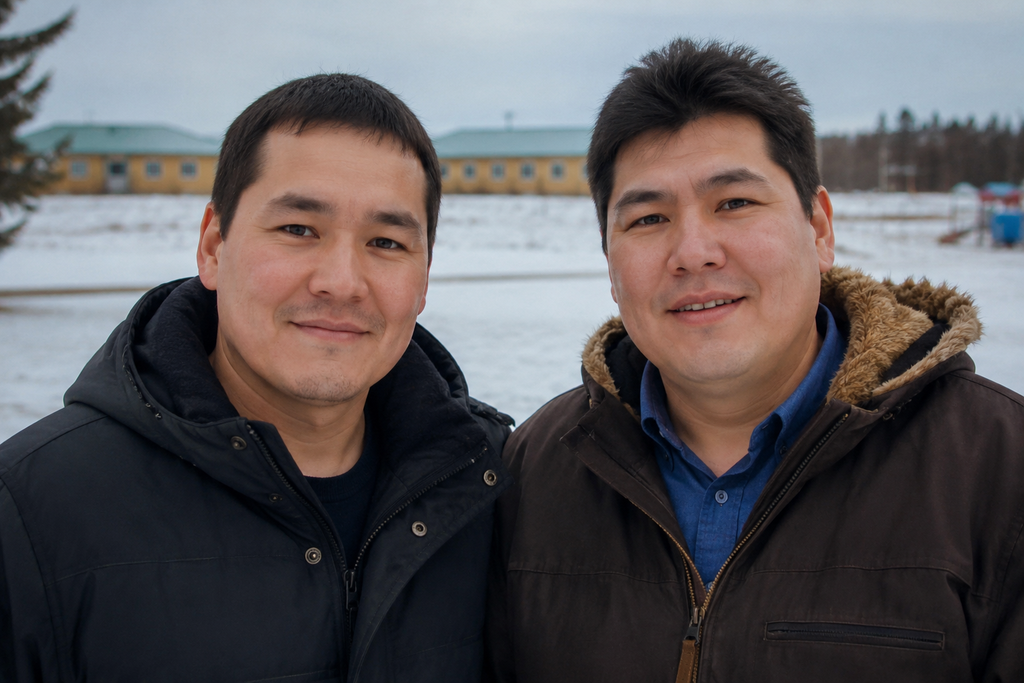
Two Babies, One Hospital and the Same Birthday
Luke Monias and Norman Barkman were both born on June 19, 1975, at Norway House Indian Hospital in Manitoba. At the time, the hospital was operated by Canada’s federal government and served communities in the province’s remote north.
Their mothers, Rosamund Monias and Rebecca Barkman, were from Garden Hill First Nation.
After leaving the hospital, Luke was raised by Rosamund and Isaiah Monias, while Norman grew up as a member of the Barkman family. Nothing at the time alerted either family that something had gone wrong.
The boys later grew up in the same community and became close friends.
As they got older, however, people continued noticing the unusual family resemblances. Norman looked remarkably like Luke’s father, while Luke appeared to share features with members of the Barkman family.
The possibility of a hospital mix-up became one of those stories that refused to disappear.
Luke later recalled hearing rumors that they had been mixed up at birth. For years there was no way to know whether the comments reflected anything more than coincidence, but eventually the uncertainty became difficult to ignore.
Nearly four decades after leaving the hospital, he decided it was time to find out.
A Question Luke Could No Longer Leave Unanswered
In July 2015, Luke approached Eric Robinson, then Manitoba’s minister responsible for Aboriginal and Northern Affairs, with his suspicions.
DNA testing followed.
Samples were taken from Luke, Norman and Rebecca Barkman. After decades of speculation, genetics could finally answer a question that physical resemblance and community gossip never could.
The results arrived in November.
They established that Rebecca Barkman was Luke Monias’s biological mother. They also showed that Norman, whom she had raised as her son, was not biologically hers.
The implication was unmistakable: the two boys born on the same day at Norway House Indian Hospital had gone home with the wrong families.
For Luke, learning the truth was not a moment of triumphant vindication. He described his immediate reaction with a simple phrase: “My heart fell.”
The result explained the resemblance people had noticed for years, but it also forced him to reconsider something far larger than an old community rumor. Behind those laboratory findings were 40 years of family relationships, childhood memories and a personal history that could never simply be rearranged to match a genetic family tree.
Norman was equally shaken. When the case became public in November 2015, he repeatedly returned to one question: he wanted to know what had happened 40 years earlier.
That answer would prove much harder to obtain than the DNA results.
Forty Years Was Too Long to Simply “Correct” the Mistake
Cases involving babies switched at birth often invite an apparently obvious question: which family does each child truly belong to?
For Luke and Norman, that question had arrived decades too late.
They were not young children whose living arrangements could be reconsidered by parents or courts. They were 40-year-old men who had already lived entire lives inside the families that had raised them.
A DNA test could identify biological relationships, but it could not erase birthdays, family gatherings, childhood experiences or the people they had known as their parents.
The discovery therefore added to their families rather than simply replacing one with another. The biological truth mattered, but so did the relationships built over four decades.
The friendship between Luke and Norman also survived the revelation. Whatever had happened in the maternity ward in 1975, neither man had caused it, nor had either of their families.
The mistake belonged somewhere in their first hours or days of life.
The consequences belonged to everyone who came afterward.
The Search for an Explanation
Once the story became public, attention shifted toward Norway House Indian Hospital.
Because the facility had been federally operated when Luke and Norman were born, Manitoba officials called on the Canadian government to investigate what had happened.
By then, reconstructing a hospital error from 1975 was enormously difficult. Records could establish where and when the men had been born, but determining the precise moment two newborns were exchanged—or identifying exactly how the mistake happened—was another matter entirely.
For Luke and Norman, however, finding an explanation mattered.
The men were not merely asking who their biological parents were. DNA had already begun answering that question. They wanted to understand how two mothers could enter a hospital, give birth on the same day and leave with one another’s babies without anyone discovering the mistake.
Then another family came forward.
And the story changed completely.
Another Pair of Men From the Same Hospital
In 2016, Canadians learned that Luke and Norman’s experience was not the only confirmed switched-at-birth case connected to Norway House Indian Hospital.
Leon Swanson and David Tait Jr. had also been born there in 1975.
Swanson was born on January 31 and Tait three days later. Like Luke and Norman, the two men had grown up knowing one another, and questions about family resemblance had existed for years.
After the Monias-Barkman case became public, their families pursued DNA testing.
The results confirmed another switch.
Two separate pairs of babies had now been identified as having gone home with the wrong families from the same federally operated hospital in the same year.
The second discovery fundamentally changed the significance of the first. What could initially have been regarded as an extraordinary isolated error now demanded broader questions about procedures at the hospital and whether other families might have been affected.
For the people involved, those questions were intensely personal.
David Tait spoke publicly about feeling confused, distressed and angry. The men wanted to understand not only what had happened to them, but whether anyone could determine how such mistakes had occurred more than once.
The Federal Government Faced Growing Pressure
With four men now connected to two confirmed switches, calls for answers became increasingly difficult to ignore.
Federal Health Minister Jane Philpott agreed in 2016 to meet with the four men affected by the Norway House cases. The federal government also faced demands to address concerns from other people who believed they might have reason to question their own birth histories.
Yet the passage of time remained a formidable obstacle.
More than four decades had elapsed. Even if investigators could examine surviving records and historical procedures, recreating the exact sequence of events inside a maternity ward in 1975 was extraordinarily difficult.
There was also a larger historical context that made the cases particularly painful. Norway House served predominantly Indigenous communities, and the revelations emerged in a country already confronting the history of damaging government policies and institutional treatment of Indigenous peoples.
For the families, however, the central issue remained deeply personal: they had lost the opportunity to know the lives they would have lived had each newborn gone home with the correct mother.
No investigation could give those years back.
A Settlement, but Not a Rewritten Past
In 2018, Luke Monias and Norman Barkman reached a financial settlement with Canada’s federal government.
The amount was kept confidential. Indigenous Services Canada also said support services were being made available to the men and their families.
The agreement brought a measure of official resolution to the case, but compensation could address only part of what had happened.
There was no way to recreate the childhood either man might have experienced with his biological family. There was no way to return to June 19, 1975, identify the moment the babies were mixed up and send each newborn home in the correct arms.
By the time science revealed the truth, Luke and Norman had already become the men their lives had shaped them to be.
The Rumor That Took 40 Years to Prove
Perhaps the most remarkable part of Luke Monias and Norman Barkman’s story is that the truth had, in a sense, been visible for years.
They grew up in the same community. They became friends. People noticed that each seemed to resemble the other’s relatives, and Norman jokingly called Luke his twin brother because they shared a birthday.
The possibility that they had been switched at birth became part of the background noise of their lives, strange enough to remember but seemingly too extraordinary to believe.
Then DNA removed the uncertainty.
The tests could establish biological relationships, but they could not rewrite four decades of family life. The parents who had raised Luke and Norman did not suddenly become strangers, nor could newly discovered biological relationships instantly recreate the bonds that would ordinarily have begun in infancy.
What the results did provide was an answer.
And when a second pair of switched babies from the same hospital and the same year was identified soon afterward, that answer became part of a much larger story.
For Luke Monias and Norman Barkman, it had begun as an old rumor in a small northern Manitoba community, repeated so often that it became almost a family joke.
Forty years later, they finally discovered that the joke had been telling the truth all along.