
The astonishing journey of an ancient Egyptian obelisk and the forgotten monuments that have watched empires rise and fall
Every day, thousands of people walk through Istanbul’s historic Sultanahmet Square without realizing they are standing among some of the oldest surviving witnesses to human civilization.
Most visitors arrive to admire the magnificent dome of Hagia Sophia or the elegant minarets of the Blue Mosque. Cameras point toward the skyline, tour guides gather their groups, and crowds move steadily through one of the world’s most famous destinations.
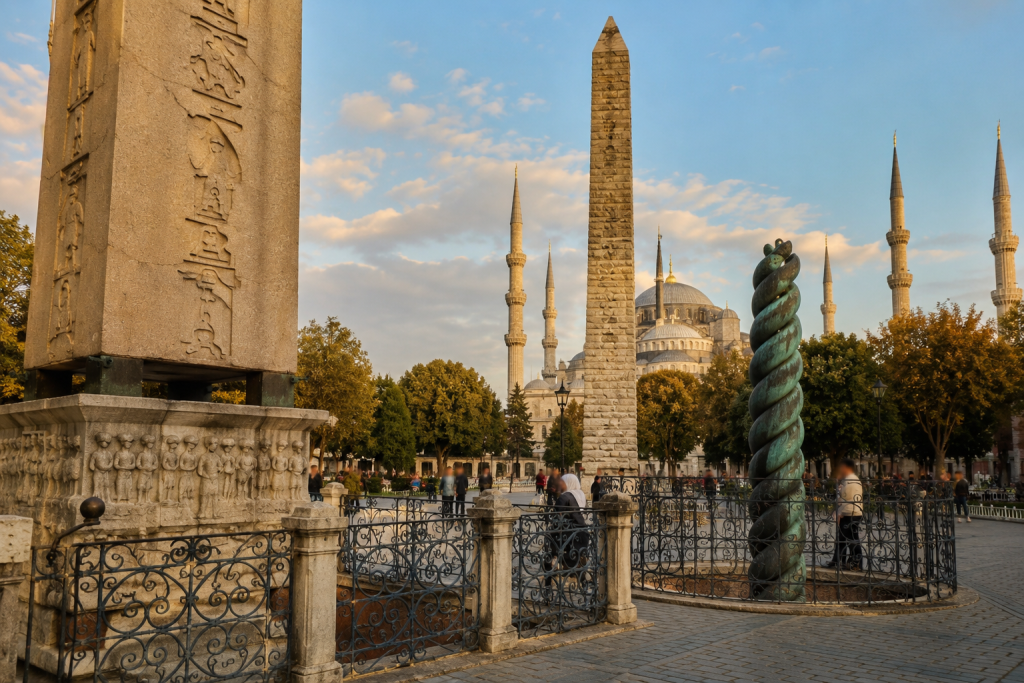
Yet the true veterans of this landscape stand quietly in the center of the square.
One monument was carved in ancient Egypt more than 3,500 years ago.
Another was built during the height of the Byzantine Empire.
A third was created to commemorate a decisive Greek victory that helped shape the future of Western civilization.
Together, these monuments have endured the rise and fall of kingdoms, empires, religions, and entire civilizations. Long before Istanbul existed, they were already part of history.
Their story is one of engineering brilliance, political ambition, cultural exchange, and extraordinary survival.
A journey that began in the age of the pharaohs
The oldest of the three monuments traces its origins to ancient Egypt during the reign of Pharaoh Thutmose III, one of the most powerful rulers of the New Kingdom.
His reign marked a period of military expansion, economic prosperity, and monumental construction. Temples were enlarged, cities flourished, and vast resources were dedicated to honoring both the gods and the authority of the pharaoh.
Among the projects commissioned during this era was a towering granite obelisk that would eventually travel far beyond the borders of Egypt.
Its age becomes even more remarkable when viewed through the lens of history.
When this monument was first erected:
- The Roman Empire did not exist.
- Classical Athens had not yet reached its golden age.
- Alexander the Great would not be born for nearly a thousand years.
- Constantinople was still almost seventeen centuries away.
- Hagia Sophia would not be built for more than two millennia.
- The Blue Mosque would not appear for roughly three thousand years.
The obelisk standing in Istanbul today was already ancient long before many of history’s most famous civilizations reached their peak.
How ancient engineers created monuments designed to last forever
Ancient Egyptian obelisks were not assembled from multiple pieces of stone.
Each one was carved from a single massive block of granite.
The stone came from the quarries of Aswan in southern Egypt, where workers spent months—or even years—extracting enormous sections of rock using surprisingly simple tools.
Evidence from the famous Unfinished Obelisk at Aswan has given archaeologists valuable insight into the process. Craftsmen used hard dolerite stones to chip away at the granite until the monument could be separated from the bedrock.
Once extracted, the stone was carefully shaped, polished, and covered with hieroglyphic inscriptions.
These monuments were more than architectural achievements. They symbolized the rays of the sun god Ra and represented a connection between the earthly world and the divine realm.
Thousands of years later, many of those inscriptions remain visible, demonstrating both the skill of their creators and the remarkable durability of granite.
The challenge that seems impossible even today
Creating the obelisk was only half the battle.
Moving it was an entirely different challenge.
The surviving section of the monument weighs roughly 200 tons, while the original structure was significantly larger.
Transporting such a massive object would be a major logistical undertaking even with modern machinery.
Ancient engineers, however, had no cranes, hydraulic lifts, diesel engines, or computer-controlled equipment.
Yet they successfully transported the monument across vast distances.
The obelisk had to be moved from the quarry to the Nile.
Loaded onto river vessels.
Transported hundreds of kilometers downstream.
Transferred to seagoing ships.
Carried across the Mediterranean.
Unloaded once again.
Moved through an urban environment.
And finally raised into a perfectly upright position.
Ancient artwork suggests that workers used wooden sledges pulled by large teams of laborers. Modern experiments have shown that wetting the sand beneath these sledges dramatically reduced friction, making it easier to move enormous weights.
What appears miraculous today was achieved through careful planning, teamwork, and a deep practical understanding of physics.
Why an Egyptian monument ended up in Constantinople
When Egypt became part of the Roman world, its monuments gained new significance.
Roman emperors viewed Egyptian obelisks as symbols of prestige, power, and legitimacy. Bringing one to a major city demonstrated imperial authority and showcased the empire’s ability to command resources from across vast territories.
Several Egyptian obelisks were transported to Rome.
One, however, was destined for a different capital.
Constantinople.
By the late fourth century, Emperor Theodosius I sought to enhance the grandeur of the eastern imperial capital. To achieve that goal, he ordered the transportation of the Egyptian obelisk to the city’s most important public space.
The Hippodrome.
The arena where history was made
Today, Sultanahmet Square feels calm and open.
In antiquity, this area was the beating heart of Constantinople.
The Hippodrome hosted chariot races, public ceremonies, political gatherings, and imperial celebrations. Tens of thousands of spectators filled its stands, making it one of the most important public venues in the Roman world.
It was far more than a sports arena.
It was a stage for power.
At times, it became a stage for chaos.
In 532 AD, the Hippodrome became the center of the Nika Riots, one of the most dramatic uprisings in Byzantine history.
What began as unrest among rival chariot-racing factions escalated into a crisis that nearly toppled Emperor Justinian.
Large sections of the city were destroyed by fire.
Government buildings were damaged.
The imperial throne itself seemed at risk.
Historical accounts suggest that around 30,000 people may have died when the revolt was ultimately suppressed.
Throughout the turmoil, the obelisk remained standing, silently witnessing one of the defining moments in Byzantine history.
The story carved into stone
The monument’s base is almost as fascinating as the obelisk itself.
Decorated with detailed reliefs, it depicts Emperor Theodosius, members of the imperial court, and scenes believed to represent the raising of the monument.
These carvings provide rare visual evidence of large-scale engineering operations during Late Antiquity.
Greek and Latin inscriptions on the pedestal even claim that the monument was erected in just 32 days.
Whether entirely accurate or not, the statement highlights the extraordinary effort involved in placing such a massive structure at the center of the city.
The obelisk that lost its outer shell
A short distance away stands another monument often overlooked by visitors.
Known today as the Walled Obelisk, it once looked very different from its current appearance.
During the Byzantine period, the structure was covered with carefully cut stone slabs and decorative elements that likely reflected sunlight across the Hippodrome.
Much of that decoration disappeared during the Fourth Crusade in 1204, when Constantinople was extensively looted.
What remains today is the monument’s durable inner core of stone and brick.
Although stripped of its former grandeur, it continues to stand after nearly a thousand years of exposure to the elements.
The bronze serpents that traveled from ancient Greece
Between the two obelisks stands perhaps the most unusual monument in the square.
The Serpent Column.
Its story begins in 479 BC after the Greek victory over the Persian Empire at the Battle of Plataea.
The monument originally stood at Delphi, one of the most sacred sites in ancient Greece.
It consisted of three intertwined bronze serpents supporting a ceremonial golden vessel.
Centuries later, Emperor Constantine the Great ordered its relocation to his new capital.
The monument survived the journey and became one of the most recognizable features of the Hippodrome.
For many centuries, the serpent heads remained intact and were recorded by travelers and artists.
Today, only fragments survive, but the column itself remains a remarkable link to the classical Greek world.
Three monuments, one extraordinary story
Few places on Earth bring together so many layers of history within such a small area.
The former Hippodrome contains physical connections to ancient Egypt, classical Greece, the Roman Empire, the Byzantine world, and the Ottoman era.
These monuments are more than archaeological relics.
They are survivors.
They have watched cities transform, governments collapse, faiths change, and generations disappear.
They have outlived the people who built them, the rulers who celebrated them, and the empires that once claimed them as symbols of power.
Humanity’s closest approach to immortality
Every morning, sunlight still falls upon the same hieroglyphs that ancient Egyptian priests once read thousands of years ago.
Since then, pharaohs, emperors, kings, and sultans have come and gone.
Entire civilizations have risen, flourished, and vanished.
Languages have disappeared.
Borders have shifted.
Cities have changed names.
Yet these monuments remain.
Perhaps that is the most remarkable part of their story.
Not that ancient people managed to move hundreds of tons of stone across rivers, seas, and continents without modern technology.
But that they created something capable of surviving for more than three millennia while continuing to inspire the same sense of wonder in those who stop, look up, and ask a simple question:
How was this even possible?