
Before we have children, parenting seems surprisingly simple.
We know exactly what we would do. How we would do it. What we would never do.
We know better than everyone else.
My brother used to be one of those confident people. He gave advice easily and sincerely, convinced that if you’re attentive, organized, and logical, raising kids isn’t really that complicated.
Then he became a father.
He and his wife live abroad, far from family, without the daily support of grandparents or relatives. Their baby came into their lives when they weren’t expecting it anymore — a long-awaited, deeply loved surprise. And with that joy came reality. The kind you can’t fully understand until you live it.
In those first months, everything they thought they knew about parenting began to shift. Slowly at first, then all at once. Like a carefully stacked house of cards that starts to collapse the moment real life blows through the room.
All the advice he had once given me about raising my daughters suddenly didn’t seem so simple when his own child began growing, moving, and discovering the world.
At nine months old, his baby had the first fall. Nothing serious. Just enough to shake the belief that if you’re careful, you can prevent everything. I told him gently:
“Get ready. It’s the first of many. The important thing is that he doesn’t get seriously hurt.”
He didn’t believe me.
“That doesn’t happen.”
Two days later he called.
The baby had fallen off the bed.
A few days after that, another scare — he slipped over the arm of the couch. Not negligence. Just reality. Babies discover gravity the same way they discover everything else: by moving.
I remember that when my girls were little, people found it strange that for a while we slept with a mattress directly on the floor. It seemed excessive. Overprotective.
For me, it wasn’t exaggeration. It was anxiety — but also something learned early.
I once read a line on a parenting forum that sounded drastic, even a little disturbing at first: that very young children constantly find ways to put themselves in danger. Not because they want to, but because they explore without understanding risk or consequence.
I took that idea seriously. Not as fear — as awareness.
And I’m glad I did.
One day, when my youngest daughter was one year and five months old, I stepped into the next room for a few seconds to grab clean sheets for the mattress we kept on the floor. I was quick. I never left her unsupervised — or so I thought.
When I came back, I saw her leaving the room with determination. A plan already in motion.
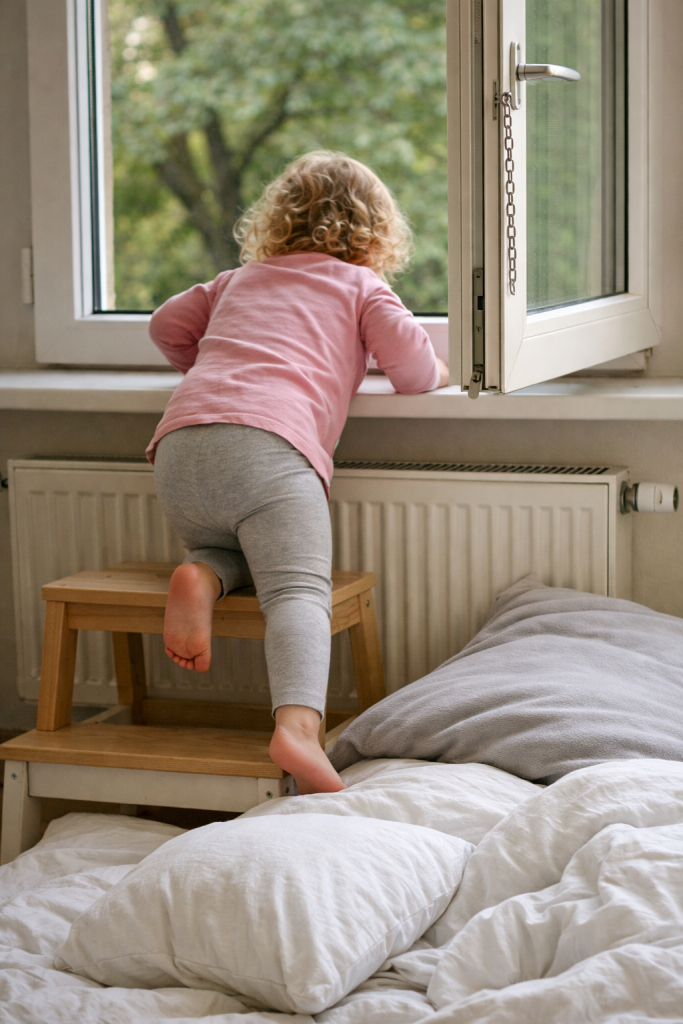
The first thing that froze me was the window — open. A window I had not opened.
I closed it instinctively and followed her.
She was pushing a small step stool across the floor, focused and impatient. Then I noticed the pillows and blanket piled near the radiator. That’s when it became clear: she had built herself a route. Pillows to climb. Radiator for height. From there she had reached the window handle. Once it opened toward her, her mind had immediately moved to the next step — bring the stool to climb higher and reach the open window fully.
She had thought fast. Acted fast.
I had been gone less than a minute.
That same evening, I ordered window locks with chains — the kind we used to have on front doors years ago. I never underestimated her again. I didn’t live in fear, but I started looking at the house through the eyes of a curious, determined toddler.
Years later, at age three, she decided to imitate us and turned on the stove. It didn’t help that I had left a pan on it. What did help was my almost obsessive habit of checking everything before leaving the house. I noticed something felt off, went back in, and found her proudly showing me what she had done.
She wasn’t a “difficult” child.
She was curious. Fast. Creative.
Maybe the hyperactivity diagnosis she later received explains part of that energy. But not all of it. Children explore — that’s what they do.
That’s why, when I now listen to my brother talk about his baby’s small adventures and close calls, I don’t feel any urge to say “I told you so.” Just a warm smile.
Before we have children, we are all perfect parents.
Calm. Certain. Logical.
After they arrive, we become more humble.
More attentive.
More aware that we cannot control everything — but we can prevent a lot.
Better to prevent than to repair.
And better to start from one simple assumption: a child will explore everything — outlets, windows, water, buttons, fire.
Not out of defiance.
Out of curiosity.
And we learn, step by step, to stay one move ahead.
Or at least… to try.