
Some objects are so ordinary that we stop questioning them altogether, and chalk is one of the clearest examples. It looks like a simple, fragile writing tool, something easily replaced and rarely examined, yet its origins go back tens of millions of years, long before humans ever existed.
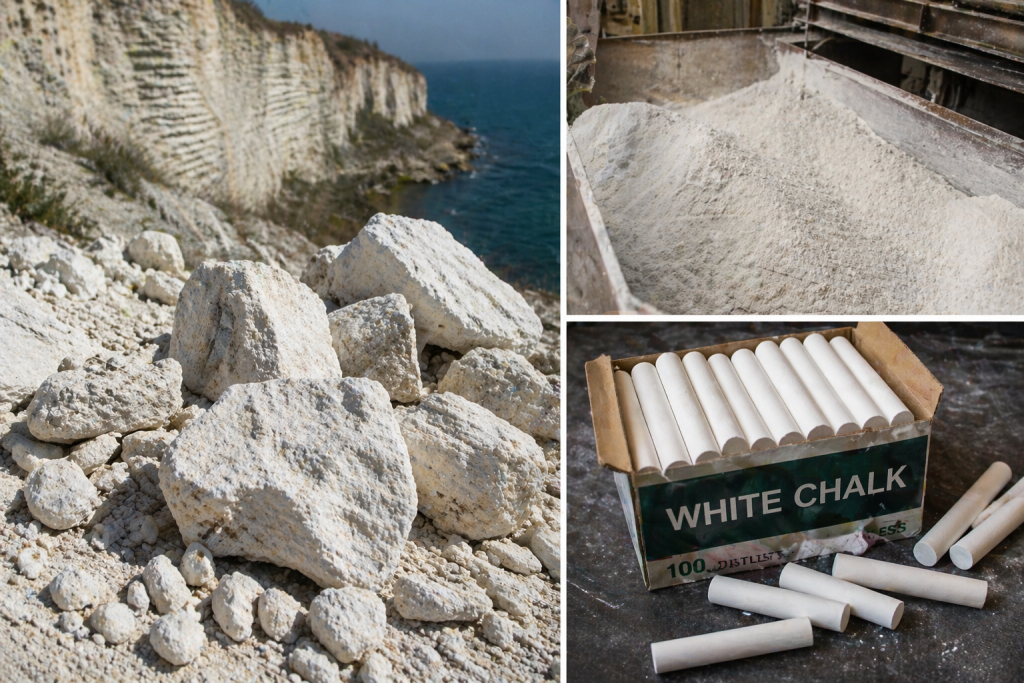
From a scientific perspective, chalk is a soft sedimentary rock composed mainly of calcium carbonate. What makes it remarkable is not just its composition, but how it forms. Chalk originates from the microscopic remains of marine organisms called coccolithophores, single-celled algae that lived in prehistoric oceans. These organisms produced tiny calcium carbonate plates, and when they died, those structures settled on the ocean floor. Over immense stretches of time, layer upon layer accumulated, compacted, and eventually turned into the chalk deposits we recognize today.
One of the most striking natural examples can be seen at the White Cliffs of Dover in United Kingdom, where entire cliff faces are built from these compressed remains. In a very real sense, every time we write with chalk, we are using material that began as microscopic marine life, transformed slowly by pressure, chemistry, and time.
Chalk wasn’t invented—it was recognized and refined
Unlike many everyday tools, chalk does not have a single inventor. There is no clear moment when it was “created,” because humans did not design it from scratch. Instead, they discovered its properties and learned how to use it.
Early civilizations noticed that this soft rock could be scratched easily and that it left visible marks on harder surfaces. The ancient Greeks and Romans used similar materials for marking and sketching, while during the Middle Ages, chalk became common in workshops, especially for drawing guidelines in construction and craftsmanship.
The version of chalk we associate with classrooms today, however, is closely tied to a much later development: the rise of structured, modern education.
The rise of classroom chalk and the blackboard era
Chalk became essential when classrooms began to evolve into organized learning environments in the 19th century. As education expanded to larger groups of students, teachers needed a practical way to present information clearly and dynamically.
The introduction of the blackboard changed everything. For the first time, lessons could be written, adjusted, erased, and rewritten in real time in front of an entire class. Chalk turned out to be the perfect companion: inexpensive, visible, easy to handle, and requiring no additional tools or energy.
Early classroom chalk was often just natural pieces cut from larger deposits. With industrialization, production became more controlled. Calcium carbonate was ground into a fine powder, mixed with water, shaped into sticks, and dried. Over time, alternative forms appeared, including versions made from gypsum (calcium sulfate), designed to produce less dust and offer more consistency.
This evolution wasn’t accidental. It was driven by a very practical need: a reliable, low-cost writing tool that could be used every day, in any classroom.
Why chalk works so well as a writing tool
Chalk’s effectiveness comes from its physical structure. Because it is soft, it breaks down into fine particles when pressed against a harder surface. These particles cling to the slightly rough texture of a blackboard, creating visible, high-contrast marks.
What seems simple is actually a finely balanced interaction. The marks are stable enough to be read clearly, even from a distance, yet fragile enough to be wiped away easily without damaging the surface. This balance between visibility and reversibility is what made chalk so well suited to teaching environments.
Uses beyond the classroom that most people overlook
Although chalk is strongly associated with education, its applications extend far beyond it. In agriculture, calcium carbonate is used to reduce soil acidity, helping create better conditions for plant growth. In industry, it plays a role in the production of cement, paints, and plastics due to its stability and chemical properties.
In sports, chalk powder is used to improve grip, particularly in activities like gymnastics, weightlifting, and climbing. In tailoring, specialized chalk is used to mark fabrics temporarily, allowing precise adjustments without damaging the material.
These diverse uses all rely on the same fundamental characteristics: softness, visibility, and the ability to leave temporary marks.
Why chalk still hasn’t disappeared in a digital world
In an era dominated by screens and digital tools, it would seem natural for something as simple as chalk to fade away. Yet it hasn’t. Its persistence is not just about cost or accessibility, but about how it supports direct interaction.
Writing with chalk is immediate and intuitive. There is no setup time, no reliance on electricity, and no technical barrier between the person explaining and the surface being used. In many situations, this simplicity becomes a genuine advantage rather than a limitation.
There is also a deeper, almost symbolic layer. For many people, chalk is tied to the idea of learning as a live process—something built step by step, in real time, through direct human interaction rather than mediated through a device.
What remains, beyond something that looks so simple
When seen in its full context, chalk is far more than a basic writing tool. It is the result of a story that begins in ancient oceans, passes through human observation and adaptation, and becomes an essential part of education and industry.
What seems ordinary at first glance turns out to be a combination of geology, chemistry, and practical ingenuity. Every line drawn on a board is, in a very real sense, a trace of ancient life reshaped over millions of years. And once you see it that way, it becomes much harder to think of chalk as something trivial.