
Imagine starting your morning with a hot drink that looks and smells like coffee, wrapping your hands around a warm mug, expecting that familiar boost of energy… only to realize it never comes. Not because the drink is weak, but because it contains no caffeine at all. And yet, the comfort, the aroma, and the ritual are still there. For many people, this is their first encounter with what is often called dandelion root “coffee.”
The root of Taraxacum officinale has been used for centuries in both traditional diets and herbal practices across Europe and parts of Asia. While the plant itself is often dismissed as a simple weed, it is entirely edible, and its root contains a range of compounds that make it nutritionally and functionally interesting.
Turning dandelion root into a coffee-like beverage is not a modern trend. Historically, especially during times when coffee was scarce or expensive, people turned to local alternatives. Dandelion root became one of the most accessible options. The process is straightforward but important: the root is cleaned, dried, roasted until it develops a deep brown color, then ground into a powder that can be brewed much like coffee.
What’s Inside the Root and Why It’s Different from Coffee
The most important difference compared to traditional coffee is the absence of caffeine. This single factor completely changes how the drink interacts with the body. While caffeine stimulates the central nervous system by blocking adenosine receptors and increasing alertness, dandelion root does not act on this pathway, meaning it won’t produce that familiar surge of energy.
Instead, the root is rich in inulin, a type of soluble fiber known for its prebiotic properties. Inulin is not digested in the usual way; it reaches the colon, where it is fermented by beneficial gut bacteria. This process may support digestive health and contribute to a more balanced gut microbiome, although individual responses can vary, especially depending on sensitivity to fermentable fibers.
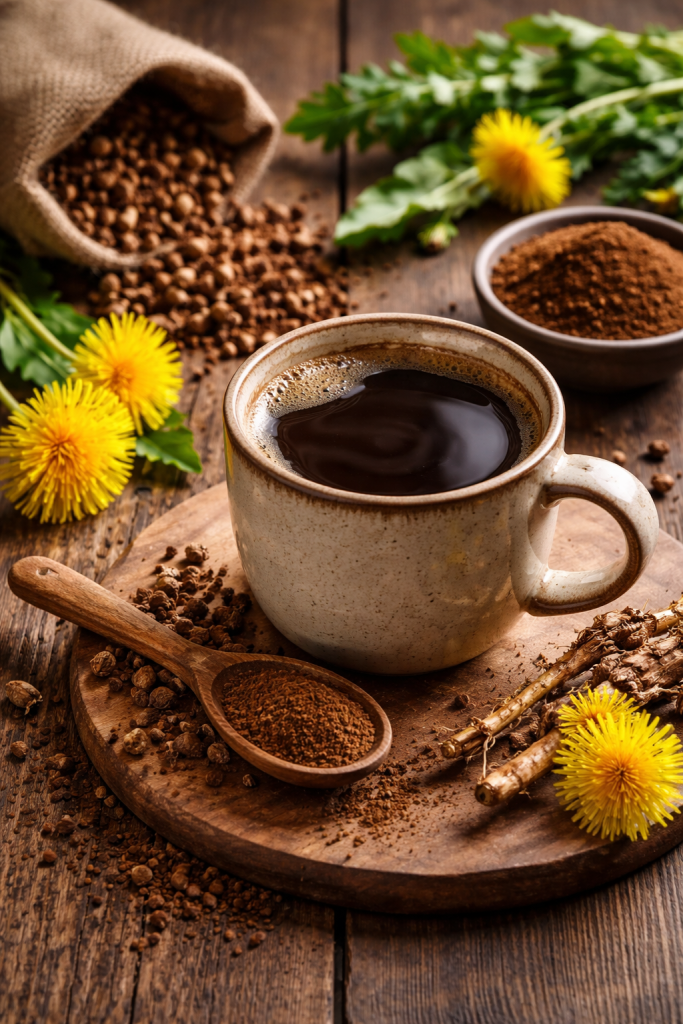
In addition to inulin, dandelion root contains phenolic compounds and flavonoids associated with antioxidant activity, as well as sesquiterpene lactones, which are responsible for its slightly bitter taste and may stimulate digestive secretions. While these compounds are being studied for potential health effects, most evidence comes from laboratory or animal studies, so conclusions about daily human consumption should remain cautious.
How It Develops a “Coffee-Like” Flavor
The resemblance to coffee doesn’t come from the raw root itself, but from what happens during roasting. At higher temperatures, natural sugars and amino acids in the root undergo complex chemical reactions known as the Maillard reaction, the same process responsible for the flavors of roasted coffee, baked bread, or toasted foods.
These reactions create aromatic compounds that produce roasted, slightly bitter, and sometimes mildly sweet notes. Some people describe hints of cocoa, nuts, or even caramel, but these perceptions are subjective and depend on roasting level, preparation method, and individual taste.
What can be stated more objectively is that the resulting drink has a warm, earthy, mildly bitter profile, typically without the acidity associated with traditional coffee.
Effects on the Body: The Real Difference from Coffee
Beyond taste, the most noticeable difference lies in how the body responds. Coffee delivers a rapid stimulation of the nervous system, increasing heart rate and temporarily boosting alertness, which can also lead to side effects like jitteriness or disrupted sleep in sensitive individuals.
Dandelion root beverages, on the other hand, do not provide that stimulation. There is no sudden spike in energy, but also no crash. Some people report a sense of digestive comfort after drinking it, which may be linked to its bitter compounds and fiber content.
That said, it’s important to avoid exaggeration. Dandelion root is not a medical treatment, and while it has been traditionally associated with digestive support, current scientific evidence in humans remains limited.
Who Should Be Cautious
Although generally considered safe when consumed as food, dandelion is not suitable for everyone. People who are allergic to plants in the Asteraceae family, such as ragweed, may experience allergic reactions.
There are also potential interactions with certain medications, particularly diuretics or drugs affecting liver metabolism. Additionally, the inulin content can cause bloating or digestive discomfort in some individuals, especially if intake increases suddenly.
As with any functional food, moderation is key, and those with underlying health conditions should consult a healthcare professional before making it a regular habit.
Why It’s Gaining Popularity Again
The renewed interest in dandelion root beverages is not accidental. Many people are actively trying to reduce caffeine intake, whether for better sleep, lower anxiety, or overall balance. At the same time, there is a growing shift toward less processed, more natural alternatives inspired by traditional practices.
There is also a subtle but important psychological aspect: the ritual itself. Coffee is not just about caffeine; it’s about the pause, the routine, the sensory experience. Dandelion root offers a way to preserve that ritual without the stimulating effects.
A True Alternative or Just a Curiosity?
Realistically, it is not a perfect substitute for coffee, nor does it try to be. It won’t deliver the same energy boost or replicate the exact flavor profile of roasted coffee beans. However, it creates its own distinct experience, one that many people find satisfying in its own right.
Its value lies not in bold promises, but in balance. It is a simple, traditional preparation grounded in real chemistry and long-standing use, offering a different kind of warmth and familiarity. In a world full of highly processed options, that simplicity is precisely what makes it stand out.