
Have you ever heard a song and suddenly felt the hair on your arms stand up?
Or walked into a cold room and felt your skin tighten instantly?
Or received unexpected news and felt chills run through you?
Same reaction. Different triggers.
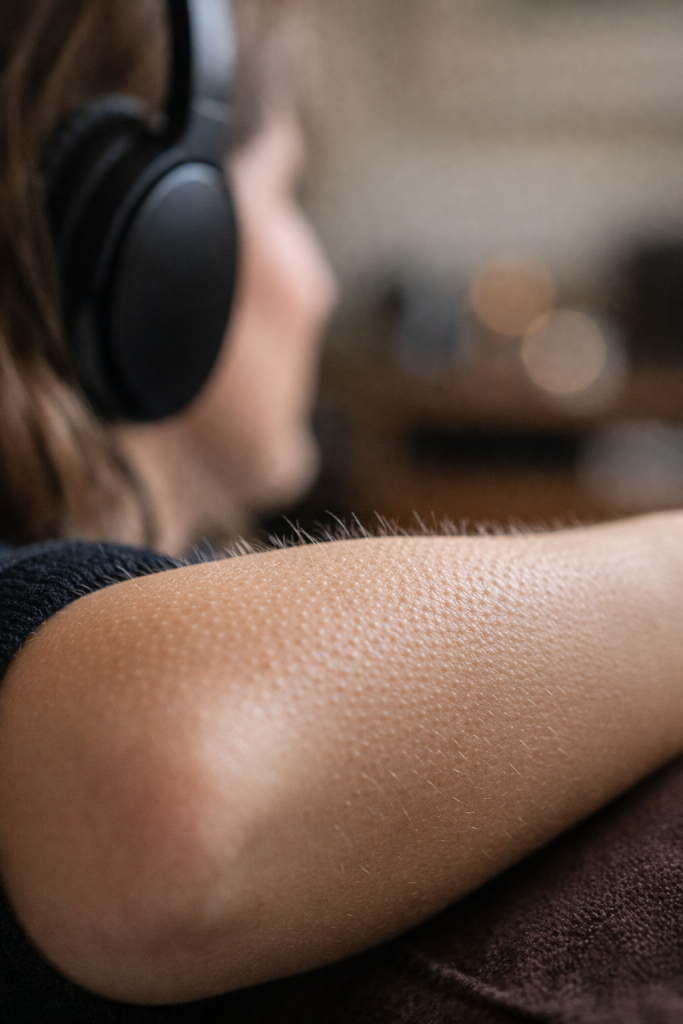
The scientific name for this phenomenon is piloerection — commonly known as goosebumps.
It’s an involuntary reflex controlled by the autonomic nervous system — the part of your body that reacts without asking permission.
What’s actually happening in your body?
At the base of every hair follicle there’s a tiny muscle called the arrector pili.
When it contracts, the hair stands up and the surrounding skin tightens — creating those small bumps on the surface.
Who gives the signal?
The sympathetic nervous system — the same system activated during:
- cold exposure
- fear
- intense emotion
- sudden surprise
- stress
It’s part of the classic fight-or-flight response.
Why do goosebumps happen when you’re cold?
From an evolutionary perspective, in furry mammals piloerection helps by:
- trapping a layer of insulating air
- making the animal appear larger for intimidation
Humans no longer have thick body hair, but the reflex remained.
It’s essentially an evolutionary leftover — no longer very useful for warmth, but still wired into our nervous system.
Why do they happen during emotional moments?
This is where things get fascinating.
Neuroscience research shows that chills triggered by music or strong emotions are linked to activation of dopamine pathways in the brain — the same reward circuits involved in pleasure and anticipation.
A study published in Nature Neuroscience (Salimpoor et al., 2011) found that people who frequently experience “musical chills” show activity in the brain’s reward system similar to what happens when we anticipate something intensely pleasurable.
In other words:
it’s not just emotion.
It’s neurochemistry.
Goosebumps can appear during:
- powerful music
- emotional speeches
- fear
- strong memories
- sudden surprises
Your body reacts before your conscious mind fully processes what’s happening.
Are there differences by age?
Yes, but subtle ones.
Children often show stronger visible reactions to cold or fear because their sympathetic nervous system is more reactive.
Teenagers and young adults tend to report emotional goosebumps (especially from music) more frequently in studies.
With aging, autonomic reactivity can decrease slightly, but the phenomenon doesn’t disappear.
Are there differences between men and women?
Research suggests small but interesting differences:
- Women report emotional chills from music more often.
- Higher emotional sensitivity and empathy correlate with a greater likelihood of experiencing goosebumps from art or music.
- Physical reactions to cold are similar across sexes, but perception of cold can differ — women often have higher peripheral sensitivity to low temperatures.
Can goosebumps ever be a medical sign?
In most cases, they’re completely normal.
But in rare situations, repeated or unusual piloerection can be associated with:
- focal seizures (rare)
- autonomic nervous system dysfunction
- fever or chills
It may be worth medical evaluation if goosebumps appear:
- only on one side of the body
- very frequently without clear triggers
- together with other neurological symptoms
The takeaway
Goosebumps are a primitive but fascinating reflex.
They’re your body saying:
“Pay attention. Something important is happening.”
Maybe it’s cold.
Maybe it’s fear.
Maybe it’s a song that hits something deep inside you.
A tiny reflex — connecting biology, emotion, and evolution all at once.