
(And Why It’s Not Just About Being Tired)
Yawning has terrible PR.
We associate it with boredom, laziness, poor sleep, bad manners. If someone yawns while we’re talking, we instinctively take it personally. If a child yawns in class, we assume they stayed up too late. If we yawn during a meeting, we try to disguise it.
And yet yawning is one of the oldest, most conserved reflexes in human biology. We yawn before we are born — ultrasound imaging has shown fetuses yawning in the womb as early as the second trimester. We yawn as newborns. As children. As teenagers dragging themselves through early school mornings. As adults under pressure. As elderly people in quiet rooms.
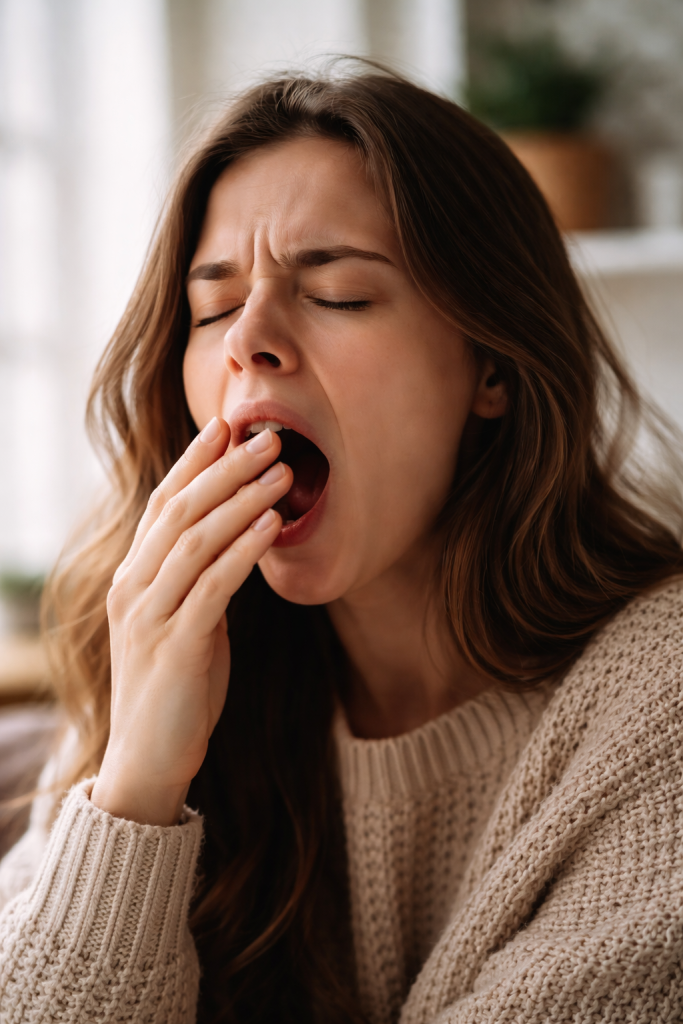
We yawn when we’re tired.
We yawn when we’re stressed.
We yawn before a big moment.
We yawn after the big moment is over.
And sometimes we yawn just because someone else did.
So what is really happening inside the body when your jaw stretches open and you take that long, involuntary breath?
For decades, the dominant theory was simple: yawning brings in more oxygen. It sounded reasonable. You take a deep breath, increase oxygen intake, reduce carbon dioxide buildup. Case closed.
Except it wasn’t.
Controlled studies in the 1980s and 1990s tested this idea by exposing participants to air enriched with oxygen or carbon dioxide. The results were surprisingly clear: oxygen levels didn’t meaningfully change yawning frequency. The “low oxygen” theory didn’t hold up under scientific scrutiny.
That forced researchers to look deeper.
One of the most compelling modern explanations is the brain cooling hypothesis. Neuroscientist Andrew Gallup and colleagues (including studies published in Frontiers in Evolutionary Neuroscience and Physiology & Behavior) proposed that yawning functions as a thermoregulatory mechanism for the brain.
The brain is metabolically expensive tissue. It generates heat constantly. Even small temperature fluctuations can affect cognitive efficiency. According to this model, yawning helps regulate brain temperature by increasing blood flow, stretching facial muscles, and drawing in cooler ambient air. Some experiments have shown that people yawn more when ambient temperatures rise within certain ranges — but not when it’s extremely hot or extremely cold, supporting the idea that yawning helps fine-tune brain temperature rather than simply react to discomfort.
In other words, a yawn may be your brain’s version of adjusting the thermostat.
But temperature regulation is only part of the story.
Yawning is also a neurological event.
It involves dopamine — associated with motivation and reward.
It involves serotonin — tied to mood regulation.
It involves oxytocin — often called the bonding hormone.
It involves acetylcholine — critical for attention and memory.
This complex neurochemical cocktail explains why yawning often appears during transitions. When you’re waking up. When you’re about to fall asleep. Before stepping onto a stage. Before a race. After a stressful event has passed.
Athletes frequently yawn before competitions. Not because they’re relaxed — but because their autonomic nervous system is recalibrating. The body is balancing sympathetic activation (adrenaline, alertness) with parasympathetic control (calm, regulation). A yawn can mark that shift.
It’s not weakness. It’s recalibration.
Children yawn for similar reasons, though we often misinterpret it. A child who yawns repeatedly in a stimulating environment may not be bored — they may be overloaded. The developing brain is still refining its regulatory systems. Yawning can be a subtle sign that the nervous system is trying to stabilize itself.
Teenagers? Their biology complicates things further. During adolescence, circadian rhythms naturally shift later — a phenomenon supported by sleep research across multiple institutions, including studies cited by the American Academy of Pediatrics. Their brains are biologically programmed to fall asleep later and wake later. Early school start times collide directly with this neurological timing. Morning yawns in teens are not moral failings. They’re circadian biology in action.
Adults often experience yawning under cognitive strain. Before presentations. During intense concentration. After prolonged screen exposure. It can signal subtle fatigue — but not necessarily sleep deprivation. Sometimes it reflects a brain switching modes, adjusting vigilance.
In older adults, yawning frequency may decrease slightly, but it remains present across the lifespan. Interestingly, excessive yawning can occasionally appear in certain neurological conditions — including multiple sclerosis, brainstem injury, or migraine — which further supports the idea that yawning is deeply tied to brain regulation rather than simple sleepiness.
And then there’s contagious yawning.
If you’ve yawned at least once while reading this, you’ve experienced it.
Functional MRI studies published in journals like NeuroImage and Consciousness and Cognition show that seeing someone yawn activates regions involved in social cognition and empathy, including components of the mirror neuron system. These are the same neural networks that allow us to intuitively “feel” what others are experiencing.
Contagious yawning is stronger among close family members and friends. It’s weaker with strangers. It’s reduced in very young children and in individuals with certain neurodevelopmental conditions that affect social processing.
Some research suggests subtle sex differences, with women potentially showing slightly higher susceptibility to contagious yawning — possibly linked to stronger activation in empathy-related neural circuits. The findings are nuanced and still evolving, but they hint at something profound: yawning is not just physiological. It’s social.
Even animals yawn. Dogs yawn. Cats yawn. Primates yawn — sometimes as social signals. In some species, yawning communicates tension or dominance. In humans, it seems to have shifted more toward internal regulation and social synchrony.
Interestingly, yawning rarely happens in moments of acute danger. When you’re in full fight-or-flight mode, your body doesn’t waste energy yawning. But once the threat passes, a yawn may appear — almost like a nervous system exhale that says: we survived, we can regulate again.
Pregnancy adds another layer. Some women report increased yawning, likely due to hormonal shifts and increased metabolic demands. The body is working continuously. The brain adjusts accordingly.
So the next time you yawn, consider this:
Your brain may be cooling itself.
Your nervous system may be shifting states.
Your neurotransmitters may be recalibrating.
Your social brain may be synchronizing with someone else.
Yawning is not laziness.
It is not disrespect.
It is not simply “being tired.”
It is an ancient reflex — observable before birth — that reflects the delicate balancing act of a metabolically demanding brain.
A wide-open mouth, hiding a remarkably sophisticated mechanism.
And if you just yawned again… science would say that’s perfectly normal.