
Every day, thousands of visitors climb the steep streets of Montmartre to reach the white-domed Basilica of Sacré-Cœur. They admire its striking architecture, take in one of the best panoramic views of Paris, snap a few photos, and move on to the city’s next famous landmark.
Most of them never realize that the basilica’s most remarkable story begins only after the crowds have disappeared.
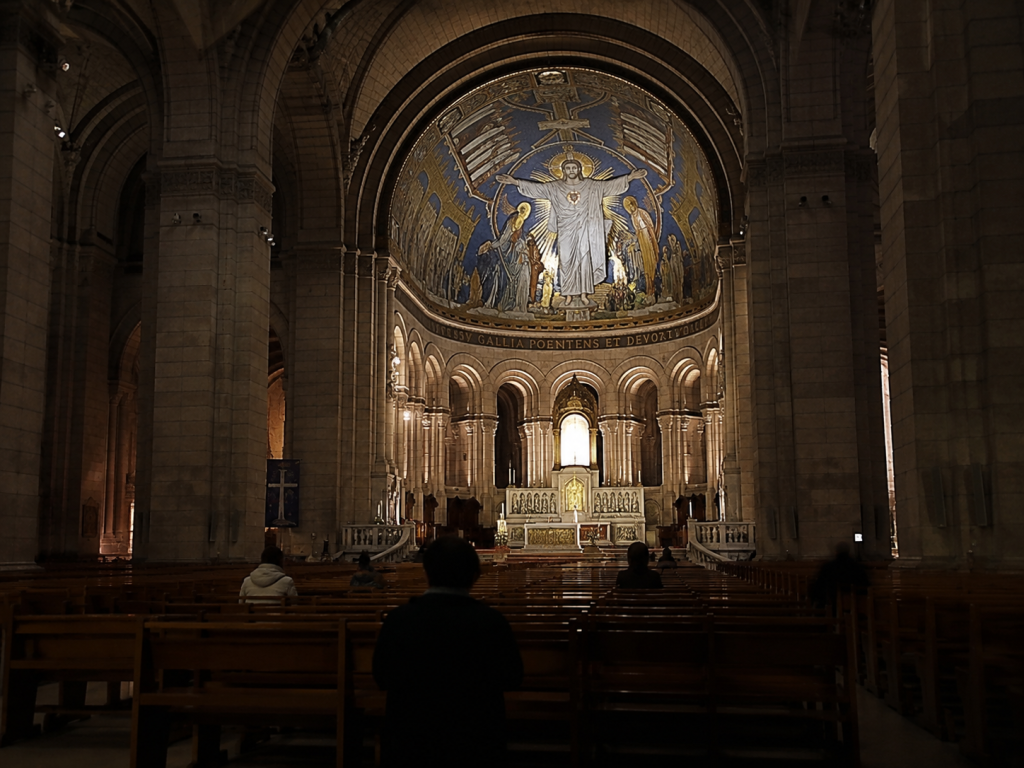
As evening falls and the doors close to ordinary visitors, a different kind of journey begins. The echoes of conversations fade, the cameras are gone, and silence fills the vast interior. Throughout the night, ordinary people from around the world quietly take turns spending an hour in prayer before the Blessed Sacrament, continuing a tradition that has remained uninterrupted since 1885.
For many, this hidden experience becomes the most unforgettable part of their visit to Paris.
A Basilica Built During One of France’s Darkest Periods
The origins of Sacré-Cœur are deeply rooted in French history.
Following the Franco-Prussian War of 1870–1871 and the turmoil of the Paris Commune, France faced political instability, social division, and widespread uncertainty. In response, two French Catholics, Alexandre Legentil and Hubert Rohault de Fleury, proposed building a church dedicated to the Sacred Heart of Jesus as a symbol of hope, reconciliation, and faith.
Montmartre was chosen for more than its spectacular elevation above Paris. Christian tradition identifies the hill as the place where Saint Denis, the first Bishop of Paris, was martyred during the third century, making it one of the city’s oldest pilgrimage sites.
Construction began in 1875 and continued for decades before the basilica was officially consecrated in 1919.
Why the Basilica Always Looks So Bright
One feature immediately catches every visitor’s attention: its brilliant white exterior.
Unlike many historic buildings that darken with age and pollution, Sacré-Cœur has retained its luminous appearance for more than a century.
The reason lies in the stone itself. Much of the basilica was built using Château-Landon travertine, a limestone that naturally releases calcite when exposed to rainwater. This process helps keep the surface clean and gives the building its distinctive white color, creating the impression that it constantly renews itself.
It is one of the basilica’s most fascinating architectural characteristics and a detail that many visitors never hear about.
A Prayer That Has Never Stopped
Long before the building was completed, something extraordinary had already begun.
On August 1, 1885, perpetual Eucharistic Adoration was established inside Sacré-Cœur. From that day forward, someone has remained in prayer before the Blessed Sacrament every hour of every day.
The tradition has survived two world wars, the German occupation of Paris, economic crises, and even the COVID-19 pandemic.
Few places in the world can claim such an unbroken history of continuous prayer.
Behind the scenes, volunteers and pilgrims ensure that every hour is covered, creating a chain of devotion that has remained intact for nearly 140 years.
Yes, You Can Spend the Night There
Many travelers are surprised to learn that they can become part of this tradition.
Adjacent to the basilica are simple accommodations reserved for pilgrims who wish to participate in the overnight adoration program. These are not luxury hotel rooms but modest guest facilities designed to support those taking part in the vigil.
Guests pay a small accommodation fee and are assigned approximately one hour during the night to pray inside the basilica.
The remainder of the night is spent resting.
Contrary to what many imagine, participants are not expected to stay awake until sunrise. Each person contributes only a single hour, allowing the continuous vigil to carry on without interruption.
What an Overnight Vigil Feels Like
Once the daytime crowds are gone, Sacré-Cœur takes on an entirely different atmosphere.
The enormous sanctuary becomes almost silent. Soft lighting illuminates the immense mosaic of Christ in Majesty, one of the largest religious mosaics in the world, while footsteps echo gently beneath the soaring domes.
There are no guided tours, no announcements, and no distractions.
Only quiet.
When their assigned hour arrives, pilgrims enter the basilica to pray in whatever way feels most meaningful to them. Some read Scripture, others pray the Rosary, while many simply remain in silent reflection.
For countless visitors, that single hour becomes one of the most profound spiritual moments of their lives.
Hidden Treasures Beyond the Prayer
Sacré-Cœur is known for much more than its perpetual adoration.
Its massive bell, La Savoyarde, weighs nearly 19 tons and ranks among the largest church bells in France.
Visitors willing to climb the basilica’s dome are rewarded with one of the finest viewpoints in Paris. On clear days, visibility stretches for dozens of kilometers, offering breathtaking views across the French capital.
These features alone make the basilica worth visiting, but together with its living spiritual tradition, they create an experience unlike any other landmark in the city.
More Than a Tourist Attraction
For many travelers, Sacré-Cœur is simply another stop on a sightseeing itinerary.
For others, it becomes something far more personal.
The knowledge that someone has been praying continuously within these walls since 1885 changes the way many people see the building. It is not merely a historic monument or an architectural masterpiece—it is a place where faith has been lived, day after day and night after night, for generations.
In an age when almost everything seems temporary, that kind of continuity is exceptionally rare.
A Different Way to Experience Paris
If your trip to Paris is about more than checking famous landmarks off a list, Sacré-Cœur offers an opportunity few visitors ever discover.
You can admire its architecture, explore its remarkable artwork, climb to the dome for unforgettable views—and, if you choose, spend a night as part of a tradition that has quietly continued for nearly 140 years.
While millions of tourists visit the basilica every year, only a small number stay after sunset to experience the peaceful side of Sacré-Cœur.
Sometimes, the most memorable places are not the ones with the biggest crowds, but the ones that reveal their true character only when the city falls silent.