
At first, it sounds like one of those internet stories that spreads simply because it’s unusual. A young woman from Cyprus, Lyubov Siryk — featured in several lifestyle outlets and online publications — says that after finishing her tea, she doesn’t throw anything away. She eats the leaves, and sometimes even the tea bags.
Not as a one-time experiment or a passing curiosity, but as a daily habit that began in her teenage years and gradually became something entirely normal to her.
The instinctive reaction is simple: if it’s tea, how harmful could it really be?
But that’s not quite the right question.
From a viral story to a real question
Her case hasn’t been formally studied in clinical research, but it isn’t completely isolated either. Stories like this appear from time to time, often because they sit at the intersection of curiosity and something less understood: why do people develop habits that involve consuming things we don’t typically consider food?
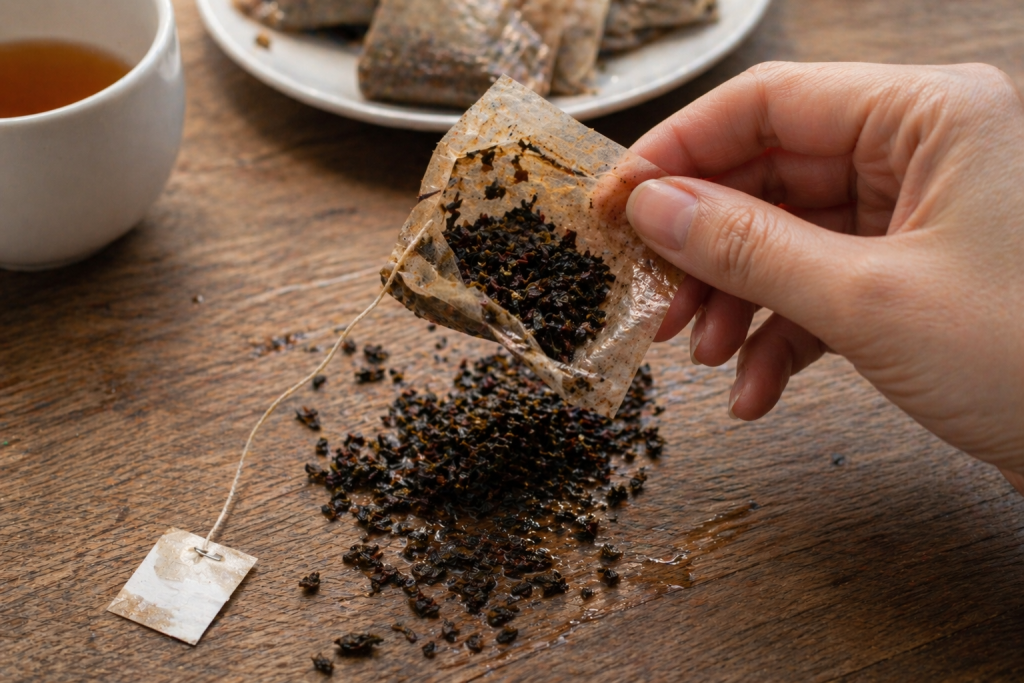
Beyond the quick reactions such stories trigger, there is an important distinction to make — between drinking tea and consuming the plant itself, or even its packaging.
Infusion vs ingestion: what actually changes
When you drink tea, you’re only extracting a portion of what’s inside the leaf. Depending on the type of tea and how it’s prepared, water pulls out certain compounds such as polyphenols, catechins, caffeine, and amino acids like L-theanine.
But the leaf itself contains more than what ends up in your cup.
Chemical analyses of Camellia sinensis show that tea leaves hold higher concentrations of tannins, plant fibers, phenolic compounds, and trace elements absorbed from the soil, including metals like manganese and aluminum. Infusion doesn’t extract everything — some of it remains in the leaf.
That means eating the leaves exposes the body to a different profile altogether.
Caffeine in a form you don’t see in your cup
Tea is often perceived as a milder source of caffeine compared to coffee, but that perception is largely tied to how caffeine is released into the liquid.
In the leaf itself, the total amount is higher than what gets extracted during brewing. Consuming the leaves directly can lead, over time, to a greater overall intake than expected. Not necessarily dramatic effects, but more subtle ones — disrupted sleep patterns, a mild but persistent sense of restlessness, or difficulty fully relaxing.
And when the habit becomes daily, the body isn’t reacting to a single intake anymore, but to continuous exposure.
Tannins and the quiet impact on iron absorption
One of the less obvious aspects is the relationship between tea consumption and iron absorption. Tannins can bind to non-heme iron found in plant-based foods, reducing how much of it the body can absorb.
Studies have shown that frequent tea consumption, especially around mealtimes, can significantly lower iron bioavailability. When you’re ingesting the leaves themselves, the tannin intake is higher than in a typical infusion, which may amplify this effect.
It’s not something that produces immediate symptoms, but rather a gradual shift that can matter over time.
Tea bags and the microplastic concern
This is where things move into a more sensitive area.
While tea leaves can be discussed in terms of quantity and frequency, tea bags introduce a different kind of issue. Many modern tea bags aren’t made from simple paper. Some contain treated fibers or synthetic materials such as nylon or PET, designed to withstand high temperatures without breaking apart.
A 2019 study published in Environmental Science & Technology found that certain types of tea bags can release billions of microplastic and nanoplastic particles into hot water. While the long-term effects on human health are still being studied, directly ingesting the bag itself is not something considered safe.
The body isn’t designed to process these materials.
Why do habits like this develop?
Beyond the chemistry, the deeper question remains.
In medicine, there’s a concept called pica, which refers to a persistent urge to consume non-food or unusual substances. It’s not rare, and it can appear in different contexts — from nutritional deficiencies, especially iron or zinc, to psychological or behavioral factors.
Not every unusual habit falls into this category, and not every case is a medical concern. But when a behavior becomes frequent, repetitive, and involves substances not intended for consumption, it tends to draw more attention from a clinical perspective.
When something “harmless” isn’t entirely neutral
Perhaps the most important takeaway isn’t that this kind of habit is inherently dangerous, but that it isn’t entirely neutral either.
Tea leaves aren’t toxic in the traditional sense, but they aren’t designed to be consumed daily in uncontrolled amounts. Tea bags, on the other hand, are not meant to be eaten at all.
And the absence of immediate symptoms doesn’t necessarily mean there’s no impact.
The body doesn’t always react quickly. Sometimes the effects are gradual, subtle, and difficult to connect to a habit that seems harmless on the surface.
And that’s often where the real difference lies.
Because not everything that looks small stays small over time.