
There are moments when you stand near something enormous and feel a quiet sense of unease that doesn’t quite make sense. It isn’t fear in the usual way, and there’s no immediate danger, yet something about the scale of what you’re looking at feels… off. It might be the side of a massive ship, the base of a skyscraper, or a towering statue that seems to dominate everything around it.
That reaction is known as megalophobia.
It refers to the discomfort or anxiety triggered by very large objects, not because they are harmful, but because their size disrupts the way the brain expects the world to look. It’s often grouped within specific phobias, where a particular type of stimulus can produce a strong emotional response, even when there is no real threat.
What makes this reaction unique is that it isn’t about danger, but about perception.
How the brain processes extreme scale
The human brain relies heavily on visual references and learned proportions to understand the environment. Over time, we build an internal sense of how large things are supposed to be and how they relate to our own body.
When something exceeds those expectations by a large margin, that system struggles to keep up. The brain can no longer easily estimate distance, size, or spatial relationships, and that gap creates a subtle form of uncertainty.
Structures like the amygdala may become involved at this point, because they are responsible for quickly evaluating unfamiliar or potentially threatening situations. Even if the object is harmless, the fact that it cannot be processed smoothly makes it feel unsettling.
The body’s response to feeling “overwhelmed”
This type of discomfort often comes with physical sensations that are easy to overlook but very real. Breathing may become slightly faster, muscles tense without conscious effort, and attention narrows.
These reactions are part of the fight or flight response, the same system that prepares the body for potential danger. In the case of megalophobia, however, the trigger isn’t a threat, but the difficulty of interpreting scale and context.
It’s less about fear of the object and more about the feeling of losing spatial control.
Why images can trigger the same reaction
You don’t have to stand next to something enormous to feel this. For many people, a photograph is enough.
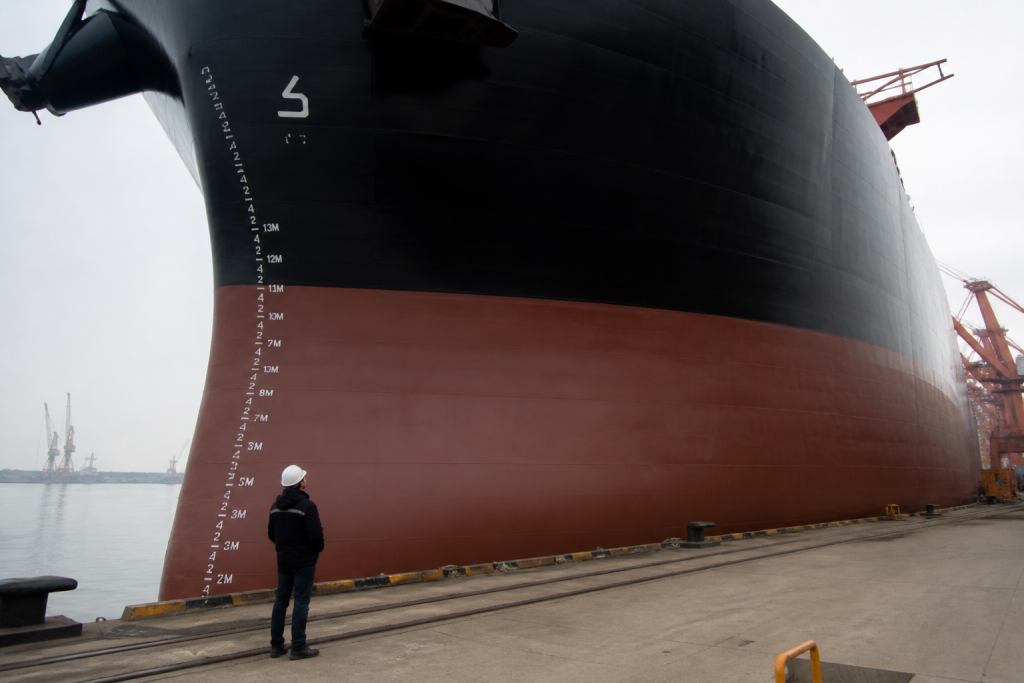
If an image clearly shows the contrast between a small human figure and a massive structure, the brain receives enough information to recreate the same sense of imbalance. Visual processing alone can activate the circuits involved in spatial awareness and threat detection.
Research in visual perception suggests that estimating size depends not only on the object itself, but also on context and prior experience. When those cues are distorted or exaggerated, the brain reacts as if something is not quite right.
An evolutionary perspective on size and control
From an evolutionary standpoint, reacting cautiously to very large objects makes sense.
Objects of extreme size could imply instability, limited ability to escape, or environments that are difficult to navigate. Even if modern structures are safe, the brain still interprets unusual scale as something that requires attention.
This tendency to err on the side of caution has been useful throughout human history, even if it occasionally leads to discomfort in safe situations.
Why not everyone feels the same thing
Not everyone experiences this reaction in the same way, and that difference is important.
Some people are drawn to large structures and find them fascinating or even calming, while others feel a subtle tension or unease. These variations are influenced by sensitivity to visual stimuli, personal experiences, and how comfortable someone is with spatial uncertainty.
In other words, the same scene can be interpreted in completely different ways depending on the individual.
What megalophobia reveals about the mind
At its core, megalophobia is not really about large objects.
It’s about the relationship between the human body and the space it occupies, and how the brain tries to maintain a sense of balance and understanding within that space.
When that balance is disrupted, even slightly, the result is a feeling of being overwhelmed.
It isn’t a flaw or a weakness. It’s a reflection of how the brain is designed to interpret the world.
And when something exceeds what it can easily process, the response is simple and deeply human: pause, reassess, and proceed with caution.