
I had just asked my aunt — my mom’s older sister — if she still remembered what my grandmother used to use to sour her soup, because no matter how many times I try, I can never quite get that same taste of home.
It was one of those quiet, familiar family moments. Plates in front of us, food still steaming, conversations overlapping softly, that warm background noise that usually makes everything feel safe and grounded.
He was sitting next to me, absentmindedly playing with his fork, not really paying attention — or so I thought.
Then it slipped.
The fork fell to the floor.
He leaned down under the table to grab it and, almost at the exact same time, in the same casual tone someone might use when they sigh or bump into something, he muttered:
For fuck’s sake…
He didn’t raise his voice.
He didn’t laugh.
He didn’t look around to see if anyone heard.
He just said it.
Naturally. Automatically. Like it belonged there.
And the table went silent.
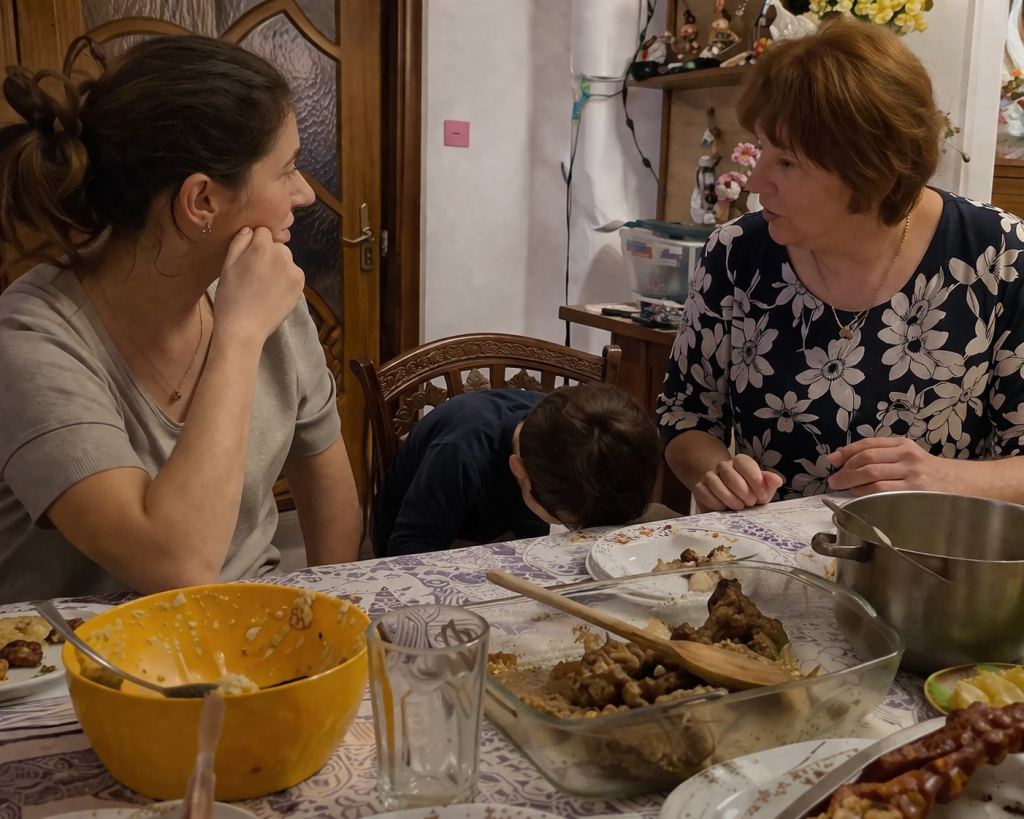
That kind of silence where everyone definitely heard it, but no one knows whether to react or pretend nothing happened. My aunt stopped mid-sentence. My mother looked straight at me. Someone cleared their throat. And I could feel that familiar heat rising in my face — that unspoken question hanging in the air.
Where did he learn that?
Meanwhile, he calmly picked up the fork, sat back down, and continued eating like absolutely nothing had happened.
For him, nothing had.
And that’s exactly what hit me the hardest.
Because in that moment, I realized it wasn’t about a “bad word.” It wasn’t about him trying to shock anyone or copy someone on purpose.
It was already part of him.
A reflex.
And without even meaning to, my mind went back to my own childhood. The house I grew up in, where words like that simply didn’t exist. Not because there were long explanations or strict rules — they just weren’t there. They weren’t part of the atmosphere.
In my husband’s family, things were always a bit more relaxed. Not aggressive, not constant — but every now and then, a word would slip out. Especially in moments of stress, or frustration… or in traffic, where patience tends to disappear the fastest.
Nothing dramatic. Nothing I ever thought mattered that much.
Until that moment.
Because that’s when it became clear — children don’t just learn words. They learn the tone, the timing, the context. They learn when those words show up, what they’re tied to, how normal they are.
Some kids grow up hearing this kind of language and decide they don’t want to speak that way. You can see it in them — the discomfort, the hesitation, that instinctive feeling that something isn’t quite right.
But there’s another kind of child. The kind you don’t notice right away.
The one for whom those words stop being “bad,” or “shocking,” or even meaningful… and just become normal.
They use them the way they breathe.
And sitting there, with everyone still quietly processing what just happened, I realized something uncomfortable.
This wasn’t about him recognizing a word. Anyone can recognize a word.
The difference is when it comes out naturally — without effort, without hesitation, without a filter.
That’s where you see what has truly been learned.
And maybe, without even realizing it, alongside “say thank you” and “be polite,” we should be paying a little more attention to something else too.
Not just what we teach them to say…
But what we slowly make feel normal to say.