
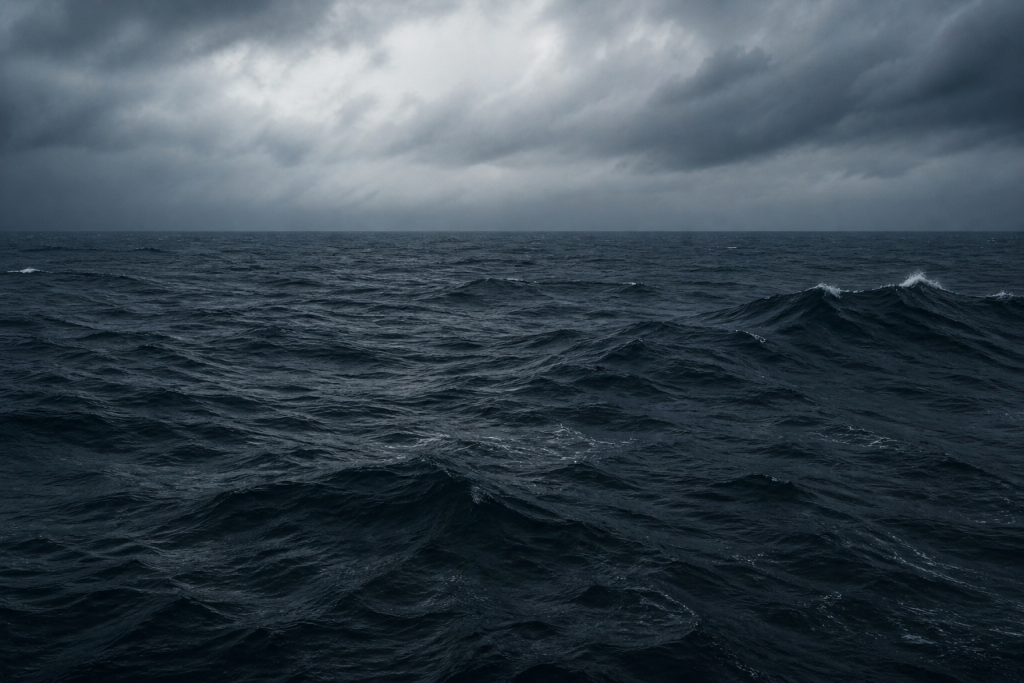
You’re looking at a photo of the ocean. The surface is calm, nothing threatening, nothing dramatic. And yet, something doesn’t sit right. There’s a quiet unease, a subtle drop in your stomach that doesn’t quite make sense.
It’s not about what you see.
It’s about what you can’t see.
That reaction has a name: thalassophobia.
It’s often misunderstood as a simple fear of water or drowning, but it goes deeper than that. Thalassophobia is tied to vast, deep bodies of water — places where there are no clear visual references, no sense of distance, no control. It’s the feeling of being exposed in an environment your brain can’t fully interpret.
While it isn’t always classified as a standalone condition in modern clinical manuals, it’s closely related to specific phobias, where a clearly defined trigger can provoke a strong emotional and physical response. What makes this one unique is that the trigger isn’t an obvious threat, but the absence of information.
How your brain reacts when it faces the unknown
When you look at deep water — or even an image that suggests depth — your brain quickly activates regions involved in threat detection, especially the amygdala. This part of the brain doesn’t wait for logical confirmation. It reacts to patterns, uncertainty, and incomplete data.
In the case of deep water, the problem isn’t what’s visible, but what’s hidden. The gradual darkening, the lack of a visible bottom, the absence of boundaries — all of these create a scenario your brain struggles to map.
And when the brain can’t predict what’s coming next, it leans toward caution.
Your heart rate increases. Breathing becomes slightly faster. Muscles tighten without you realizing it. This is part of the fight or flight response, a survival mechanism designed to prepare you for potential danger, even if no immediate threat exists.
Why even photos can trigger the same reaction
One of the most surprising aspects of thalassophobia is that you don’t have to be in the water to feel it. For many people, a single image is enough.
The brain doesn’t always distinguish clearly between direct experience and visual simulation when it comes to emotional triggers. If an image contains enough cues — depth, darkness, lack of control — it can activate the same neural pathways as a real-life situation.
Neuroscience research supports this idea, showing that visual stimuli alone can engage circuits associated with fear and uncertainty. That’s why a photo can make you uneasy even when you know, rationally, that you’re safe.
An ancient survival instinct still at work
From an evolutionary perspective, this reaction makes sense.
Humans evolved primarily on land, where visibility and control were key to survival. In water — especially deep water — those advantages disappear. You can’t see what’s beneath you. You can’t judge distance. You can’t rely on stable ground.
For early humans, this type of environment meant vulnerability.
So the brain learned to treat it with caution.
Thalassophobia can be seen as a modern expression of that ancient instinct — a system designed to detect risk, still active even in situations that are objectively safe.
Why some people feel nothing at all
Not everyone reacts the same way, and that difference is important.
Some people are naturally more comfortable with uncertainty, while others have a more sensitive internal alarm system. Personal experiences, early exposure to water, and even genetic factors can influence how strongly someone responds.
That’s why the same ocean can feel calming to one person and deeply unsettling to another.
What this reaction actually says about you
It might feel like a weakness, but in reality, it’s not.
Thalassophobia is an example of your brain doing exactly what it was designed to do — anticipate potential threats when information is incomplete. It prefers to assume risk rather than ignore it.
It’s not a flaw. It’s a protective bias.
In the end, this isn’t just about water.
It’s about how we respond to the unknown, how much control we need to feel safe, and how the brain tries to fill in the blanks when it can’t see the full picture.
And that quiet discomfort you feel?
It’s your mind choosing caution — just in case.