
A crying baby, an exhausted mother and a small bottle promising relief.
In nineteenth-century Britain, that combination could lead to something that seems almost unimaginable today. Some remedies given to babies and young children contained opium, and they were used for problems ranging from diarrhea and teething pain to persistent crying and sleeplessness.
The result could appear remarkably convincing. A restless baby became quiet. A child who had been crying finally fell asleep.
To a tired parent, it could look as though the medicine had worked.
But the calm sometimes came from the sedating effects of an opioid.
The story is often reduced online to a shocking claim: Victorian parents routinely drugged their babies to make them sleep. The historical reality is more complicated — and far more revealing.
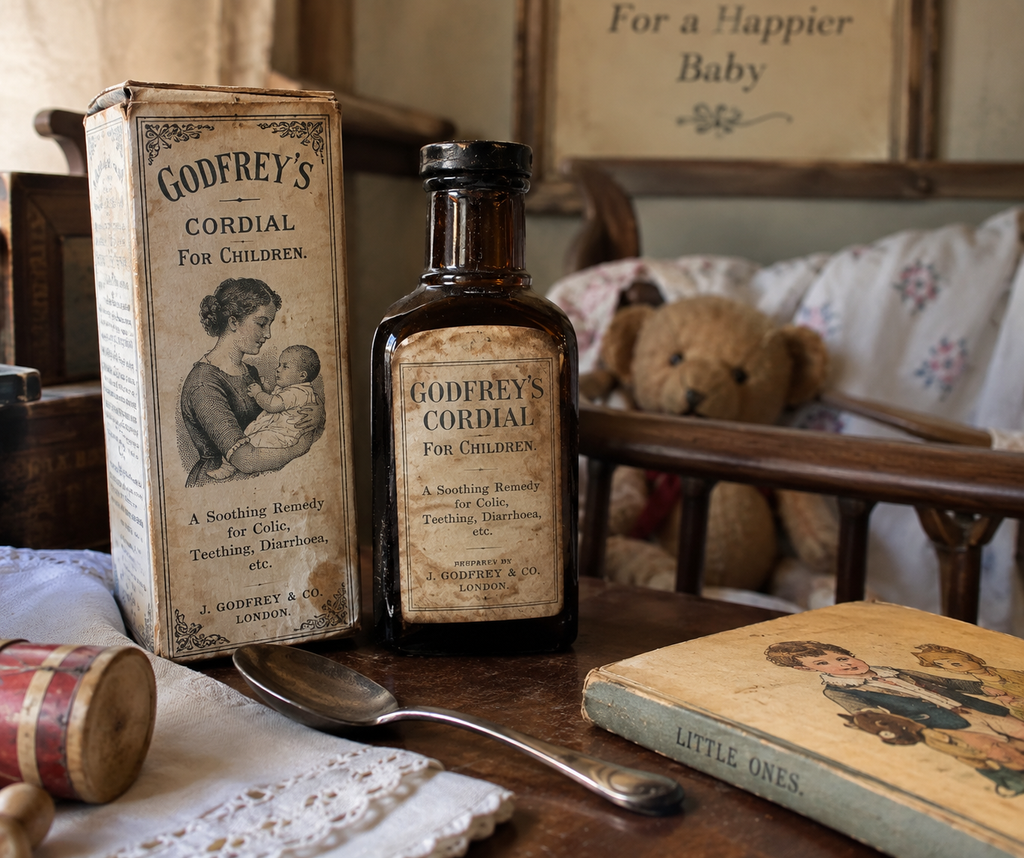
Opium-based preparations really were given to infants. Some became commercially successful products, and their use became particularly significant among working-class families during industrialization. Yet this was neither a universal Victorian parenting practice nor simply a story about careless mothers.
Behind these medicines was a world in which effective treatments were limited, drug regulation was still developing, advertising could make powerful substances appear reassuring, and many working women had few practical options for childcare.
Giving opium to babies was much older than Victorian Britain
The practice did not begin with the Victorians.
Medical historian Michael Obladen traced the use of poppy extracts in infant care across more than three thousand years. Such preparations were used for excessive crying, suspected pain, diarrhea and difficulty sleeping, among other complaints.
Opium also found its way into remedies associated with teething.
What changed during the nineteenth century was the scale and commercial environment surrounding these substances.
Industrial production made medicines easier to manufacture and distribute, while an expanding market offered families preparations sold as soothing syrups, cordials and other remedies.
In English-speaking countries, some opium-containing products were available not only through medical professionals but through ordinary shops and traveling sellers.
A powerful drug could therefore enter the home looking surprisingly ordinary.
Godfrey’s Cordial became one of Britain’s best-known examples
Among the preparations associated with British childhood was Godfrey’s Cordial.
Its history predates the Victorian period, but it remained widely known during the nineteenth century. Historical medical literature identifies it alongside products such as Dalby’s Carminative as a remedy administered to infants and children, sometimes without medical supervision.
Godfrey’s Cordial contained opium.
That ingredient helped produce the very effect families were looking for: a distressed child could become sleepy and quiet.
From the perspective of someone caring for a screaming baby, the change must sometimes have seemed dramatic.
Yet there was a fundamental problem.
Crying is communication.
A baby may cry because of hunger, illness, pain, cold, discomfort or the need for physical contact. Making the child sleepy does not necessarily address any of those causes.
The apparent success of the medicine could therefore be misleading. What looked like relief might simply have been sedation.
Why would parents take such a risk?
Looking back from the twenty-first century, it is tempting to assume that people simply did not understand how dangerous opium could be.
That explanation is only partly satisfactory.
Historical research indicates that opium’s toxicity in infants was not completely unknown. Fatal poisonings had been reported, yet opiates continued to be used in childhood medicine.
The persistence of the practice makes more sense when we consider the social world surrounding it.
For many poor and working-class families, a mother’s income could be essential. Women worked in factories, agriculture, domestic service and other occupations, often under conditions very different from modern employment.
There was no modern system of maternity leave and childcare support waiting for every working mother.
Someone still had to care for the baby.
In such circumstances, a cheap remedy capable of keeping a child quiet for hours could acquire an importance that is difficult to understand if we judge the decision only by today’s standards.
That does not make the medicine safe. It does change the story.
Instead of asking only why a mother would give opium to her child, we also have to ask why a society could create conditions in which such a product seemed useful in the first place.
Sleep itself could become part of the danger
Opioids can suppress activity in the central nervous system. Excessive exposure can slow breathing, which is particularly dangerous in an infant.
But sudden poisoning was not the only concern.
Babies need to wake and feed frequently. A child who remained unusually drowsy could feed less effectively or less often. Repeated sedation could therefore contribute to poor nutrition and increasing weakness.
This made the consequences difficult to recognize.
A dramatic overdose might have an obvious connection with a medicine. A baby who gradually became weaker while eating too little was a different matter, especially in a period when infant mortality was already high and could have numerous causes.
Obladen’s historical research describes opium poisoning as becoming a significant contributor to infant mortality as private opiate use expanded among working-class populations during the nineteenth century.
The very symptom parents wanted — prolonged quietness — could therefore conceal a serious problem.
Advertising made powerful medicines look reassuring
The bottles did not arrive with the cultural meaning that the word “opioid” carries today.
They were remedies.
Their names and advertising spoke about soothing, comfort, teething, colic, diarrhea and sleep.
That presentation matters.
Parents were not necessarily choosing between “giving my baby a dangerous drug” and “not giving my baby a dangerous drug.” They might instead believe they were choosing a familiar commercial remedy for a child who was suffering.
The distinction becomes especially clear when we look beyond Britain.
One of the most striking examples appeared in the United States.
Mrs. Winslow’s Soothing Syrup was introduced in 1849 and became a famous remedy marketed to mothers, particularly for children experiencing teething discomfort.
Its soothing power had a pharmacological explanation.
The syrup contained morphine.
A soothing syrup containing morphine
The Smithsonian’s National Museum of American History preserves advertising material for Mrs. Winslow’s Soothing Syrup and documents the product’s composition and history.
According to the museum, the syrup contained approximately 65 milligrams of morphine per fluid ounce, roughly 30 milliliters.
Advertising promoted it as a solution for problems such as teething pain and colic and claimed that it had been used by millions of mothers. One surviving promotional item lists a price of 25 cents per bottle.
The example is important not because Mrs. Winslow’s was the same product as Britain’s Godfrey’s Cordial — it was not — but because it illustrates the wider commercial culture surrounding medicines intended to quiet distressed children.
These products could have recognizable brands, widespread advertising and the appearance of ordinary consumer medicines.
That legitimacy could make the danger much harder for families to judge.
Doctors were not completely unaware of the problem
Another misconception is that nineteenth-century medicine simply had no idea that opium could harm babies.
Warnings existed.
Reports of fatal poisoning existed.
Yet medical practice does not always change the moment a danger becomes known. Treatments can remain in use because alternatives are limited, traditions are deeply established or regulation has not caught up with medical evidence.
Opium was also genuinely useful for certain symptoms. Its ability to reduce pain and intestinal activity helped explain why it occupied such an important place in medicine.
The same pharmacological power that made it effective, however, made uncontrolled use especially hazardous for infants.
The history is therefore less a story of complete ignorance than one of slowly changing ideas about acceptable medical risk.
So, did Victorian parents routinely “drug their babies”?
Not in the sweeping way that viral posts sometimes suggest.
It would be misleading to imagine that every Victorian nursery contained an opium bottle or that parents universally regarded sedating infants as harmless.
What the historical evidence does support is substantial enough without exaggeration.
Opium had a very long history in infant care. During industrialization, private use of opiate preparations became widespread in parts of the working-class population. Commercial remedies containing opium were available, and some were used to treat or quiet children.
At the same time, evidence of their dangers was accumulating.
Both realities existed together.
And that is arguably more interesting than the sensational version of the story.
Regulation eventually began catching up
The transition away from these medicines was gradual.
As governments developed stronger systems for regulating pharmaceuticals and narcotics, manufacturers faced increasing restrictions and labeling requirements.
Mrs. Winslow’s Soothing Syrup provides a particularly well-documented example.
The United States passed the Pure Food and Drugs Act in 1906, strengthening requirements surrounding the labeling of certain ingredients in medicines. The Smithsonian reports that the manufacturers subsequently removed morphine from Mrs. Winslow’s formula and dropped the word “Soothing” from its name.
The old version did not disappear instantly. According to the museum, federal authorities were still encountering it on store shelves at least as late as 1912.
That same year was important internationally. The International Opium Convention was signed at The Hague in 1912, becoming an important milestone in the emerging international effort to control opium and related substances.
The transformation from familiar household remedy to tightly controlled drug did not happen overnight.
It took decades of medical evidence, public-health concern and regulation.
The bottle tells a bigger story
An old bottle of opium-containing children’s medicine is easy to turn into a piece of historical horror.
The deeper story is more uncomfortable.
These medicines existed at the intersection of several problems. Parents had sick or distressed children. Medicine had relatively few reliable treatments. Poor families faced intense economic pressure. Working mothers often lacked meaningful childcare support. Manufacturers discovered a profitable market, while regulation remained limited.
Then there was the most persuasive evidence of all.
The baby stopped crying.
For the person holding the bottle, that immediate change could seem more convincing than an abstract warning about risk.
This is one reason the history still feels surprisingly modern.
We are naturally attracted to treatments that produce visible results. We tend to trust products that appear familiar and legitimate. And when someone is exhausted, frightened or desperate for a solution, a promise of immediate relief becomes extraordinarily powerful.
A quiet baby was not necessarily a healthier baby
Imagine the scene again.
The medicine is given.
The crying stops.
The room becomes quiet.
To a parent who has been awake for hours, perhaps while worrying about work the following morning, that silence may feel like success.
But the child might simply be deeply sedated. Breathing could be slower. Feeding could be reduced. The illness or discomfort responsible for the crying might still be there.
The symptom had disappeared from view.
The problem had not necessarily disappeared with it.
Today, surviving bottles and advertisements for these remedies sit in museum collections, artifacts from a medical world that can feel impossibly distant from our own.
Yet their most important lesson may have very little to do with Victorian parenting.
A treatment can appear effective because it suppresses the thing we can see. Advertising can make risk look like reassurance. Widespread use does not automatically establish safety, and legality is not the same thing as evidence.
More than a century ago, a sleeping baby could seem like proof that the medicine had worked.
Sometimes the silence was the warning.
Sources and further reading
Michael Obladen, “Lethal Lullabies: A History of Opium Use in Infants,” Journal of Human Lactation, 2016. A medical-historical review tracing the use of poppy extracts and opiates in infant care over thousands of years and examining their expansion during industrialization.
Michael Obladen, “Lethal lullabies: Opium use in infants,” in Oxford Textbook of the Newborn: A Cultural and Medical History, Oxford University Press, 2021.
T. E. C. Jr., “What Were Godfrey’s Cordial and Dalby’s Carminative?”, Pediatrics, 1970. A historical discussion of two opium-containing preparations used for infants and children.
Thomas E. Jordan, “The Keys of Paradise: Godfrey’s Cordial and Children in Victorian Britain,” Journal of the Royal Society of Health, 1987.
Smithsonian Institution, National Museum of American History, “Rule Advertising Mrs. Winslow’s Soothing Syrup.” The museum collection documents the product’s advertising, morphine content and later changes to its formula.