
There is a moment in the water when you realize how small you are.
Not when everything is calm. Not when you’re floating peacefully and the sun warms your shoulders. But when something shifts. When your body senses danger before your mind can translate it into words.
The ocean has a particular kind of silence before fear. A split second when everything still feels normal.
Then the shadow appears.
In 2004, off the coast of New Zealand near Whangārei, a group of teenagers were training in the ocean. They were junior lifeguards — kids who knew the water well, who were comfortable with waves, who had learned to see the sea as both friend and teacher.
It was an ordinary day.
Until someone noticed movement.
A great white shark was nearby.
This wasn’t cinematic panic. It wasn’t screaming or chaos. It was that dense, heavy quiet that comes when you realize you’re no longer in control — when you know you cannot outswim a predator built for this environment.
One of the teens later said they clearly saw the fin. The shark was close enough to change the rhythm of their breathing. It wasn’t imagination. It wasn’t distant.
And then the dolphin appeared.
A female dolphin known locally as Moko. People in the area already recognized her for occasional playful interactions with swimmers, but nothing in her past behavior suggested what happened next.
Moko began swimming in tight circles around the teenagers. Not once. Not randomly. Repeatedly. Intentionally. Almost strategically.
She positioned herself between the group and the shark.
She stayed there for roughly forty minutes.
Forty minutes during which a group of kids were no longer alone in open water.
One witness later described how the dolphin seemed to gently push them inward, keeping them grouped together. When one of the teens drifted slightly away, Moko repositioned herself.
The shark eventually retreated.
The teenagers made it back to shore.
No one can definitively say what the dolphin “decided.” We cannot easily assign moral reasoning to an animal. But the protective behavior was real, observed, and reported internationally at the time.
And the question lingers:
Why?
Three years later, in 2007, off the coast of California, another man would experience what statistics classify as a “severe attack.”
Todd Endris, an experienced surfer, was in the water when a great white shark struck him violently. He later described the impact as feeling like being hit by a truck. At first, he didn’t fully comprehend what had happened — until he saw the water change color.
The shark bit into his back. It tore into him. It returned for a second bite. Todd later said his instinct was to punch the shark in the eye — a desperate, almost automatic reaction.
He managed to break free.
But he was badly injured. He was losing blood. He knew he had to reach shore, but the distance suddenly felt enormous.
As he struggled to stay conscious and move forward, a group of dolphins approached. Witnesses on shore later reported clearly seeing the dolphins form around him.
They were not swimming aimlessly.
They formed a tight circle.
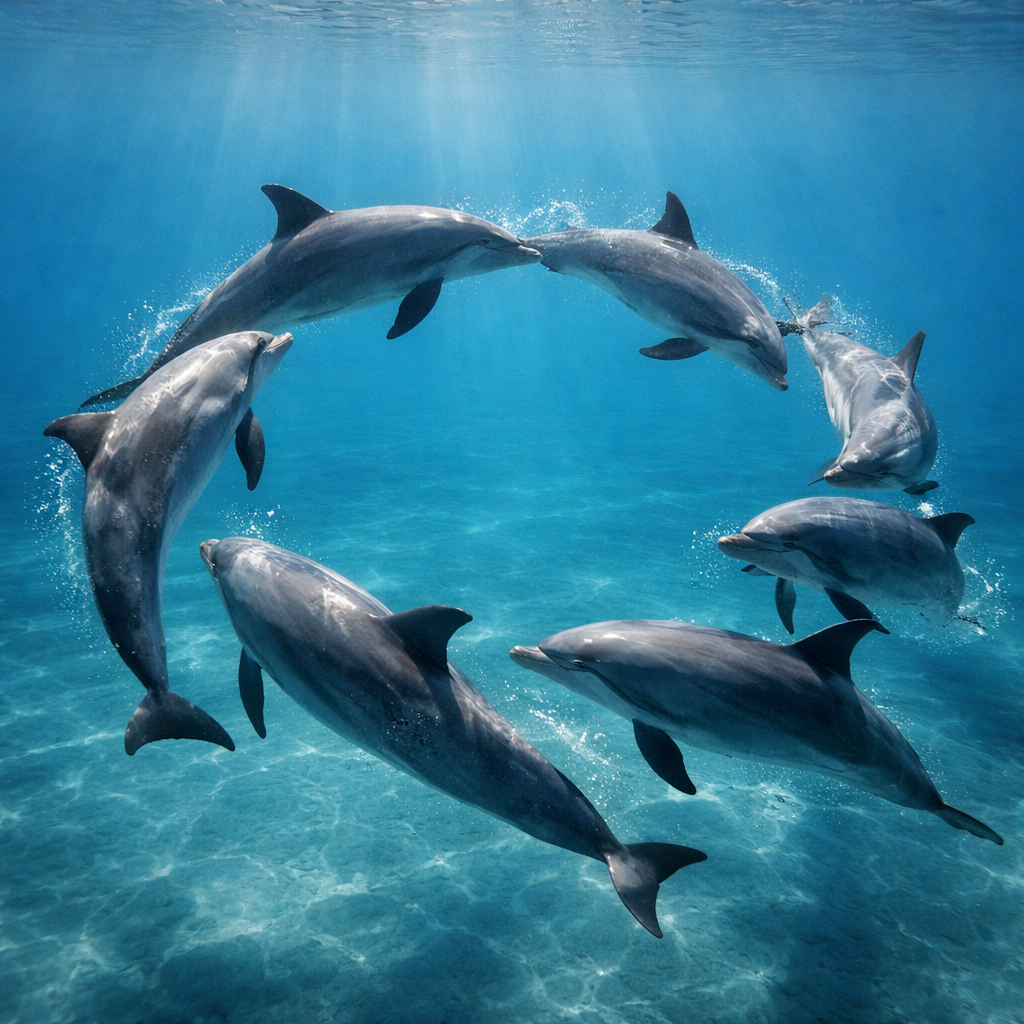
The exact formation dolphins use when protecting a calf or an injured member of their pod.
Todd later said that in that moment, he felt something shift. He described feeling a “barrier” between himself and the area where the shark had been. The dolphins appeared to hold position.
They stayed until he was close enough to shore.
He survived. After more than a hundred stitches and months of recovery.
In interviews afterward, Todd did not romanticize what happened. He didn’t claim the dolphins saved him out of love. He simply said they were there. And without that circle, the outcome might have been very different.
It’s tempting to turn stories like these into metaphors about the pure goodness of nature.
But reality is more complex — and perhaps more powerful.
Dolphins are highly social mammals. They live in structured pods. They cooperate when hunting. They support injured individuals at the surface so they can breathe. They’ve been observed sustaining sick pod members for hours.
Their brains are large and highly developed, especially in regions associated with social and emotional processing. Communication among dolphins is sophisticated. Social learning is critical to their survival.
The “protective circle” behavior was not invented for humans.
It already existed.
What surprises us is that sometimes they extend it beyond their own species.
Science remains cautious. We cannot definitively claim dolphins understood they were “saving” a human. We don’t know whether they perceived the shark as a direct threat to people or whether they were responding to distress, blood, unusual movement, or acoustic signals.
But we know they intervened.
And that the intervention was organized, sustained, and consistent.
Maybe what moves us most isn’t the idea of heroism.
Maybe it’s the fact that, in a moment when a human being was completely vulnerable, another mammal stayed.
Stayed long enough to alter the ending.
Perhaps dolphins don’t save us because they “love” us.
Perhaps they respond to vulnerability with a protective reflex.
And that says something important about attachment and empathy.
For a long time, we told ourselves empathy was uniquely human. That we intervene because we possess moral frameworks, because we understand life and death in abstract terms.
But in the ocean — where humans are not dominant — another species formed a wall.
Not once.
But in multiple cases, across different contexts.
And maybe the lesson isn’t about “animals saving humans.”
Maybe it’s about how some species respond to weakness.
In our world, vulnerability is often exploited.
In the ocean, sometimes vulnerability triggers protection.
And that leaves us with an uncomfortable question:
If a dolphin can respond to vulnerability with presence, why do we sometimes respond with indifference?