
I recently watched a U.S. courtroom show where a judge listens to both sides of a dispute and delivers a decision.
A young couple. Likeable.
He was romantic.
He wanted to surprise his girlfriend with a special evening. He hired a private chef who came to their home, arranged elegant platters, opened Italian wines, and presented a selection of rare cheeses. Perfect atmosphere. Warm lighting. Music. A carefully planned surprise.
Until the story took an unexpected turn.
Shortly after dinner, they said they started feeling sick. They went to the hospital. Then, dramatically, they showed X-rays: inside each of their abdomens — parasites.
Shocking, of course.
But that’s not the real surprise.
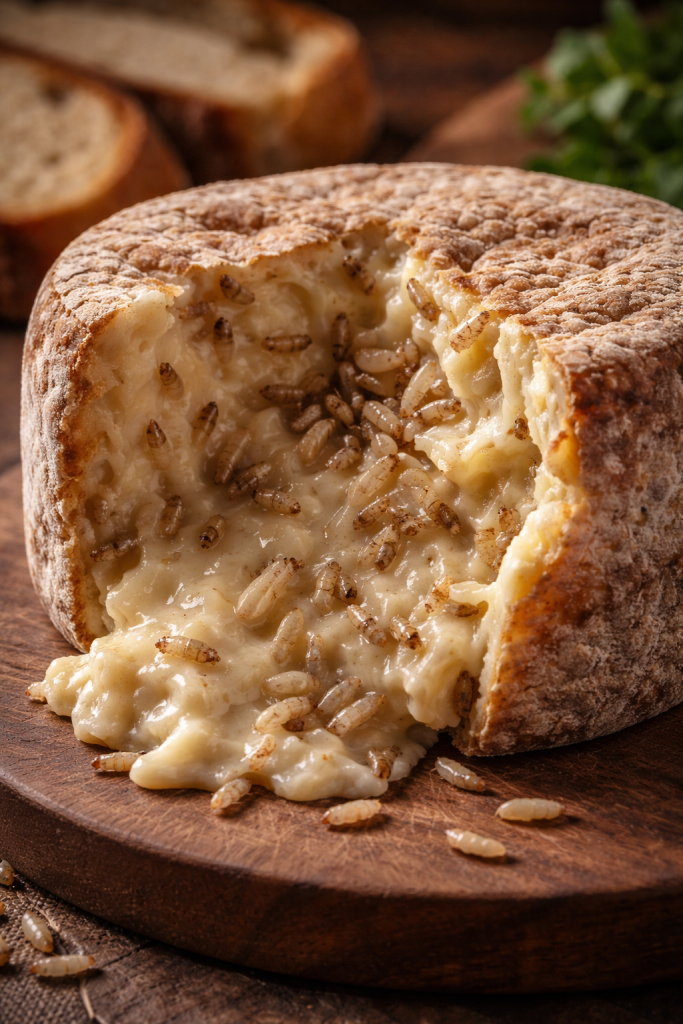
As they told their story, it became clear that the chef had explained exactly what he would be serving. He told them about a rare, controversial cheese — even illegal in many countries. He explained how it was made. The “surprise ingredient” wasn’t hidden.
The larvae were alive.
Visible.
Moving inside the cheese.
They knew.
They were curious.
They wanted the experience.
They tasted it.
The next day they were supposed to leave for a vacation in Italy. They never made it. Instead, they sued the chef for making them sick. And the judge awarded them damages.
That’s where the story becomes truly interesting.
The cheese is real. It’s called Casu Marzu and comes from Sardinia. It starts as pecorino, but the process continues intentionally by allowing flies to lay eggs inside. The larvae break down the fats, turning the cheese into an extremely soft, intense paste. Traditionally, it’s eaten with the live larvae inside.
For locals, it’s an old delicacy — part of cultural identity.
For modern food safety authorities, it’s a high-risk product.
It’s banned in the U.S. and much of Europe for safety reasons. The larvae can survive digestion and cause intestinal infections. The fermentation process is uncontrolled, and the risk of bacterial contamination is real. There are no proven medical benefits. It’s not a superfood or a nutritional recommendation. Essentially, it’s an extreme culinary experience.
Did the chef make a mistake?
Absolutely.
He served an illegal product.
But the real question isn’t about the cheese.
It’s about us.
Because the couple wasn’t tricked.
They didn’t eat it unknowingly.
They saw. They understood. They chose.
And yet, when the consequences appeared, responsibility suddenly moved outward.
Psychologically, this reaction isn’t unusual. People are drawn to extreme experiences — rare tastes, new sensations, “once-in-a-lifetime” moments. The brain loves rarity. It loves the story. In the moment of the experience, risk feels distant and small. When consequences appear, the need to find someone to blame often follows.
But maybe the most interesting part isn’t about that couple.
It’s about how often we do the same thing — on a smaller scale.
We don’t read labels.
Or we skim them.
We don’t care exactly how something is made as long as it looks good and tastes good. We don’t want to see the process — only the result.
Few people know, for example, that some red food colorings are made from insects.
That figs sometimes contain traces of naturally digested insects.
That gelatin comes from bones and skin.
That many fine cheeses are created through fermentation processes that, if examined closely, are far from “sterile.”
None of this is dramatic.
It’s simply the reality of food.
But the line between “acceptable” and “shocking” isn’t always biological.
It’s cultural.
And often deeply psychological.
We choose how much we want to know.
And especially how much we prefer not to know.
If we look closely, the story of cheese and larvae isn’t an isolated case. It’s just an extreme version of a much broader phenomenon: how we react to foods we don’t understand, don’t recognize, or might avoid if we fully analyzed how they’re made.
Around the world, many foods are considered delicacies in one culture and disturbing in another.
Fugu — pufferfish in Japan — contains a deadly neurotoxin. If prepared incorrectly, it can cause paralysis and death. Only specially licensed chefs are allowed to prepare it, and the risk itself has become part of the experience.
Foie gras in France is a refined delicacy for some and a symbol of cruelty for others. The liver of a duck or goose is enlarged through force-feeding, making the debate around it largely ethical rather than medical.
In Iceland, hákarl — fermented shark aged for months — is safe to eat but has an overwhelming ammonia smell that many visitors can barely tolerate. In the Philippines, balut — a fertilized duck egg with a partially developed embryo — is a common street food but shocking to many Westerners.
Shark fin soup is controversial not because of taste or safety, but because of its environmental impact and the brutal way fins are obtained. Horse meat is normal in some European countries and taboo in others. Edible insects are considered the future of sustainable nutrition — yet still trigger strong aversion in many Western cultures.
Even some of the world’s most prized cheeses — with mold, active bacteria, and intense fermentation — would likely have seemed disgusting to many people centuries ago. Today, they’re gourmet.
Very few foods are controversial purely from a biological standpoint.
Most are controversial culturally and psychologically.
The disgust we feel doesn’t always come from real danger. Sometimes it comes from upbringing, habit, and social norms. Sometimes from ethical beliefs. And sometimes it’s simply an instinctive reaction to what feels unfamiliar.
What is considered a delicacy in one country can be unthinkable in another.
What feels normal today was shocking a hundred years ago.
What repels us now may become ordinary in a few decades.
We live in a culture of experiences: new tastes, new places, new sensations.
“You have to try it.”
“At least once.”
“What could happen?”
Curiosity drives many of our choices — and there’s nothing wrong with that.
But there is a delicate moment between curiosity and accountability.
Between “I want to try” and “I accept what comes with it.”
Maybe this story isn’t really about a rare cheese from Sardinia.
Maybe it’s about how we relate to what we consume, to risk, to personal and cultural limits. About how we define “normal” — and how easily we shift responsibility outward when an experience stops being pleasant.
Because in everyday life, not everything that happens to us is unpredictable.
Sometimes we know.
We sense.
We see.
And we still choose.
When consequences appear, the temptation to move responsibility elsewhere is deeply human.
Maybe that’s why this story lingers — not because of the cheese, but because of one simple, uncomfortable question:
How much of what happens to us is actually our choice?
And how much of our disgust is natural… and how much is learned?