
Ask a group of Christians who Veronica was, and the answers may not all be the same. Some will think of the woman who was healed after touching Jesus’ garment. Others will remember the compassionate figure who, according to Christian tradition, offered Jesus a cloth as He carried the cross to Golgotha. Still others may recognize the name of Veronica Giuliani, an Italian mystic who lived many centuries later.
At first glance, these stories appear connected by a single name. In reality, they belong to different periods of Christian history and come from different kinds of sources. Some are rooted in the New Testament, while others emerged through centuries of tradition and devotion.
Understanding these distinctions helps explain why the name Veronica has become one of the most fascinating examples of how biblical history and later Christian tradition can intertwine.
The unnamed woman in the Gospels
One of the most moving healing accounts recorded in the New Testament tells the story of a woman who had suffered from continuous bleeding for twelve years.
Her story appears in the Gospels of Matthew, Mark, and Luke. She had exhausted her savings seeking medical treatment, yet nothing had relieved her condition. Beyond the physical suffering, her illness carried serious social and religious consequences. Jewish purity laws described in Leviticus meant that someone with such a condition lived under ritual restrictions that affected daily life and relationships with others.
When she heard that Jesus was passing through the crowd, she believed that simply touching the edge of His garment would be enough.
She quietly reached out.
Immediately, according to the Gospel accounts, her bleeding stopped.
Jesus then turned and asked who had touched Him. His disciples found the question surprising because many people were surrounding Him. Yet Jesus explained that divine power had gone out from Him.
The woman came forward, confessed what she had done, and heard the words that have echoed through Christian history:
“Daughter, your faith has made you well. Go in peace.”
Despite the richness of the narrative, the Gospel writers never reveal one detail many readers naturally expect.
They never tell us her name.
When tradition filled in the missing details
The anonymity of the woman encouraged later Christian communities to ask who she might have been.
Over time, some early Christian traditions began referring to her as Berenice (also written Bernice), a genuine Greek name commonly used throughout the eastern Roman world.
The existence of the name itself is not surprising. Members of the Herodian royal family also bore the name Berenice, demonstrating that it was well known during the first century.
However, this does not prove that the healed woman actually carried that name. The identification belongs to later tradition rather than the biblical text itself.
An early historical tradition
One of the earliest references comes from the fourth-century church historian Eusebius of Caesarea.
He describes a bronze monument in the city of Paneas (modern-day Banias in northern Israel) that local Christians associated with the woman healed by Jesus. According to his account, the monument also included a figure of Christ, while a remarkable plant growing nearby was believed to possess healing properties.
Modern historians cannot verify whether the monument truly commemorated the Gospel miracle. Nevertheless, Eusebius’ account demonstrates that devotion connected with the woman had already developed within early Christian communities.
How Berenice became Veronica
The transition from Berenice to Veronica remains the subject of scholarly discussion.
Some linguists believe Veronica developed as a Latin adaptation of the Greek name Berenice.
Others point to the Latin phrase vera icon, meaning “true image.” This expression became closely connected with another well-known Christian tradition involving a woman who compassionately offered Jesus a cloth during His journey to the crucifixion.
Many scholars believe both linguistic development and devotional tradition contributed to the widespread use of the name Veronica in medieval Europe.
Veronica and the veil
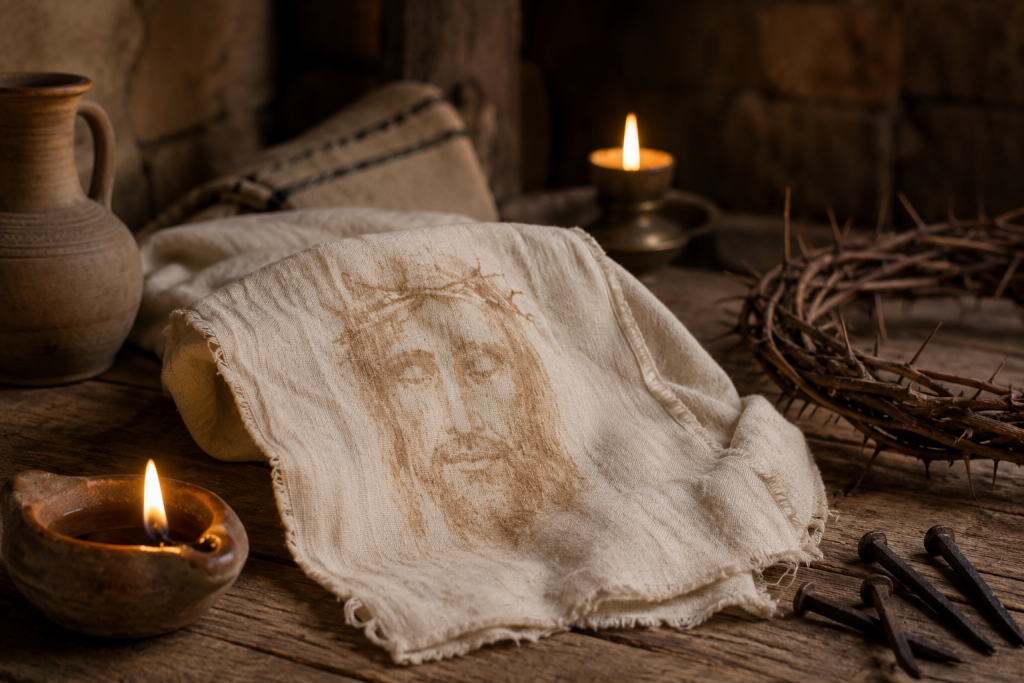
Unlike the woman healed by touching Jesus’ garment, the story of Veronica offering Christ a veil does not appear anywhere in the four canonical Gospels.
Instead, it belongs to later Christian devotion, particularly the medieval tradition of the Stations of the Cross.
According to this tradition, Veronica wiped Jesus’ face as He carried the cross toward Calvary. When He returned the cloth, His image had miraculously appeared upon it.
Although deeply respected in Christian spirituality, this account should not be confused with the biblical narratives. It represents a cherished tradition rather than an event recorded in Scripture.
As centuries passed, many people naturally assumed that the compassionate woman with the veil and the woman healed of her illness were the same individual, even though historical evidence does not support that conclusion.
Veronica in Eastern Christian tradition
An interesting distinction appears within Eastern Christianity.
In Orthodox tradition, the woman healed after touching Christ’s garment is honored as Saint Veronica (Bernice) in certain synaxaria and liturgical traditions. Her commemoration reflects the long-standing tradition that sought to identify the anonymous woman from the Gospel accounts.
This should not be confused with the Western devotional figure associated with the veil, whose story developed independently within medieval Christian spirituality.
Recognizing this distinction helps explain why Christians from different traditions sometimes use the same name while referring to different historical or devotional figures.
Veronica Giuliani: a different Veronica altogether
More than sixteen centuries after the events described in the Gospels, another woman named Veronica became widely known throughout the Christian world.
Veronica Giuliani was born in Italy in 1660 and entered the Order of the Capuchin Poor Clares. She became renowned for her mystical experiences, her extensive spiritual diary, and reports that she bore the stigmata associated with Christ’s Passion.
She died in 1727 and was later canonized by the Catholic Church.
Apart from sharing the same name, Veronica Giuliani has no historical connection with either the anonymous woman from the Gospels or the medieval figure of Veronica with the veil.
Why the confusion persists
The confusion surrounding Veronica is understandable.
The Bible tells the story of a remarkable healing but leaves the woman unnamed.
Later Christian tradition introduced the name Berenice, which gradually evolved into Veronica in parts of the Christian world.
At the same time, medieval devotion popularized the story of Veronica’s veil, while centuries later Saint Veronica Giuliani became one of Catholicism’s best-known mystics.
As these traditions developed alongside one another, they naturally became intertwined in popular memory.
Looking beyond the name
Perhaps the most remarkable detail is not what the woman was called, but why the Gospel writers never chose to record her name at all.
Their focus was not on preserving her personal identity but on preserving her testimony of faith.
For nearly two thousand years, countless believers have remembered the moment she reached through a crowd to touch Christ’s garment. Her act of trust has endured across generations, even while her historical identity remains uncertain.
In many ways, that may be the deepest message of her story. The Gospels invite readers to remember not the name of the woman, but the faith that transformed her life.