
Many gardening videos online show people snapping off a thick stem growing from the middle of an onion plant. Some viewers believe they are cutting normal leaves. Others think the plant is being damaged on purpose.
In reality, two completely different gardening practices are often mixed together online, even though they happen at different stages of the onion’s life.
One involves removing the flowering stem that eventually produces seeds. The other involves bending the green leaves of mature onions near harvest time. Understanding the difference makes onion growing much easier and explains why gardeners sometimes argue over what is “right.”
Green Onions and Dry Bulb Onions Are Often the Same Plant
One of the biggest sources of confusion is the idea that green onions and regular cooking onions are separate vegetables.
Most of the time, they are simply the same species harvested at different stages.
A young onion pulled early from the soil is what most people call a green onion or spring onion. The white base is still small, the leaves are soft, and the plant has not fully matured.
If that same onion remains in the ground longer, the lower portion gradually swells into the layered bulb people recognize as white, yellow, or red storage onions.
Some varieties are specifically bred for green onion production, while others are designed for large bulbs and long-term storage, but biologically they belong to the same onion family.
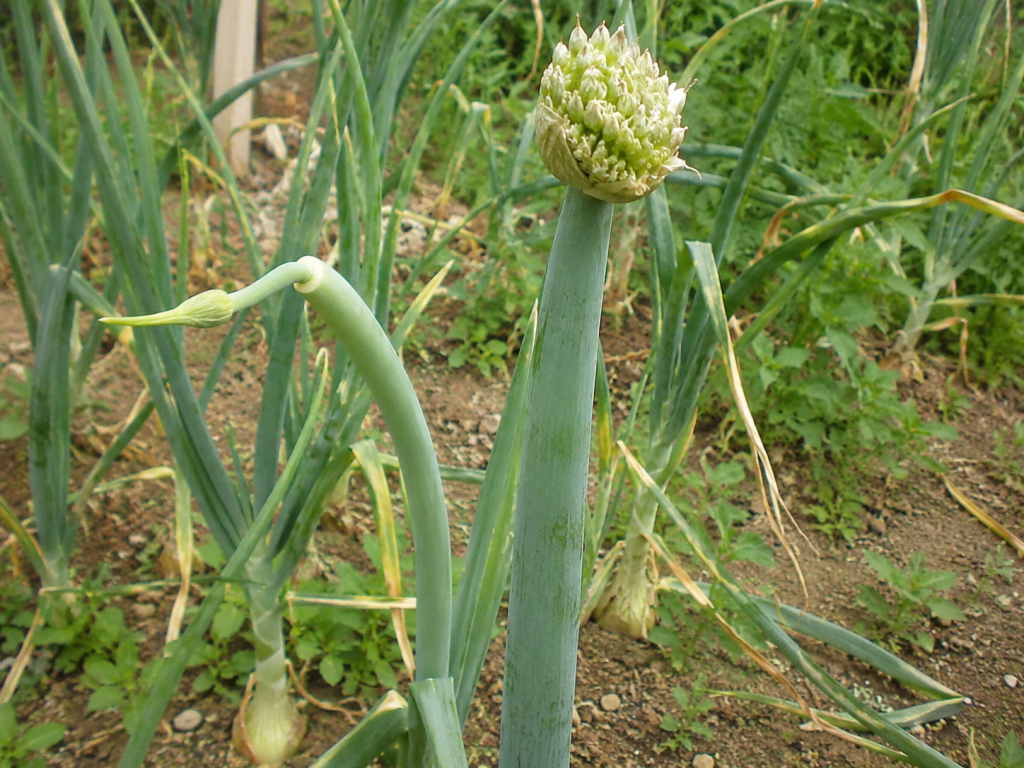
The Thick Stem With Seeds Is Not a Normal Leaf
The part many gardeners remove is not an ordinary green onion leaf.
It is the flower stalk, often called the seed stem in everyday language. Gardeners also describe it as the onion “going to seed.”
Unlike the soft tubular leaves, this stem is:
- thicker;
- firmer;
- more upright;
- hollow but rigid;
- topped with a round flower head that later develops seeds.
In horticulture, this process is called bolting. Universities and agricultural extensions describe bolting as premature flowering, usually triggered by environmental stress such as temperature swings or exposure to cold weather.
Why Onions Produce Flower Stalks
Onions naturally follow a two-stage life cycle.
During the first stage, the plant focuses on producing leaves and storing energy inside the bulb. During the second stage, the onion attempts to reproduce by creating flowers and seeds.
Under normal conditions, flowering would happen later in the plant’s life. However, stress can confuse the onion into believing it has already passed through winter and should begin reproduction early.
Several conditions can trigger this:
- sudden temperature changes;
- unusually cold periods;
- drought stress;
- inconsistent watering;
- transplant shock;
- planting too early in cold soil.
Once flowering begins, the onion redirects part of its energy away from bulb development and toward seed production.
Why Gardeners Remove the Seed Stem
If the goal is to harvest seeds, the flower stalk is useful.
But most home gardeners want edible onions with healthy bulbs, not seeds. That is why many people remove the flowering stem as soon as they notice it.
The reason is simple: once the onion focuses on flowering, bulb quality often declines.
Agricultural sources explain that onions that bolt early may produce:
- smaller bulbs;
- hollow centers;
- tougher texture;
- reduced storage life.
Removing the flower stalk does not completely reverse the process, but it may reduce how much additional energy the plant spends on seed production.
When Should the Flower Stem Be Removed?
Gardeners usually remove the flowering stem as early as possible after it appears.
The earlier it is removed, the less energy the onion wastes producing flowers and seeds.
This is especially important if the onion is being grown for eating rather than seed saving.
However, onions that already started bolting are generally best used sooner rather than stored for months. Even if the stem is removed, the bulb often does not keep as well as onions that never flowered.
What Happens If You Want Green Onions?
If the goal is fresh green onions, the plant is harvested young before large bulbs fully develop.
At this stage:
- leaves remain soft and tender;
- the white base is still small;
- storage is not the priority.
Ideally, green onions are harvested before any flower stem appears.
If a flowering stem begins forming, the plant can still be eaten, but the texture may become tougher and the flavor sharper over time.
Because green onions are usually consumed quickly, long-term storage quality matters far less.
What Happens If You Want Large White or Yellow Bulbs?
Growing onions for storage is very different from growing green onions.
For mature bulb onions, the green leaves are extremely important because they continue feeding the bulb through photosynthesis.
This is why modern horticulture generally advises against removing healthy leaves too early. Damaging the foliage prematurely may reduce the onion’s final size because the plant loses part of its energy-producing system.
As onions approach maturity naturally:
- the neck softens;
- leaves begin falling over on their own;
- outer layers dry into papery skin;
- the bulb prepares for dormancy and storage.
Many gardeners wait until a significant portion of the tops have naturally bent before harvesting the crop.
Are Gardeners Supposed to Bend All the Leaves?
This is the second practice that often gets confused with removing the seed stem.
Some traditional growers intentionally bend all the green tops near harvest time to encourage faster drying and maturation.
Others prefer allowing the process to happen naturally.
Modern agricultural recommendations tend to be more cautious because healthy leaves still help feed the bulb until maturity is nearly complete.
The important detail is that bending all the leaves is not the same thing as removing the flower stalk. These are two separate actions with different purposes.
Why Flowering Onions Do Not Store Well
Once an onion sends up a flower stalk, the structure grows through the center of the bulb itself.
Even after the stalk is removed, the bulb may remain more vulnerable to:
- softening;
- splitting;
- internal hollow spaces;
- fungal decay during storage.
Agricultural extensions often recommend eating bolted onions first because their shelf life is usually shorter than properly matured storage onions.
What Happens After Harvest
Storage onions are not fully finished the moment they are pulled from the ground.
After harvest, they go through a drying process commonly called curing.
During curing:
- outer skins dry completely;
- the neck seals shut;
- moisture levels decrease;
- the bulb becomes more resistant to rot.
Experts warn that cutting onions while the neck tissue is still green and moist may increase the risk of neck rot and fungal infection during storage.
The Simple Way to Understand the Difference
If the onion has one thick upright stem with a flower or seed head at the top, that is the flowering stem. Many gardeners remove it because they want better edible onions rather than seeds.
If the onion simply has normal green leaves, those leaves are feeding the bulb and usually should not be damaged too early.
If the goal is green onions, the plant is harvested young and tender.
If the goal is large storage onions, the plant is left to mature naturally until the tops begin falling over on their own.
These two situations are often mixed together online, which is why so many gardening videos create confusion even among experienced growers.