
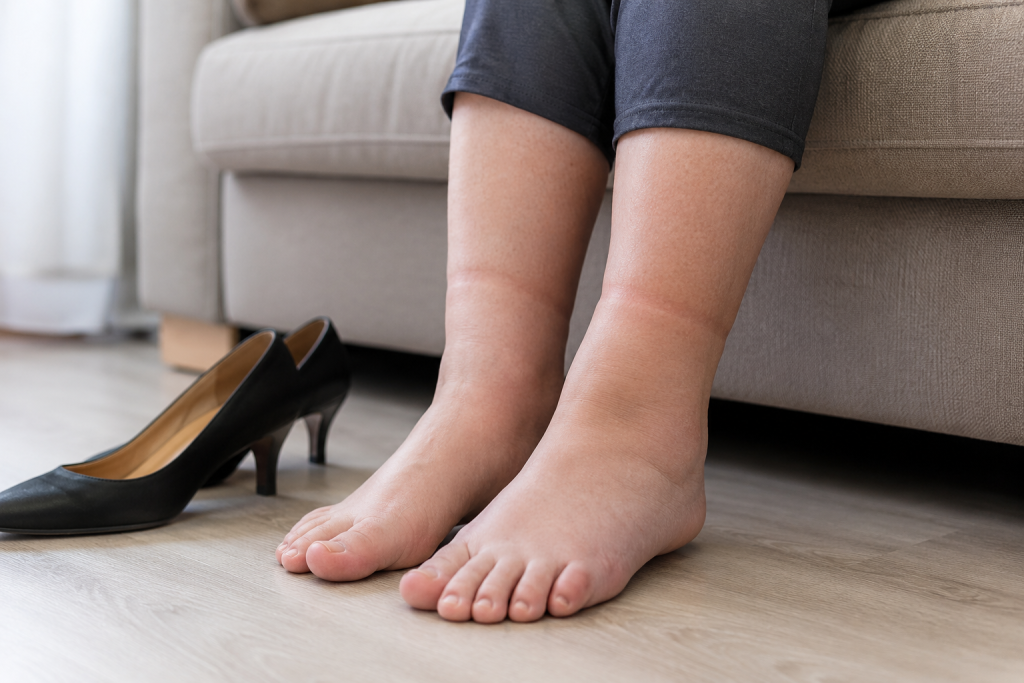
It often starts with something you notice almost by accident. At the end of a long workday, you take off your shoes and realize your ankles don’t look quite the way they did that morning. Your socks have left deeper marks than usual, and shoes that felt comfortable a few hours ago suddenly seem tighter.
It’s easy to wonder if something is wrong.
The reassuring news is that, in many cases, the explanation is surprisingly simple.
Our bodies were never designed to stay still for hours
Modern life keeps many of us behind a desk for most of the day, but our circulatory system works best when we’re moving.
Every time you walk, the muscles in your calves contract and help push blood back toward your heart. This natural process keeps circulation flowing efficiently. When you spend several hours sitting without much movement, those muscles remain largely inactive.
At the same time, gravity begins to do its job. Fluid can slowly collect in the tissues around your ankles and feet, making them appear slightly swollen by the evening.
For many healthy people, this is a normal response to prolonged sitting rather than a sign of illness.
Why do your ankles usually look normal in the morning?
During sleep, your body is in a horizontal position, so gravity no longer pulls fluid toward your feet in the same way it does while you’re standing or sitting.
That’s why many people wake up with ankles that look perfectly normal, only to notice mild swelling later in the day after hours spent at work.
Warm weather can make the problem even more noticeable because higher temperatures cause blood vessels to expand, allowing more fluid to move into nearby tissues.
Small changes can make a surprisingly big difference
You don’t need an intense workout to help your circulation.
Simply standing up once every hour, walking for a few minutes, climbing a flight of stairs, or stretching your ankles can reactivate the calf muscles that assist blood flow.
A 20- to 30-minute walk after work is often enough to ease that heavy, tired feeling many people experience in their legs. Elevating your feet for a short time once you’re home may also help reduce the fluid that has accumulated throughout the day.
These simple habits may seem minor, but over time they can noticeably improve comfort, especially if your job requires long hours at a desk.
When swelling shouldn’t be ignored
Although mild swelling after prolonged sitting is common, there are situations where it’s worth seeking medical advice.
Contact a healthcare professional if you notice that:
- only one leg becomes swollen;
- the swelling is accompanied by pain, redness, or warmth;
- it doesn’t improve after a night’s sleep;
- it continues for days or becomes progressively worse;
- you also experience shortness of breath, chest pain, or unusual fatigue.
These symptoms may point to conditions that require prompt medical evaluation.
Swollen feet don’t always mean you’re “retaining water”
People often describe swollen feet as simply “water retention,” but the reality is more complex.
Prolonged sitting is only one possible cause. Swelling may also be linked to chronic venous insufficiency, pregnancy, certain medications, or medical conditions affecting the heart, kidneys, or liver.
Paying attention to when the swelling appears, whether it affects one or both legs, and whether it improves overnight can provide valuable information for your healthcare provider.
Sometimes your body is simply asking you to move
Our bodies have subtle ways of letting us know when something needs attention. Mild swelling after a day spent sitting may be nothing more than a reminder that we’ve been inactive for too long.
Taking regular movement breaks, walking more throughout the day, and avoiding sitting for hours without getting up can often make a noticeable difference.
If the swelling disappears after rest and returns only after prolonged sitting, it’s usually not a cause for alarm. But if it becomes persistent, more severe, or is accompanied by other symptoms, it’s important not to ignore it.
Listening to these small signals today may help prevent bigger problems tomorrow.