
If you listen carefully to people who have been in long-term relationships, you start to notice something interesting. Almost everyone has an opinion about why sex tends to fade over time, yet very few of those explanations fully align. Some insist that it’s simply a natural part of being together for years, while others see it as a warning sign that something deeper is wrong. But when you start paying attention to what people say when they’re being honest — not polite, not careful, just honest — a more complex and far less comfortable picture begins to emerge.
The truth is that intimacy rarely disappears overnight. It doesn’t suddenly switch off without warning. Instead, it fades gradually, almost imperceptibly at first, as small things begin to accumulate. A gesture that goes unnoticed, a conversation that never quite gets resolved, a growing sense of exhaustion that leaves little room for emotional connection. Over time, life becomes heavier, filled with responsibilities, stress, work, children, financial pressure, and mental overload. Without realizing it, intimacy slowly shifts from something natural and desired into something that feels like effort.
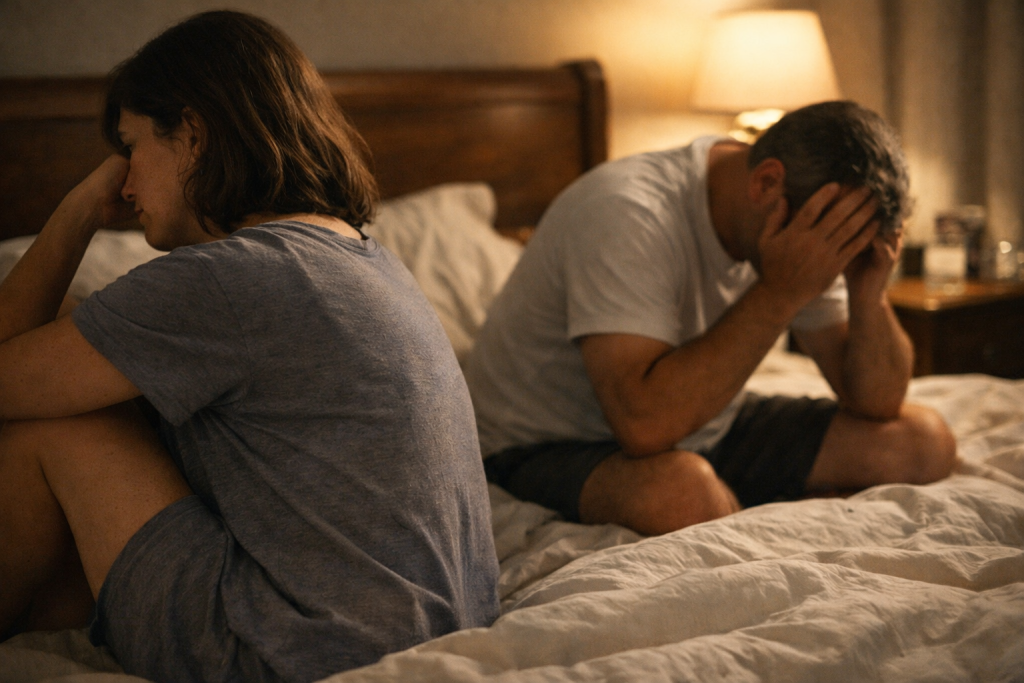
And if you listen closely to how people describe this stage, the honesty can be surprisingly blunt.
Some admit that by the end of the day, they feel so drained that even the idea of physical closeness feels overwhelming, not because they don’t care, but because they have nothing left to give. Others talk about how their partner started to feel less like a lover and more like someone they share responsibilities with — a teammate in logistics, not in intimacy. There are those who quietly acknowledge that they began avoiding affection altogether, because it felt like it might lead to expectations they didn’t have the energy to meet.
One of the most common threads in these stories is not a dramatic betrayal or a single defining moment, but something much quieter: resentment. It builds in subtle ways, often rooted in everyday experiences where one partner feels unseen, unheard, or unappreciated. It may come from carrying more responsibility, from feeling emotionally neglected, or from a persistent imbalance in effort. As this resentment grows, it doesn’t just affect communication or mood — it quietly erodes desire, because attraction struggles to survive in an environment where connection feels strained.
In more candid moments, people admit things they rarely say out loud. They talk about how difficult it is to feel attracted to someone they are constantly frustrated with, even if they still love them. They describe the slow shift from admiration to irritation, from wanting closeness to wanting space. Not because something dramatic happened, but because too many small things were left unresolved for too long.
At the same time, comfort begins to take the place of intention. In the early stages of a relationship, people naturally invest energy into each other. There is effort, curiosity, playfulness, and a desire to impress. But as time passes, many couples settle into routines, assuming that the relationship will sustain itself without the same level of attention. Life becomes louder than romance, and without even noticing, they stop doing the very things that once created attraction.
Some people admit that they no longer feel “seen” in the same way, that the version of themselves that once felt interesting or desired slowly disappeared in the routine of everyday life. Others confess that they stopped trying too, not out of indifference, but because it felt like the effort was no longer reciprocated.
This is why the absence of sex is rarely the core issue. More often, it is a symptom of something deeper — emotional distance, accumulated stress, unresolved tension, or a lack of balance in the relationship. Many people describe a similar pattern: when the relationship feels light, safe, and connected, intimacy tends to happen naturally. When it feels heavy or strained, desire tends to fade.
There is also a truth that people hesitate to say directly: you can love someone and still not feel attracted to them in the same way anymore. Not because they changed drastically, but because the dynamic between you changed. Because the emotional context that once made attraction easy is no longer there.
It’s also important to understand that for many people, intimacy is not just about physical release. It carries emotional meaning — it reflects feeling desired, chosen, close, and connected to a partner. That is why it cannot simply be replaced by something solitary, because what is missing is not just the physical aspect, but the sense of connection that comes with it.
At the same time, there are very real and often unavoidable factors that influence desire. Raising children, especially in the early years, can leave people physically and emotionally exhausted. Sleep deprivation, health issues, hormonal changes, medication, and mental health struggles all play a role. In many cases, it’s not about a lack of love or attraction, but simply about having no energy left to give.
And yet, when you look at couples who manage to maintain their connection over time, one pattern stands out. They do not rely on chemistry alone, nor do they assume that closeness will sustain itself. Instead, they remain intentional. They continue to invest in each other, to communicate, to show affection, to create moments of connection even when life is demanding. Not because it comes easily, but because they understand that without effort, that part of the relationship can quietly disappear.
Which leads to a question that many people quietly avoid:
If intimacy fades slowly, through neglect, imbalance, and emotional distance…
at what point does it stop being “just how relationships are” and start being something we’ve simply accepted?
So is it inevitable that sex fades in marriage? Not necessarily. But it is very common. Not because people stop loving each other, but because the conditions that support intimacy are no longer actively maintained.
Perhaps the most uncomfortable truth is this: marriage itself does not destroy attraction. What erodes it is neglect, unresolved resentment, emotional distance, and sometimes simply the weight of everyday life that slowly pulls partners away from each other without them even realizing it.
And maybe the hardest part to admit is not that it happens — but how many people recognize it… and say nothing.