
If certain images make you uncomfortable instantly, you’re not imagining it
You might have experienced it without ever being able to explain it properly. You come across an image that looks harmless at first — a honeycomb, a plant, a clustered surface — and suddenly something feels off. It’s not exactly fear, and not quite disgust either, but a strange, immediate discomfort that makes you want to look away.
This reaction is more common than most people realize, and it even has a name: trypophobia. It isn’t always classified as a formal phobia, but it has been studied enough to be considered a real and consistent human response, not just a random quirk.

What these images have in common
Not every repetitive pattern triggers this feeling. The reaction tends to appear in response to a very specific visual structure: clusters of small holes, tightly packed together, often irregular and high in contrast.
On paper, that doesn’t sound threatening. But the moment you see it, the reaction can appear instantly. What’s important here is that the discomfort doesn’t come from what you know about the image, but from how your brain processes it visually. Even when you’re fully aware there’s no danger, your body may respond before logic has a chance to step in.
What’s happening inside the brain
Researchers believe this reaction may be linked to how the human brain evolved to detect potential threats quickly. Throughout history, recognizing signs of danger — such as disease, parasites, or venomous animals — was essential for survival. Some of those warning signs shared visual patterns that are surprisingly similar to what triggers trypophobia today.
In other words, your brain may not be reacting to “holes” as such, but to something that subtly resembles a biological warning signal. It’s not a conscious decision. It’s an automatic response designed to protect you.
There is also a visual-processing explanation. Certain studies suggest that trypophobic images contain spatial patterns and contrast distributions that put strain on the visual system. The brain has to work harder to process them, and that effort may translate into a feeling of discomfort or unease.
Why the reaction can feel so intense
For some people, the reaction is mild and passes quickly. For others, it can be strong enough to cause physical sensations such as nausea, goosebumps, or a sudden urge to avoid the image altogether. This variation depends on individual sensitivity and context.
What’s important is that the reaction happens even when the person knows the image is harmless. That’s what makes it feel so involuntary and sometimes frustrating. You can understand there is no threat, and still feel the need to look away.
Why it’s not “just in your head”
People often dismiss this kind of reaction, especially if they don’t experience it themselves. But for those who do, the response is very real and can be physical.
Trypophobia is a clear example of the gap between rational thinking and automatic response. Your mind may interpret the image as safe, but your body reacts as if something is wrong.
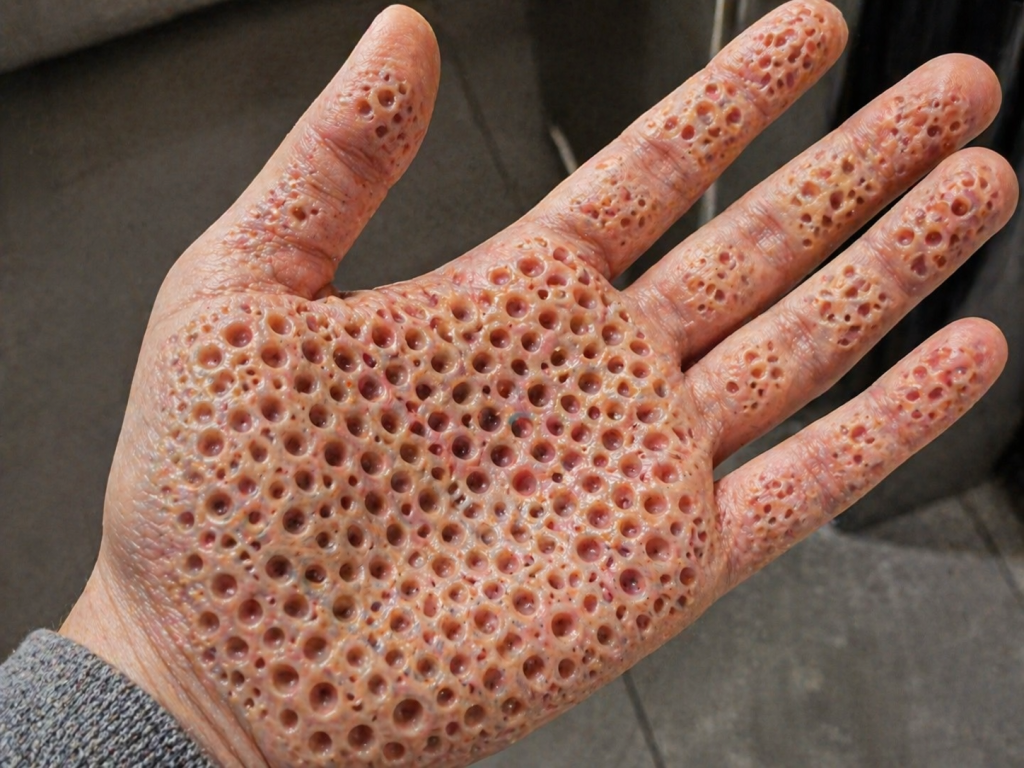
The detail that changes how you see it
What makes this phenomenon so interesting is that it isn’t a flaw, but rather a protective mechanism that sometimes overshoots. It reflects a system designed to notice potential danger quickly, even when that danger is only suggested, not real.
What feels like an irrational reaction is, in many ways, evidence of a highly sensitive detection system at work. It doesn’t always get it right, but it is constantly trying to keep you safe.
And the next time an ordinary-looking image gives you that strange, hard-to-explain feeling, it might be worth seeing it differently. Not as a weakness, but as a signal — one that reveals just how finely tuned the human brain really is.