
In the winter of 1956, an extraordinary story began circulating through the Soviet Union. It spoke of a young woman who allegedly became frozen in place after mocking a sacred icon during a New Year gathering. According to the tale, she remained standing for 128 days before finally recovering on Easter.
For many believers, the event became a powerful testimony of divine intervention. Historians, however, see it as a fascinating blend of documented events, eyewitness accounts, oral tradition, and folklore that evolved over decades.
Nearly seventy years later, the story of “Zoya’s Standing” continues to spark debate. What actually happened, and how much of the famous account can be verified?
A Story Born During an Era of State Atheism
To understand why this incident attracted so much attention, it’s important to consider the historical setting.
The Soviet Union of the mid-1950s officially promoted atheism. Although the harshest religious persecutions of Stalin’s era had eased, churches were still tightly controlled, and public expressions of faith were discouraged. Religion was often portrayed as an outdated belief incompatible with a modern socialist society.
Yet beneath the surface, religious traditions remained deeply rooted in many families. Icons still hung quietly in homes, and major Christian holidays continued to be observed, often away from public attention.
In that atmosphere, even a rumor involving a possible miracle had the potential to spread with remarkable speed.
The Party That Became a Legend
The best-known version of the story begins during a holiday celebration in Kuibyshev, now known as Samara.
A young woman named Zoya was reportedly waiting for her fiancé, Nikolai, who never arrived. Frustrated, she is said to have taken an icon of Saint Nicholas from the wall and declared that if her Nikolai would not dance with her, she would dance with “this Nicholas” instead.
Some versions add that she challenged God by saying that if He truly existed, He should punish her.
According to the legend, a sudden flash of light filled the room, followed by a loud crash. At that moment, Zoya allegedly became completely motionless, still clutching the icon in her hands.
The guests reportedly fled in fear, believing they had witnessed something supernatural.
No contemporary records, however, confirm that these events unfolded exactly as later versions describe.
What the Historical Record Confirms
While the miraculous elements remain impossible to verify, historians agree on one important point: an unusual public incident did occur.
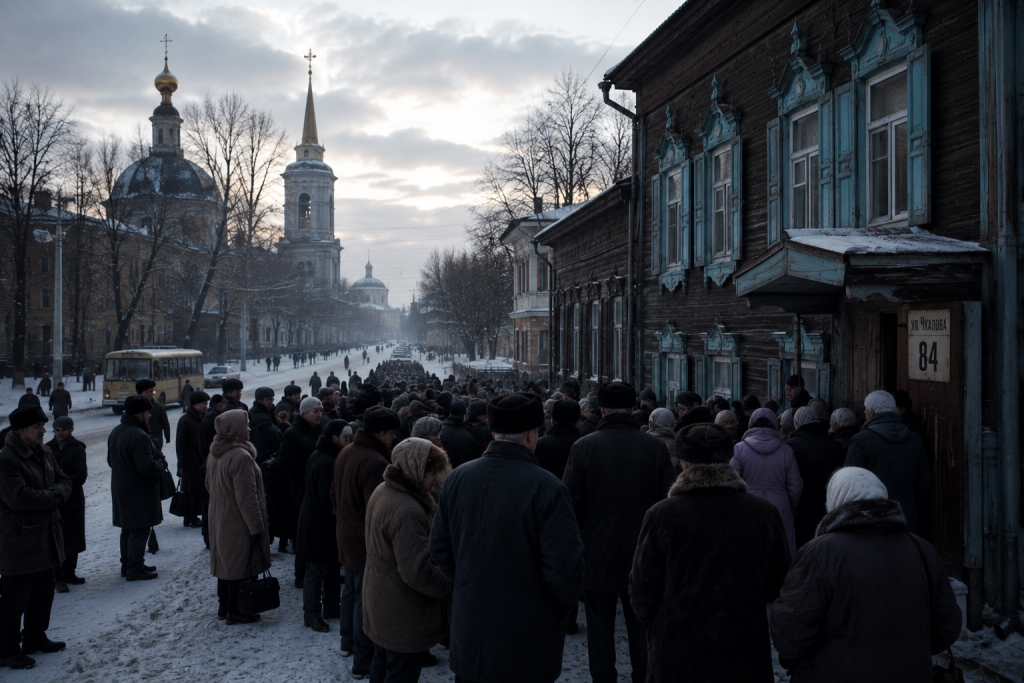
Communist Party documents from early 1956 reveal that large crowds gathered outside a private residence in Kuibyshev after rumors spread that something extraordinary had happened inside. Police were deployed to manage the growing number of curious visitors, and local officials discussed the challenge of suppressing what they described as dangerous religious superstition.
These records demonstrate that the social phenomenon was real.
They do not, however, confirm the miraculous details that later became central to the story.
The Famous 128 Days
The most dramatic part of the legend claims that Zoya remained standing for 128 consecutive days.
According to later accounts, she was alive but could not move. Witnesses allegedly said that doctors were unable to bend her limbs and even claimed that medical needles broke when attempts were made to inject her.
The story goes further, suggesting that she survived the entire period without food or water.
These are also the claims that historians find most difficult to support.
No hospital records, medical reports, or contemporary documentation have ever been found to verify these extraordinary details.
Could Medicine Explain the Story?
From a modern medical perspective, surviving more than four months without water is impossible.
Several specialists have suggested that if an actual patient inspired the legend, conditions such as catatonia or severe neurological disorders might explain prolonged immobility. Others have proposed that psychological illness or extreme muscle rigidity could account for some aspects of the story.
Yet none of these hypotheses fully matches the popular version of events.
Because no original medical documentation has survived, any diagnosis remains speculative.
Who Was Zoya?
Surprisingly, even the identity of the central figure remains uncertain.
Different sources provide different surnames, while others identify her only as “Zoya.” Accounts of her life after the alleged miracle vary just as widely.
Some narratives claim she died shortly after Easter.
Others suggest she entered religious life.
Still others insist she lived quietly for many years afterward.
Without reliable historical records, none of these versions can be confirmed.
The Mysterious Visitor
One of the legend’s most memorable episodes involves an elderly stranger who reportedly visited the house shortly before Easter.
According to the traditional account, he was initially turned away several times before finally being allowed inside.
He is said to have looked at Zoya and quietly asked, “Are you tired of standing yet?”
Soon afterward, he disappeared without explanation.
Many believers later identified the mysterious visitor as Saint Nicholas himself.
Historians note, however, that this episode appears mainly in later retellings and is absent from the earliest known accounts.
Easter Morning
The legend concludes with Zoya regaining movement during the Easter celebration.
Some versions say that her first words urged those around her to pray and repent.
What happened afterward depends entirely on which version is told.
One account says she died soon after.
Another claims she devoted the rest of her life to faith.
Others suggest she simply disappeared from public attention.
The conflicting endings illustrate how the story changed as it passed from one generation to another.
How Researchers View the Case
Russian folklorists who have studied the legend point out that its structure closely resembles much older religious narratives found throughout Eastern Europe.
Many traditional stories describe someone showing disrespect toward a sacred object, suffering an immediate supernatural punishment, and eventually experiencing repentance or spiritual transformation.
Researchers believe that the Zoya story likely developed in a similar way, gradually expanding through oral tradition while incorporating increasingly miraculous details over time.
This process is common in folklore, where historical events often become intertwined with symbolic storytelling.
Why the Story Was Never Officially Declared a Miracle
Many people assume that the Russian Orthodox Church officially recognizes Zoya’s Standing as a confirmed miracle.
In reality, that is not the case.
Although many priests and believers personally accept the story and regard it as an example of divine intervention, the Church has never formally authenticated the event through an official declaration.
Such caution is understandable. Religious institutions typically require extensive evidence before recognizing a miracle, and the available documentation surrounding this case remains too limited for definitive conclusions.
From Local Rumor to International Legend
After the collapse of the Soviet Union, public interest in the story grew dramatically.
Books, documentaries, and newspaper articles revisited the mystery, while the 2009 Russian film The Miracle (Чудо) introduced the legend to an even wider audience. Although inspired by the famous account, the film is a dramatization rather than a documentary reconstruction.
Today, the internet has carried the story far beyond Russia, often presenting legendary elements as established historical facts without distinguishing between documented evidence and later tradition.
Where History Meets Faith
Perhaps the lasting appeal of Zoya’s Standing lies in the way it exists between two very different worlds.
For historians, it represents an intriguing example of how rumors, memory, and folklore can shape public perception over time.
For believers, it remains a powerful reminder of faith, repentance, and the sacred.
These perspectives do not necessarily cancel each other out. History seeks evidence, while faith often rests on personal conviction rather than documentary proof.
Conclusion
The story of Zoya’s Standing remains one of the Soviet era’s most compelling religious mysteries.
Historical records clearly show that unusual events in Kuibyshev drew large crowds and attracted the attention of Soviet authorities in early 1956. That part of the story is well supported by documentary evidence.
The extraordinary claims—that a young woman stood motionless for 128 days, survived without food or water, or encountered Saint Nicholas himself—cannot be independently verified and remain matters of belief rather than established historical fact.
Whether viewed as a miracle, a symbolic legend, or a remarkable chapter in Soviet social history, Zoya’s Standing continues to captivate people because it sits at the crossroads of faith, history, and human curiosity. Even after decades of investigation and debate, it remains a story that invites readers to consider not only what may have happened, but also why certain stories continue to endure long after the events themselves have faded into history.