
There’s a moment most people hesitate to talk about, but almost everyone has experienced.
You notice a single strand that wasn’t there before.
Thicker than the rest.
Darker.
Growing in a place that used to be smooth.
Maybe on your chin.
Maybe above your lip.
Maybe in your eyebrows, ears, or nose.
And sometimes, it shows up earlier than you’d expect — even in childhood, when it feels like it shouldn’t be happening at all.
The first reaction is almost always the same:
“Where did that come from?”
It feels sudden.
But it isn’t.
That hair didn’t appear out of nowhere.
It was already there — your body just hadn’t activated it yet.
Your Skin Has More Hair Follicles Than You Think — Most of Them Are Just Quiet
Human skin is covered with hair follicles. The difference isn’t whether they exist, but what kind of hair they produce.
There are two main types:
– vellus hair — fine, soft, and often barely visible
– terminal hair — thicker, darker, and more noticeable
In many areas of the body, follicles stay in that “quiet” vellus state.
But under certain conditions, they can shift.
And when they do, the same follicle can start producing a completely different kind of hair.
Hormones: The Invisible Switch
The main drivers behind this change are hormones called androgens — including testosterone and dihydrotestosterone (DHT).
Important detail:
These are not “male-only” hormones.
Women produce them too — just in smaller amounts.
Androgens don’t create new follicles.
They change how existing ones behave.
They can turn fine, barely visible hair into thicker, pigmented strands.
Sometimes, it doesn’t take much — especially if your follicles are more sensitive to them.
In Women: Facial Hair and What It Can Mean
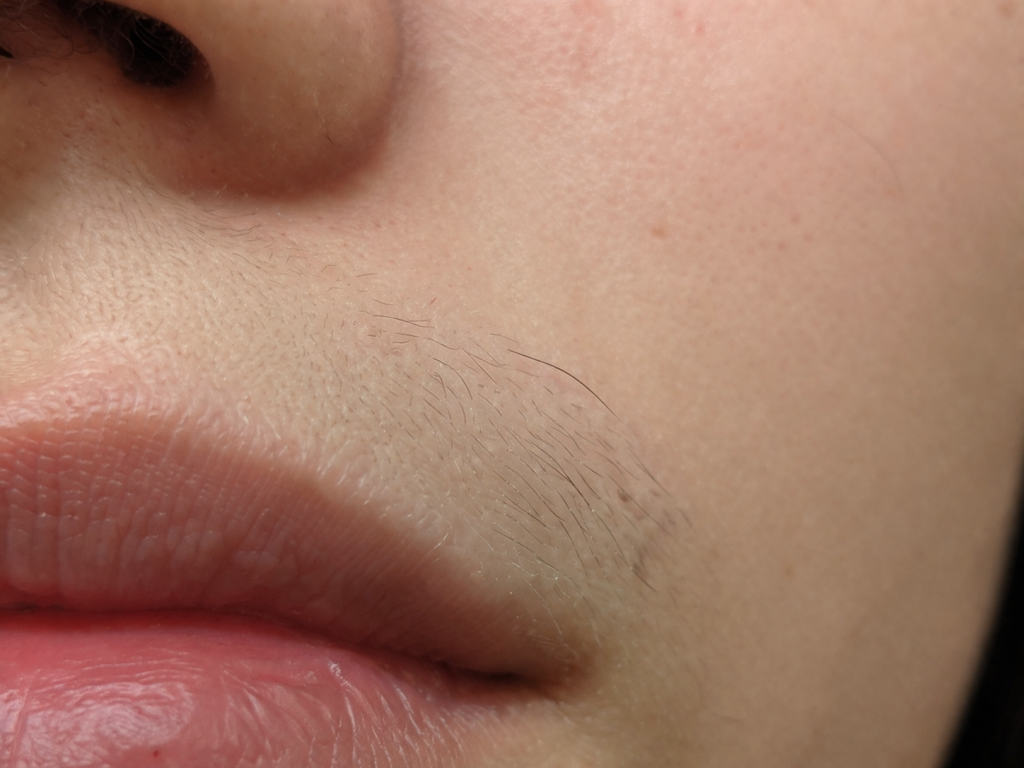
For many women, noticing hair growth on the face — especially the upper lip, chin, or jawline — can feel unsettling.
Medically, this pattern is called hirsutism.
There are several possible reasons:
– increased sensitivity of hair follicles to androgens
– natural hormonal shifts (puberty, pregnancy, menopause)
– conditions like polycystic ovary syndrome (PCOS)
– genetics
It’s important to understand:
This doesn’t automatically mean something is wrong.
But it usually reflects a shift — even a subtle one — in hormonal balance.
In Men: Why Hair Appears in New Places Over Time
In men, these changes often become more noticeable with age.
Eyebrows get thicker.
Hair appears in the ears.
Nose hair becomes more prominent.
The explanation is surprisingly counterintuitive.
Even though overall testosterone levels may decrease with age, certain follicles become more sensitive to DHT.
So the effect becomes stronger in specific areas.
It’s not random growth.
It’s redistribution.
Why It Can Happen Even in Young Girls — And Why It’s Often Normal
This is one of the most common concerns.
How can visible hair appear at a young age?
The answer lies in early hormonal activity.
Even in childhood, the body produces small amounts of androgens, mainly from the adrenal glands. This is part of normal development.
In some cases, even these low levels are enough to activate more sensitive follicles.
This can lead to:
– slightly more visible hair above the lip
– darker or more noticeable hair on arms or legs
– occasional thicker strands
This does not automatically mean early puberty.
Often, it’s part of a natural phase called adrenarche — when the body gradually begins hormonal activity before full puberty starts.
Genetics also plays a major role.
In some families, hair is simply more visible earlier.
Age Changes the Pattern
Hair growth isn’t static — it evolves over time.
In childhood:
hair is usually fine and barely noticeable.
During puberty:
hormonal shifts activate new areas.
In adulthood:
patterns stabilize but remain influenced by lifestyle and internal balance.
After 40–50:
redistribution often occurs — less hair in some areas, more in others.
Your body isn’t producing hair randomly.
It’s adjusting how and where it grows.
Why Some Strands Are Thicker and Darker
When a follicle is activated by hormones, it doesn’t produce “more” hair — it produces a different type.
Thicker.
More pigmented.
More visible.
That’s why a single strand can stand out so much.
It’s not new.
It’s the same follicle, behaving differently.
Lifestyle, Stress, and Internal Balance
While hormones are the main factor, your body works as a connected system.
Insulin resistance can influence androgen levels.
Chronic stress can disrupt hormonal balance.
Sleep affects how your body regulates these processes.
These aren’t the cause in every case — but they can play a role.
Not Random — But Not a Reason to Panic
That unexpected hair isn’t an accident.
It’s the result of a shift happening beneath the surface.
At the same time, not every change signals a problem.
In most cases, it’s simply how the body adapts over time.
What Your Body Might Be Telling You
Your body doesn’t act randomly.
It responds. It adjusts. It reflects internal changes in subtle ways.
And sometimes, something as small as a single strand of hair is enough to show that something has shifted.
Not necessarily that something is wrong.
But that your body is constantly evolving — even when you don’t notice it.