
Some stories spread across the internet because they make people laugh. Others go viral because they shock us. Then there are the rare stories that seem to restore our faith in humanity.
One such story has circulated widely across social media in recent years. It tells of a worker named Thomas O’Rourke who supposedly risked his life high above the Saint Lawrence River in 1915 to rescue a pregnant woman trapped on a narrow steel beam during a violent windstorm.
According to the popular version, the woman had become stranded nearly 200 feet above the water while powerful winds battered the structure. As other workers retreated to safety, O’Rourke allegedly secured himself with a rope and crawled across the beam to reach her. The story ends with a dramatic rescue, a child named in his honor, and a moving tribute delivered decades later at his funeral.
It is the kind of story that feels as though it belongs in a movie.
There is only one problem.
Despite its popularity, there is no clear historical evidence proving that the event occurred as described.
What makes the story particularly convincing is that it is set against the backdrop of a very real place with a very real history of danger, tragedy, and extraordinary engineering.
The Real Quebec Bridge Was One of the Most Ambitious Engineering Projects of Its Time
At the beginning of the twentieth century, Canada was undergoing rapid industrial growth. Expanding rail networks were transforming transportation across the country, and engineers sought a way to create a permanent crossing over the Saint Lawrence River near Quebec City.
The solution was an enormous steel cantilever bridge, a design that was considered one of the most advanced engineering achievements of the era.
The project was ambitious from the start. Engineers hoped to create the longest cantilever bridge span in the world, a structure that would stand as a symbol of technological progress and national pride.
Instead, the bridge became famous for entirely different reasons.
The 1907 Disaster That Changed Engineering History
On August 29, 1907, while the bridge was still under construction, workers noticed unusual distortions in parts of the steel framework.
Warnings were raised, but events moved faster than anyone could react.
A massive section of the bridge suddenly collapsed into the river below.
Approximately 75 workers lost their lives.
The disaster shocked North America and became one of the deadliest bridge construction accidents ever recorded. Engineers, government officials, and journalists all sought answers.
Investigations later revealed serious design errors. The structure was significantly heavier than engineers had anticipated, and several key components were subjected to stresses far beyond their intended limits.
Today, the collapse remains a classic case study in engineering education, demonstrating how small calculation errors can have catastrophic consequences when applied to large-scale projects.
A Second Tragedy Followed
Construction resumed after extensive redesign efforts.
Many believed the lessons from the first collapse had solved the bridge’s problems.
Yet tragedy struck again.
On September 11, 1916, while workers were lifting the massive central span into position, the section broke loose and fell into the river.
Thirteen more workers were killed.
Although the cause differed from the 1907 disaster, the second accident reinforced the bridge’s reputation as one of the most dangerous construction projects of its era.
The Quebec Bridge was finally completed in 1917 and remains in service today. It is still recognized as one of the most remarkable engineering structures ever built in Canada.
Working Conditions Were Extremely Dangerous
One reason the viral rescue story feels believable is that construction work during the early twentieth century was genuinely hazardous.
Modern safety standards did not exist.
Workers routinely operated at significant heights with minimal protective equipment. Safety harnesses, automatic fall-arrest systems, and comprehensive risk-management procedures were decades away.
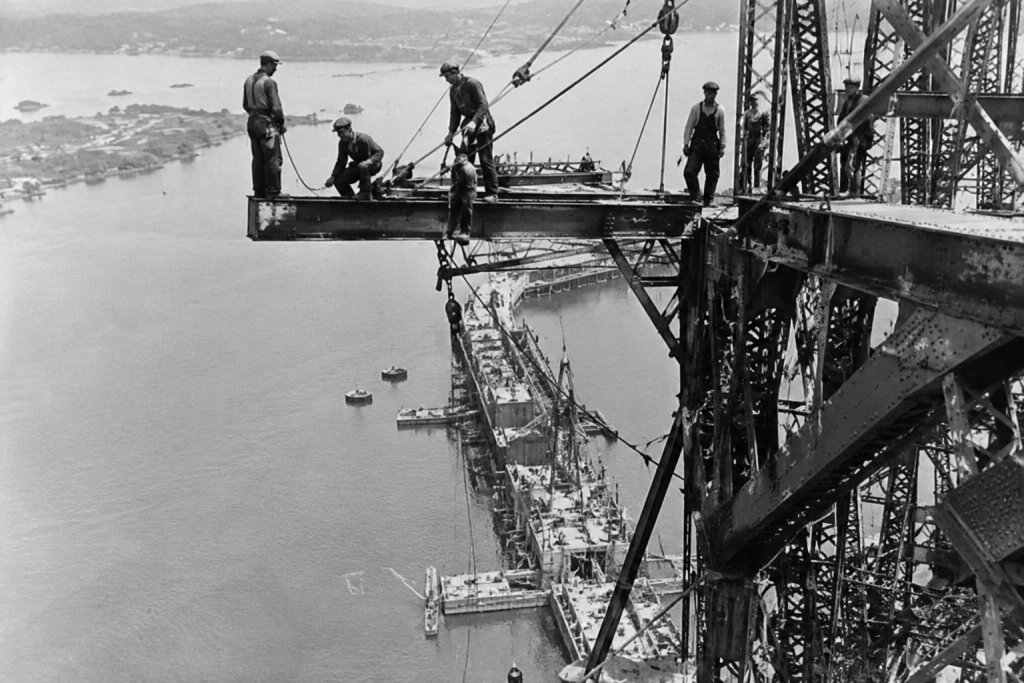
Historic photographs show workers sitting on narrow steel beams hundreds of feet above the ground with little more than balance and experience protecting them.
Weather posed an additional threat.
From a scientific perspective, high winds can create powerful lateral forces that affect both people and structures. Gusts approaching 80 miles per hour can seriously compromise a person’s balance, especially on elevated surfaces where movement is restricted.
Steel structures themselves may also vibrate under certain wind conditions. While these movements are often small, they can create a challenging environment for workers operating at great heights.
Because of these realities, the idea of a dangerous rescue on a bridge under construction is not inherently impossible.
The challenge is finding evidence that this specific event actually happened.
The Missing Historical Record
The viral account includes a remarkable amount of detail.
It names the alleged rescuer. It identifies the woman. It provides a specific date. It describes the weather conditions and even includes memorable dialogue.
Yet researchers searching newspapers, engineering records, historical archives, and bridge documentation have not uncovered reliable evidence confirming the story.
There are no widely recognized contemporary newspaper reports describing the rescue.
No official bridge records appear to document the incident.
No verified historical sources have been found that support the famous quotations attributed to those involved.
This absence of evidence does not automatically prove the story is false. History contains many events that were poorly documented or never recorded at all.
However, without verifiable sources, historians cannot treat the account as an established fact.
Why the Story Feels So Convincing
The structure of the narrative helps explain its popularity.
It contains many of the elements commonly found in stories that spread rapidly online.
There is an ordinary hero.
There is a vulnerable person in danger.
There is a seemingly impossible challenge.
There is a memorable quote.
And there is an emotional ending that provides a sense of closure.
Psychologists have long observed that people respond strongly to stories involving sacrifice, courage, and selflessness. Such narratives trigger emotional reactions that often outweigh critical analysis.
Another factor is known as the “illusory truth effect.” Research has shown that repeated exposure to a claim can increase the likelihood that people perceive it as true, even when they have never verified the information themselves.
In other words, seeing the same story shared repeatedly can make it feel increasingly credible.
The Image That Helped Fuel the Legend
Many versions of the story are accompanied by a dramatic photograph showing a worker positioned high above the river on a narrow steel beam.
For many readers, the image serves as proof.
Yet images alone are rarely sufficient evidence.
Questions have been raised about some versions of the photograph, particularly as modern editing tools and artificial intelligence have made it easier than ever to alter or generate realistic historical-looking images.
Without a confirmed source, date, and chain of custody, even a compelling image cannot establish that a specific event occurred.
This is why historians place greater value on contemporary documents, newspaper reports, eyewitness accounts, and official records than on isolated images circulating online.
The Real Legacy of Quebec Bridge
Although the viral rescue story remains unverified, the bridge’s actual history had a lasting impact on engineering and workplace safety.
The disasters associated with the project helped shape future approaches to structural design, independent review processes, and risk assessment.
Over time, governments and regulatory bodies introduced increasingly strict safety requirements for construction work, particularly at height.
Today, organizations such as the Occupational Safety and Health Administration enforce standards covering fall protection, worker anchoring systems, weather-related hazards, and emergency procedures.
Many construction projects now halt operations entirely when wind speeds exceed safe limits.
These regulations exist because earlier generations of workers often faced risks that would be considered unacceptable today.
Sometimes the Real History Is More Powerful Than the Legend
Whether Thomas O’Rourke was a real person, a heavily embellished figure, or a modern invention remains unclear.
What is clear is that the actual story of the Quebec Bridge does not require additional drama to be remarkable.
Its history already includes engineering ambition on an unprecedented scale, catastrophic failures, hard-earned lessons, and the loss of many lives.
The viral rescue tale may continue to circulate because it offers something people naturally want to believe: that extraordinary courage can emerge from ordinary individuals when it matters most.
But the broader lesson may be even more important.
In an age where stories can travel around the world within minutes, taking the time to verify a compelling claim is often the best way to honor both history and the people who truly lived it.
Sometimes the facts are every bit as fascinating as the legend—and occasionally, they are even more extraordinary.