
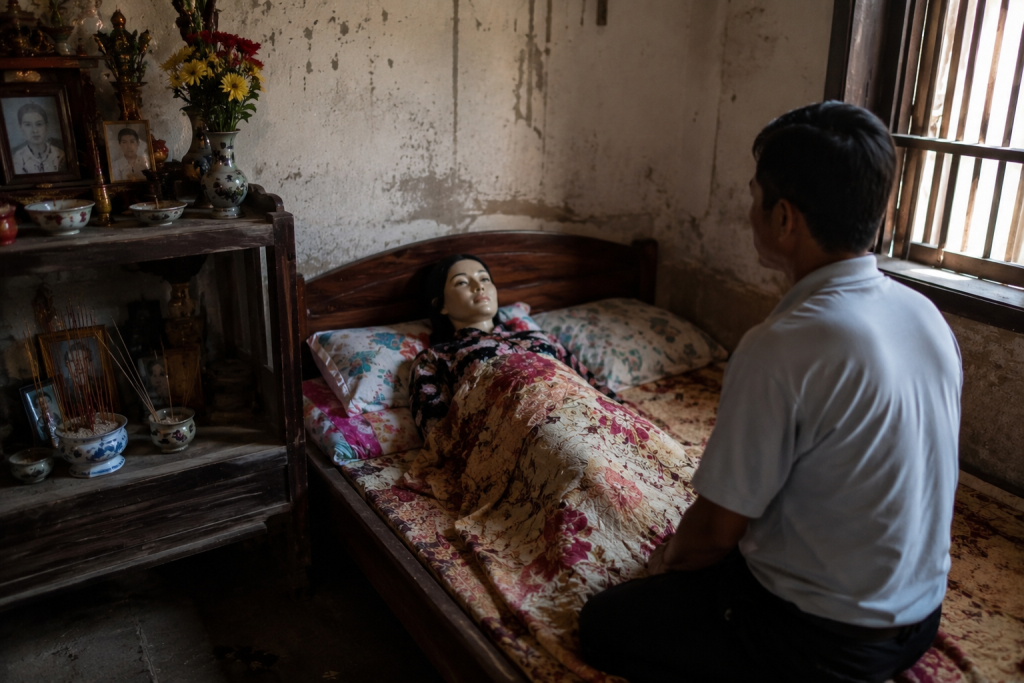
In 2009, a series of photographs from rural Vietnam began attracting international attention. The images showed the interior of a modest home in Quang Nam Province, a region in central Vietnam known for its strong family traditions and close-knit communities. What caught the attention of journalists was not the house itself, but a life-sized female figure resting on a bed, dressed in everyday clothing and treated as though she were still a member of the household.
The owner of the home was a man named Le Van. Years earlier, he had lost his wife, and according to numerous reports, he never fully recovered from the loss. Over time, he created a figure resembling her and continued living alongside it for years afterward.
As the story spread across the world, it became one of the internet’s most discussed examples of extreme grief. Some saw it as an extraordinary act of devotion. Others viewed it as a heartbreaking illustration of how profoundly loss can affect the human mind. Yet behind the viral headlines lies a far more complex story—one that combines documented facts, cultural context, psychological research, and a lingering mystery that remains unresolved.
A Life Changed by Loss
Public information about Le Van’s early life is limited. Before international media discovered his story, he was simply a resident of a rural Vietnamese community, living a quiet life with his family.
That changed in 2003 when his wife died.
Reports from Vietnamese media described a man overwhelmed by grief. Friends and neighbors allegedly noticed that he spent increasing amounts of time thinking about and mourning his wife. Several accounts claimed that he frequently visited her gravesite and struggled to adjust to life without her.
While some of the more dramatic details have been repeated so often that they are difficult to verify independently today, there is broad agreement on one point: the death of his wife had a profound and lasting impact on him.
For many people, grief gradually becomes more manageable with time. For Le Van, however, the years that followed seemed to deepen rather than ease his attachment to the woman he had lost.
The Figure That Captured Global Attention
Several years after his wife’s death, Le Van reportedly began building a life-sized figure designed to resemble her.
According to accounts published in Vietnamese newspapers, he used materials such as clay, plaster, and cement to shape the figure. It was eventually dressed in clothing and placed inside his home, where it became a permanent part of his daily environment.
Photographs later published by journalists showed the figure positioned on a bed and treated with a level of care that surprised observers around the world.
Le Van reportedly said that having the figure nearby helped ease his loneliness. In various interviews attributed to him, he suggested that it allowed him to feel connected to his wife despite her death.
Those images quickly traveled beyond Vietnam. International news outlets, blogs, and television programs picked up the story, transforming a personal tragedy into a global conversation about grief, attachment, and emotional survival.
The Controversy That Fueled the Story’s Viral Spread
One particular claim became responsible for much of the case’s notoriety.
Numerous reports stated that Le Van had secretly exhumed his wife’s remains and placed them inside the figure he created. This detail appeared in countless articles and was often presented as fact.
However, the evidence supporting that claim has always been less clear than many viral retellings suggest.
Some early reports repeated the allegation without providing independent verification. Later accounts indicated that Le Van denied having placed human remains inside the structure, describing it instead as a symbolic representation of his wife.
To this day, no widely available public records have conclusively confirmed what, if anything, was contained within the figure. What is well documented is the existence of the sculpture itself and the fact that it remained in his home for years.
As a result, historians and journalists who revisit the story often separate the verified elements from the claims that remain uncertain.
What Psychology Can Tell Us About Extreme Grief
Cases like Le Van’s often attract attention because they appear difficult to understand through everyday experience. Yet psychologists have long studied how severe grief can influence behavior.
In recent years, mental health researchers have focused increasing attention on a condition known as Prolonged Grief Disorder. Unlike typical bereavement, where emotional pain gradually becomes easier to manage, prolonged grief can persist for years and significantly interfere with daily life.
Individuals experiencing this condition may remain intensely preoccupied with the person they lost. They may struggle to accept the reality of the death, withdraw socially, or feel unable to move forward.
Modern brain imaging studies have provided additional insight. Research suggests that in some people experiencing severe grief, brain regions associated with attachment and emotional reward remain highly active when they think about the deceased. In a sense, the brain continues searching for a connection that no longer exists in the physical world.
This does not mean a person is unaware of reality. Rather, emotional systems built around years of attachment may continue responding long after a loved one is gone.
For most people, these responses gradually diminish. In rare cases, however, they can become a defining part of daily life.
The Role of Culture and Family Traditions
Understanding the cultural context is also important.
Vietnam has a long history of ancestor veneration and family-centered traditions. In many households, altars dedicated to deceased relatives serve as places of remembrance and respect. Rituals honoring family members who have passed away remain a meaningful part of life for millions of people.
This cultural background does not explain every aspect of Le Van’s behavior, nor does it suggest that his actions were considered typical within his community. In fact, many local residents reportedly found the situation unusual.
What it does illustrate is that attitudes toward death, memory, and continuing bonds with loved ones vary significantly across cultures. Practices that seem extraordinary in one society may be interpreted differently in another.
How the Internet Turned a Local Story Into a Modern Legend
The rise of social media played a major role in the global spread of Le Van’s story.
As articles were translated, reposted, and summarized across different platforms, the distinction between confirmed facts and unverified claims often became blurred. Some versions focused on romance and devotion. Others emphasized shock value and mystery.
Researchers who study online information sharing have repeatedly found that emotionally powerful stories spread faster than nuanced ones. Narratives involving love, death, and unusual behavior are especially likely to capture public attention.
Le Van’s story contained all of those elements.
Over time, it evolved from a local news report into something resembling a modern internet legend, with each retelling adding new interpretations and assumptions.
A Story That Raises Universal Questions
More than two decades after the death of his wife, the story of Le Van continues to resonate because it touches on something deeply human.
At its core, this is not simply a story about a sculpture in a Vietnamese home. It is a story about attachment, memory, and the struggle to cope with loss.
Every culture has stories about people who could not let go of someone they loved. Most eventually learn to carry their grief while continuing with life. A few remain caught between remembrance and acceptance, unable to fully reconcile the two.
Whether viewed as an expression of devotion, a manifestation of profound grief, or a combination of both, Le Van’s story remains one of the most unusual and thought-provoking examples of how powerful human bonds can be.
Perhaps that is why it continues to fascinate people around the world. Beneath the mystery and the headlines lies a question that has existed for as long as humanity itself: what happens when love remains, but the person we love is gone?