
Some routines become so familiar that we stop noticing them.
Most mornings begin the same way. We make coffee, grab our keys, check our phones and, just before walking out the door, reach for a bottle of perfume. Two sprays on the neck, one on the wrists—or perhaps directly onto a jacket—and we’re ready to start the day.
Almost nobody pauses to read the ingredient list.
There doesn’t seem to be a reason to. Perfume has been part of everyday life for centuries. We associate it with confidence, memories, elegance or simply with feeling good about ourselves. Like shampoo or toothpaste, it feels ordinary.
Yet there’s something unusual about nearly every bottle of perfume on the market.
Turn it around and look closely at the ingredient list. You’ll probably find a single word doing an extraordinary amount of work.
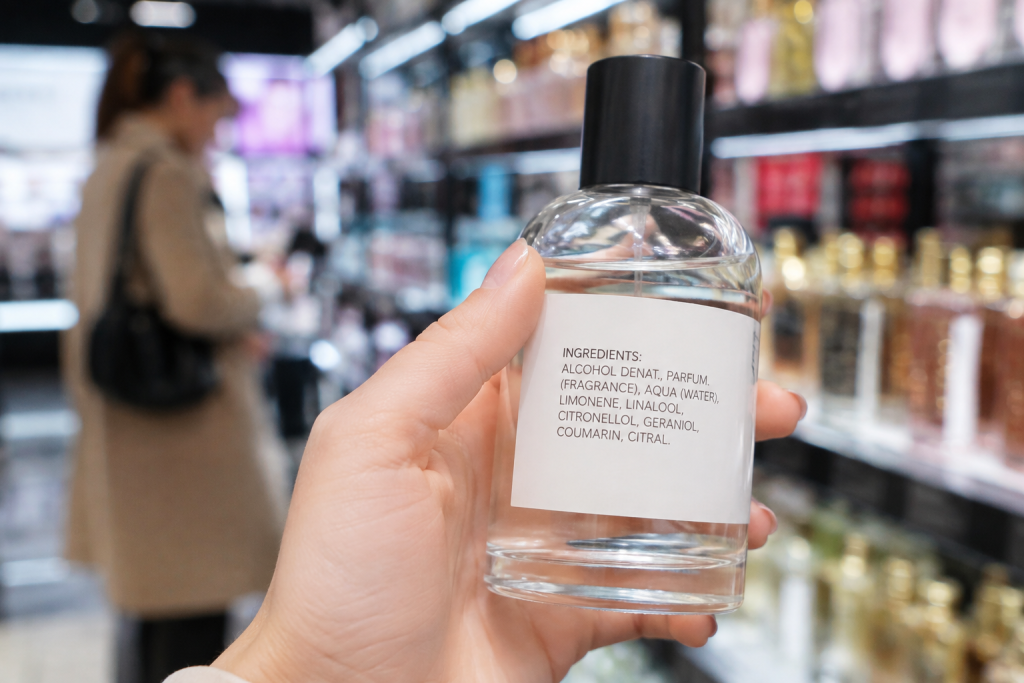
Fragrance.
Sometimes it’s written as Parfum, depending on where the product is sold.
That’s it.
No detailed breakdown of the aromatic ingredients. No complete list of the molecules responsible for the scent. No explanation of how that signature fragrance came to life.
Just one word.
It’s so familiar that most of us never question it. But once you do, it opens the door to a surprisingly complex story.
Why is one of the world’s most widely used cosmetic products allowed to keep much of its formula hidden from consumers? Is this a loophole in the law? A lack of transparency? Or is there a legitimate reason why the fragrance industry operates differently from many other sectors?
These questions reached a much wider audience after the release of the documentary Stink!, which challenged viewers to think about ingredients they had probably ignored for years.
For some, the film exposed a hidden truth.
For others, it painted a far darker picture than the available scientific evidence supports.
The reality, as is often the case, is considerably more nuanced.
The deeper you explore the subject, the clearer it becomes that this isn’t simply a story about mysterious chemicals or secret formulas. It’s a story about two interests that have been competing with each other for decades.
Consumers want transparency. If a product is applied directly to the skin every day, it’s perfectly reasonable to ask what’s inside and whether it’s safe.
Manufacturers, however, invest years—and often millions of dollars—developing original fragrances. Their formulas represent valuable intellectual property, and revealing every detail would make it much easier for competitors to reproduce their work.
The tension between those two perspectives has shaped one of the most fascinating corners of the cosmetics industry.
A perfume formula is more than a recipe
When people think about trade secrets, Coca-Cola usually comes to mind.
Its recipe has become almost legendary, protected for generations because it represents one of the company’s greatest competitive advantages.
The perfume industry works in much the same way.
Behind every successful fragrance are years of research, hundreds of experimental blends and countless failed versions that never leave the laboratory. Some perfumes take five or even ten years to develop before their creators decide they’re ready for the public.
Every ingredient serves a specific purpose. Every concentration influences the final scent. Changing the amount of a single aromatic compound by a fraction of a percent can alter the entire personality of a fragrance.
That’s why a perfume formula isn’t viewed simply as a list of ingredients.
It’s the result of scientific knowledge, artistic creativity and extensive experimentation.
In many cases, it’s one of a company’s most valuable assets.
This story began long before modern laboratories
Long before today’s global fragrance brands existed, the small French town of Grasse had already earned a reputation that would eventually make it the world’s perfume capital.
Generations of perfumers worked there, passing their knowledge from one family member to another. Recipes were guarded carefully, shared only with trusted collaborators and treated almost like family heirlooms.
The goal wasn’t to hide dangerous ingredients.
It was to protect originality.
Success depended on creating scents that nobody else could reproduce.
Although today’s industry relies on sophisticated laboratories instead of small workshops, that philosophy hasn’t changed very much. A unique fragrance formula remains something companies are determined to protect.
Does secrecy mean nobody checks what’s inside?
This is probably the biggest misunderstanding surrounding perfumes.
Many people assume that if the complete formula isn’t printed on the label, then nobody knows what’s actually in the bottle.
That’s not how the system works.
Keeping a formula confidential is very different from avoiding regulatory oversight.
In the European Union, cosmetic products cannot simply appear on store shelves without undergoing a formal safety assessment. Manufacturers must prepare detailed technical documentation describing the product, its ingredients, toxicological evaluations and the evidence supporting its safe use under normal conditions.
Consumers don’t see those documents.
Regulatory authorities can.
That distinction changes the conversation completely.
The formula may be protected from competitors, but it isn’t hidden from the authorities responsible for enforcing cosmetic regulations.
Understanding that difference is essential because it shifts the debate away from conspiracy theories and toward a much more interesting question.
If consumers don’t see the full formula, who decides which ingredients are acceptable? Who determines whether a fragrance ingredient is safe enough to be used? And why have certain ingredients disappeared from perfumes over the years while others continue to be used?
The answers lead far beyond the marketing departments of luxury fragrance brands.
They lead into toxicology laboratories, scientific advisory committees, international standards and regulatory decisions that most consumers never even realize exist.
Who Decides What Goes Into a Perfume?
At first glance, the answer seems obvious. A fragrance company selects its ingredients, blends them together and releases the finished product.
The reality is considerably more complex.
Long before a perfume reaches a department store shelf, it has passed through the hands of perfumers, chemists, toxicologists, safety assessors and regulatory specialists. Each one looks at the formula from a different perspective, but they all focus on the same fundamental question.
Not whether the fragrance smells beautiful.
Whether it can be used safely under normal conditions.
That distinction matters.
In everyday conversations, we often divide substances into two simple categories: safe or dangerous, natural or chemical, good or bad.
Science doesn’t work that way.
Very few substances are inherently harmless or inherently dangerous in every situation. Their effects depend on factors such as concentration, frequency of exposure, the way they’re used and the people who are exposed to them.
Water is essential for life, yet excessive amounts can become dangerous. Oxygen keeps us alive, but under specific conditions it can also damage living tissue.
The same principle applies to fragrance ingredients.
Their presence alone tells us very little.
Understanding risk requires context.
Creating a Perfume Is a Long Process
Many people imagine perfume development as a perfumer mixing a few pleasant-smelling ingredients until something magical happens.
In reality, creating a successful fragrance can take years.
Every project starts with an idea rather than a formula. It may be inspired by a landscape, a season, a memory, a flower or even an emotion that the perfumer wants to translate into scent.
Dozens—or sometimes hundreds—of experimental versions follow.
Some ingredients disappear after the first trial.
Others remain but are used in different proportions.
Small adjustments can dramatically change the personality of a fragrance.
Once the creative process is complete, the scientific work continues.
The formula must remain stable over time, tolerate different temperatures, survive transportation and continue smelling as intended months or even years after production.
At the same time, every ingredient is evaluated within the finished formula rather than in isolation.
Only after these stages are complete can the product move toward commercial release.
Why Do Some Classic Perfumes Smell Different Today?
Collectors and fragrance enthusiasts have noticed something interesting for years.
Sometimes an iconic perfume purchased today doesn’t smell exactly like a bottle produced fifteen or twenty years ago.
The differences are often subtle.
Occasionally, they’re obvious enough that experienced users recognize them immediately.
Many people assume manufacturers simply changed the formula to reduce production costs.
That can happen.
But it isn’t always the reason.
Scientific knowledge evolves.
As researchers publish new evidence and assessment methods improve, regulators sometimes re-evaluate ingredients that have been used safely for decades.
If new evidence suggests that an ingredient poses a higher risk than previously understood—or causes allergic reactions more frequently than expected—regulations may change.
When that happens, manufacturers must adapt.
Some ingredients disappear entirely.
Others remain, but only at lower concentrations.
To consumers, it may look like a company quietly altered a beloved perfume.
Behind the scenes, however, the change often reflects advances in scientific knowledge rather than a marketing decision.
IFRA and SCCS: Two Organizations That Shape the Industry
Anyone who starts researching perfumes eventually encounters two abbreviations: IFRA and SCCS.
Although they are often mentioned together, they serve very different purposes.
The International Fragrance Association (IFRA) represents the fragrance industry and develops standards for the safe use of fragrance ingredients. Those standards are based on scientific assessments and are widely followed by manufacturers around the world.
The Scientific Committee on Consumer Safety (SCCS) has a different role.
It is an independent scientific committee that advises the European Commission on consumer safety issues, including cosmetic ingredients.
When new research raises questions about a substance, SCCS reviews the available scientific evidence and publishes opinions that may eventually influence European legislation.
These organizations are sometimes confused with one another.
They shouldn’t be.
IFRA does not create European laws.
SCCS does not manufacture perfumes.
One develops industry standards based on scientific evidence.
The other evaluates scientific data to help regulators make informed decisions.
Understanding that distinction makes it much easier to understand how modern fragrance regulation actually works.
When Science Changes the Rules
Perhaps one of the best-known examples is Lilial, a fragrance ingredient that was widely used for many years because of its floral scent.
As scientific evidence evolved, European regulators concluded that it no longer met the current safety requirements for cosmetic use.
The consequence wasn’t the disappearance of perfumes from store shelves.
Instead, manufacturers reformulated their products.
Most consumers never noticed.
The bottle looked the same.
The name stayed the same.
The advertising campaign remained unchanged.
Only the formula inside had evolved.
This illustrates something important about the fragrance industry.
It isn’t static.
As scientific knowledge advances, regulations change—and manufacturers are expected to adapt.
That also explains why two bottles bearing the same famous name may not contain exactly the same formula if they were produced years apart.
But this raises another important question.
If certain ingredients have been restricted or removed over time, should we become suspicious of every perfume we use?
Or are we confusing the existence of individual risks with the safety of an entire category of products?
Answering those questions requires leaving the world of regulations behind and looking at the scientific evidence itself.
That’s where the discussion becomes even more interesting.
What do researchers actually know about skin absorption? How common are fragrance allergies? What is cumulative exposure, and why has it become such an important topic in modern toxicology?
The answers are more nuanced—and often more reassuring—than the headlines circulating online might suggest.