
A school can reasonably tell students what uniform to wear. It can prohibit makeup, jewelry or dramatic hairstyles. But should it be able to tell a teenager that the hair they were born with is the wrong color?
That question became the center of an unexpectedly serious debate in Japan after reports emerged of students with naturally brown or lighter hair being required to prove that they had never dyed it. In one particularly well-known case, a high school student said she was repeatedly told to make her naturally brown hair black.
The controversy eventually reached the courts, attracted international attention and became part of a much broader conversation about Japan’s notoriously strict school regulations.
The viral version of the story is startling enough. The reality behind it, however, reveals something more complicated: what happens when rules designed to make everyone equal begin demanding that some students change who they naturally are?
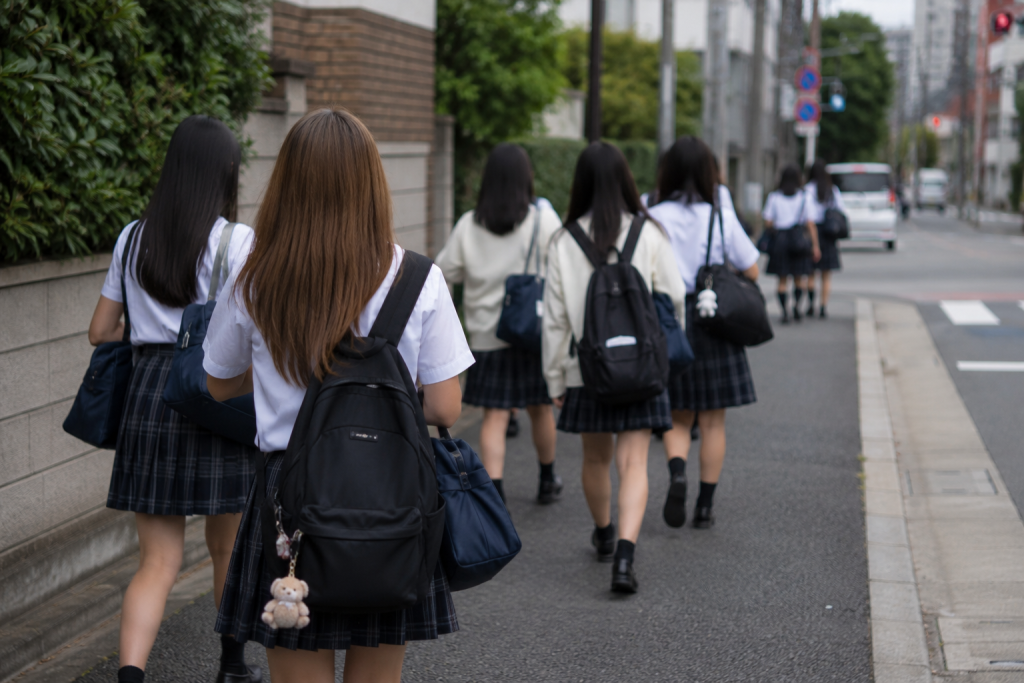
Japan’s school rules can extend far beyond the uniform
Japanese schools are often associated with order, discipline and a strong sense of collective responsibility. Uniforms are common, but appearance policies in some schools have historically gone considerably further.
Students could face detailed restrictions concerning hairstyles, cosmetics, accessories, clothing and other aspects of personal appearance.
Some particularly rigid policies became associated with the expression burakku kōsoku, commonly translated as “black school rules.” The term has been used in Japan when discussing regulations viewed by critics as excessively restrictive or unreasonable.
Hair became one of the most controversial examples.
Because naturally very dark hair is predominant in Japan, a prohibition on dyed hair might initially appear straightforward. Schools wanted students to arrive with their natural hair rather than using color to stand out or follow fashion trends.
But that seemingly simple rule created an obvious problem.
Natural hair does not come in precisely the same shade for everyone.
Imagine having to prove that your own hair is natural
Some Japanese students naturally have brownish or lighter hair. Children from families with diverse backgrounds may also have physical characteristics that differ from those commonly expected by school authorities.
When schools treated black hair as the default, students whose natural appearance did not match that expectation could find themselves under suspicion.
Reports surrounding the controversy described schools asking families to verify that a child’s hair had never been artificially colored. In some instances, parents were expected to provide information about their child’s natural hair, and reports even described old photographs being used as evidence.
The paradox was difficult to ignore.
A policy intended to prevent students from artificially changing their appearance could ultimately pressure a student to artificially change their appearance.
And one teenager’s experience brought that contradiction into national focus.
The Osaka student whose dispute ended up in court
One of the cases that received the greatest international attention involved a female high school student in Osaka Prefecture.
Her hair was naturally brown. According to accounts of the subsequent lawsuit, her mother had informed the school about her natural hair color when she enrolled.
Nevertheless, a prolonged dispute developed over the school’s appearance policy.
The student said she was repeatedly instructed to dye her hair black. She also alleged that repeatedly coloring it caused damage to her hair and scalp.
What might have remained an internal disagreement between a student and her school escalated dramatically. She eventually stopped attending classes, and the dispute reached the courts.
By then, the issue was no longer simply whether one teenager should have black or brown hair. It had become a public discussion about how much control a school should have over a student’s natural appearance.
The court decision did not simply ban hair-color rules
The eventual legal outcome is important because it is frequently oversimplified online.
In 2021, a court awarded the former student compensation in relation to aspects of how the school had treated her during the dispute. However, the judgment did not amount to a blanket ruling that every school policy concerning hair color was unlawful.
That distinction matters.
The case therefore should not be summarized as “Japan ruled that requiring black hair violates human rights.” The actual legal story was more nuanced.
At the same time, restrictive appearance policies were facing growing criticism from lawyers, activists and human-rights advocates. Human Rights Watch was among the organizations that publicly challenged excessive Japanese school rules and raised concerns about the harm such policies could cause students.
The debate consequently moved beyond one school and one teenager.
Why would schools have such strict rules in the first place?
Viewed from another country, requiring students to conform so closely in appearance can seem unnecessarily severe. Understanding why these policies existed, however, requires considering the philosophy behind them.
Uniformity has traditionally played an important role in many Japanese schools. Supporters of strict appearance standards have argued that reducing visible differences can discourage competition over fashion, minimize displays of wealth and reinforce a sense that students belong to the same community.
From that perspective, a ban on dyed hair was not necessarily created with naturally brown-haired children in mind. It was intended to prevent students from deliberately altering their appearance.
That distinction explains the origin of the rule.
It does not resolve the problem created when the rule is applied without flexibility.
There is an enormous difference between telling a student, “You cannot dye your hair,” and telling that same student, “Your natural hair needs to be dyed.”
When equality starts looking like conformity
This is ultimately what made the controversy resonate far beyond the question of hairstyles.
Schools need rules. Few people dispute that. Dress codes and behavioral standards can serve legitimate purposes, particularly when they are applied consistently and reasonably.
But consistency is not necessarily the same thing as fairness.
Treating every student identically can become unfair when students do not begin with identical physical characteristics.
A policy banning cosmetic changes is regulating a choice. A policy that requires someone to alter a natural characteristic is doing something fundamentally different.
That distinction became increasingly difficult for schools and education authorities to ignore.
A wider reassessment began
Public criticism of excessively restrictive school rules eventually contributed to changes in different parts of Japan.
Schools and local education authorities began reviewing policies governing students’ appearance, and some controversial requirements were revised or abandoned. The discussion also encouraged greater scrutiny of rules that had survived for years largely because few people had openly challenged them.
This did not mean Japanese schools suddenly abandoned uniforms, discipline or standards of appearance.
Instead, a different question began receiving more attention: does a particular rule genuinely contribute to education and school life, or does it simply enforce conformity because that is how things have always been done?
That is a far more consequential question than the color of someone’s hair.
The viral claim is based on reality, but it needs context
Posts claiming that Japanese students with naturally brown hair were forced to dye it black are not entirely fictional. Documented cases and controversial school policies provide a genuine basis for the claim.
What is misleading is the suggestion that every Japanese school operated under a nationwide rule requiring every student’s hair to be black. School policies have varied, and attitudes toward these regulations have also evolved considerably.
The real story does not need exaggeration to be remarkable.
Students were questioned about whether their natural hair was genuine. Families sometimes had to explain or document a child’s appearance. A dispute involving a naturally brown-haired teenager reached court, while the broader controversy helped fuel a national conversation about some of Japan’s strictest school rules.
Perhaps the most interesting question left by the controversy has nothing to do with hair at all.
If a rule created to make everyone appear equal requires one child to change something they were born with, is it still promoting equality — or has equality quietly been replaced by conformity?