
For four months, 9-year-old Mary Katherine Smart carried a piece of information she couldn’t quite reach.
She had been in the bedroom on the night her 14-year-old sister, Elizabeth Smart, was abducted from their Salt Lake City home. She had heard the intruder. She knew something about him was familiar. But she couldn’t immediately give investigators the name that would eventually transform the case.
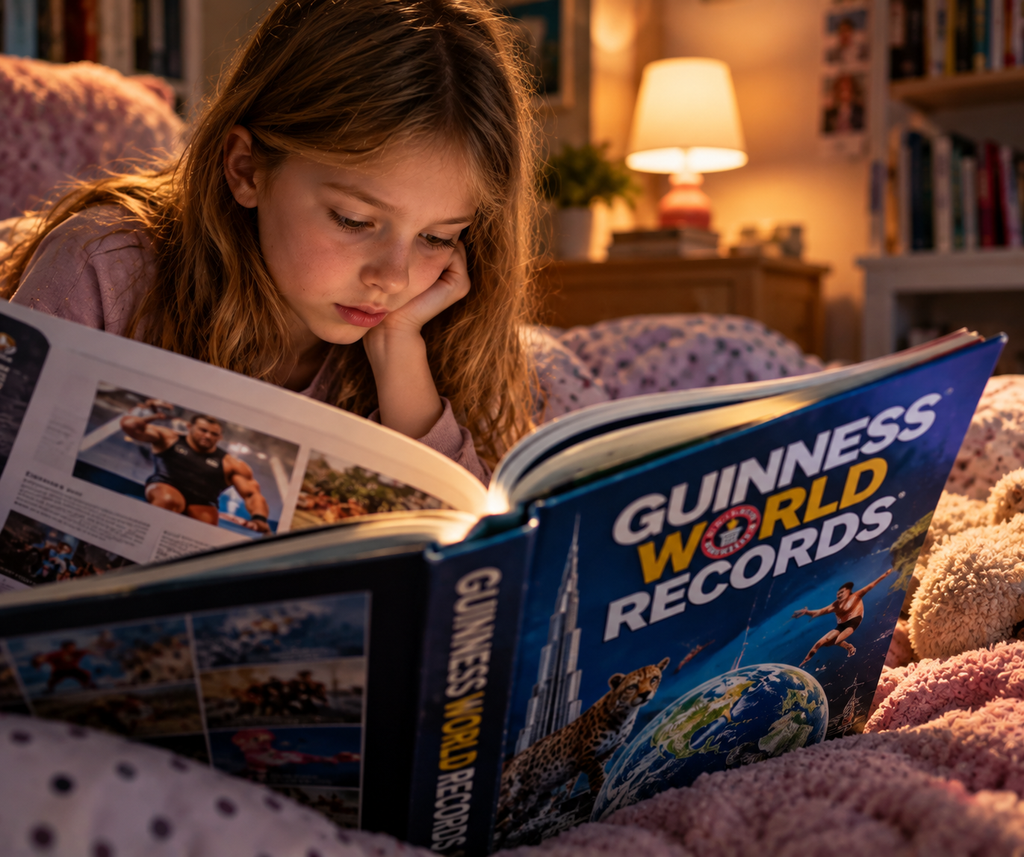
Then, on an ordinary Saturday evening in October 2002, Mary Katherine was flipping through a Guinness Book of World Records.
She reached a photograph of a muscular woman.
And suddenly, a name came to her:
Emmanuel.
The detail sounds almost too perfectly scripted to be true. But the story of the Guinness book isn’t an internet invention. Mary Katherine later described the moment herself, and the episode became part of the documented history of the Elizabeth Smart case.
The book didn’t contain a photograph of the kidnapper.
The woman in the photograph wasn’t someone connected to the crime.
There was no hidden clue on the page.
Somehow, while looking through the book and thinking about people who had passed through the family’s home, Mary Katherine remembered a man they had once known as Emmanuel.
His real name was Brian David Mitchell.
And months later, Elizabeth would be found alive.
The Child Who Was in the Room
During the early hours of June 5, 2002, Elizabeth and Mary Katherine Smart were sleeping in the same bedroom.
Mary Katherine awoke to a man in the room. He had a knife.
Terrified, the child remained still and pretended to be asleep. She would later explain that she feared he might take her too if he realized she was awake.
The man left the bedroom with Elizabeth.
Once Mary Katherine believed it was safe, she alerted her parents. Police were called and an enormous search began.
But investigators faced a difficult problem.
The person who had been closest to the abduction was a frightened 9-year-old who had not gotten a clear enough look at the intruder’s face to identify him immediately.
Elizabeth seemed to have vanished.
Weeks passed.
Then months.
Four Months Later, Something Changed
On October 12, 2002, Mary Katherine was alone in her bedroom looking through the Guinness Book of World Records.
She came across a photograph of a muscular woman.
Nothing about that photograph directly identified Elizabeth’s abductor. Mary Katherine herself would later say she wasn’t sure why it triggered the thought that followed.
She began thinking about people who had been around the family’s home.
And then she remembered:
Emmanuel.
When her parents returned, Mary Katherine told them she believed she knew who had taken Elizabeth.
This was significant because Emmanuel wasn’t an imaginary figure or a vague description invented months after the crime.
A man using that name really had worked for the Smart family.
The Man the Family Knew as Emmanuel
In 2001, the Smarts had briefly hired a man who called himself Emmanuel to perform work around their property.
His real name was Brian David Mitchell.
He had been such a temporary presence in the family’s life that, viewed before the kidnapping, there was little reason for the family to imagine how important he would later become.
But Mary Katherine remembered something other than his appearance.
She remembered his voice.
The voice of the man who had taken Elizabeth sounded, she believed, like Emmanuel.
It gave investigators something they hadn’t previously had: a lead connected to an actual person who had been inside the orbit of the Smart family.
Yet Elizabeth wasn’t rescued the next day.
The path from a child’s memory to finding her sister would take several more months.
Why Would a Guinness Book Trigger a Memory?
This is where the case intersects with something scientists have studied for decades: the strange way human memory is retrieved.
Mary Katherine apparently didn’t know exactly why that particular page brought Emmanuel to mind.
Her mother later offered one possible explanation. Mary Katherine had suggested that she might have looked at the same book around the time Emmanuel was working near the family’s home.
We cannot know whether that was actually the connection.
And it would be misleading to claim that neuroscience can reconstruct exactly what happened inside Mary Katherine’s mind on that October evening.
What we can say is that the general phenomenon is scientifically plausible.
Human memory isn’t a video archive.
We don’t necessarily store an experience as one perfect recording that can later be replayed from beginning to end. Memories exist within networks of associations involving places, sounds, smells, objects, emotions and other contextual information.
Sometimes one of those details can become what psychologists call a retrieval cue.
A seemingly insignificant stimulus may help make information accessible that a person was previously unable to recall.
Research into context-dependent memory has repeatedly found that the context surrounding an experience can affect later recall. A major meta-analysis published in Psychonomic Bulletin & Review, for example, found reliable context-dependent memory effects, although their strength varies substantially depending on the circumstances.
That doesn’t prove the Guinness book unlocked Mary Katherine’s memory in precisely this way.
It simply means the idea that an apparently unrelated object might help bring an old association to mind isn’t as mysterious as it first sounds.
There Is an Important Warning About Memory
Stories like this can easily create another misconception: that a memory which suddenly returns must be accurate.
Human memory doesn’t work that way either.
Memory is reconstructive.
Details can fade. Information learned later can become entangled with earlier experiences. Repeated questioning and other influences can affect recollection.
A major National Research Council review of eyewitness identification emphasized precisely these limitations. Human perception and memory are powerful, but neither operates like an objective recording device.
That distinction matters enormously in criminal investigations.
A person’s confidence in a memory does not, by itself, establish that every detail of the memory is correct.
What made Mary Katherine’s recollection particularly important was that investigators could test it against reality.
There really had been an Emmanuel.
He really had worked for the family.
And investigators were eventually able to connect that identity to Brian David Mitchell.
Remembering the Name Wasn’t the End of the Case
The compressed version of the Elizabeth Smart story can make the sequence sound almost instantaneous:
Mary Katherine remembers Emmanuel.
Police identify him.
Elizabeth is rescued.
The real timeline was much longer.
Mary Katherine remembered the name in October 2002.
Elizabeth wasn’t found until March 12, 2003.
Investigators and the Smart family still needed to turn the recollection into an identifiable suspect.
A composite image of the man the family knew as Emmanuel was eventually released publicly in February 2003. After seeing the image, someone contacted authorities with information suggesting the man could be Brian David Mitchell.
Members of Mitchell’s family also recognized him as the image received wider exposure.
The case and Mitchell’s image were subsequently featured through national media, including America’s Most Wanted.
Now the public had something it hadn’t had during the earliest months of the search.
Not just the face of a missing girl.
A face connected to the man investigators were looking for.
Then Someone Saw Him Walking Down the Street
On March 12, 2003, people in Sandy, Utah, noticed a man who resembled the widely circulated image of Emmanuel.
Police were alerted.
Officers encountered three people walking together: Brian David Mitchell, Wanda Barzee and a teenage girl.
The girl was Elizabeth Smart.
She was alive.
Approximately nine months had passed since she disappeared from her bedroom.
The discovery produced another question that would follow Elizabeth for years.
If she had sometimes been around other people during those nine months, why hadn’t she simply run away?
Why Didn’t Elizabeth Run When She Had the Chance?
The question sounds logical when asked by someone who isn’t being held captive.
It becomes far more complicated when viewed from the victim’s position.
Elizabeth was 14 when she was abducted. She was subjected to threats, abuse, intimidation and prolonged control.
A victim’s failure to escape during an apparent opportunity should not be interpreted as evidence that the captivity was voluntary.
Someone living under coercive control isn’t making decisions under ordinary conditions. Fear, threats and the belief that an abuser can harm the victim or people they love can radically alter how an apparent opportunity is perceived.
What looks from the outside like an obvious moment to run may not feel remotely safe to the person experiencing it.
Elizabeth has spent years explaining parts of that reality.
The 2026 Netflix documentary Kidnapped: Elizabeth Smart revisits the nine months of her captivity from her perspective, including experiences she wasn’t ready to discuss publicly immediately after her rescue.
What Happened to the Kidnappers?
Wanda Barzee pleaded guilty in 2009 to federal charges connected to Elizabeth’s kidnapping and unlawful transportation of a minor. She agreed to a 15-year prison sentence.
Brian David Mitchell went to federal trial.
In December 2010, a jury found him guilty of interstate kidnapping and unlawful transportation of a minor.
On May 25, 2011, U.S. District Judge Dale Kimball sentenced Mitchell to life in federal prison.
Elizabeth survived.
And the little sister who had remained motionless in that bedroom would always occupy an extraordinary place in the story of how she was found.
“She’s My Hero. She Saved Me.”
More than two decades after the kidnapping, Elizabeth still describes Mary Katherine’s role in remarkably simple terms:
“She’s my hero. She saved me.”
But perhaps the most remarkable version of this story isn’t the one in which a Guinness book magically solves a kidnapping.
Because that isn’t what happened.
A frightened child survived witnessing her sister being taken.
Months later, while looking through an ordinary book, something prompted her to think again about people who had passed through her family’s life.
One name surfaced.
Emmanuel.
That memory could be investigated.
The name led to a real person. A composite image was released. People who knew Brian David Mitchell recognized him. His face reached a much wider audience. Eventually, members of the public spotted a man who resembled the suspect and contacted police.
And walking beside him was the girl America had been searching for.
Alive.
The Guinness book never contained the answer.
The photograph Mary Katherine happened to be viewing wasn’t a photograph of Mitchell, and there is no evidence that she somehow recognized the kidnapper in the woman pictured on the page.
The book may simply have provided an accidental cue that helped an old association become accessible again.
We cannot know that for certain.
And that uncertainty is part of what makes the true story more compelling than the viral version.
Most of us have experienced a much smaller version of the same mystery: a name that refuses to come to mind until a song plays, a familiar smell appears or we return to a place we haven’t visited in years.
The answer wasn’t inside the song, the smell or the place.
Something simply helped us find our way back to it.
For 9-year-old Mary Katherine Smart, on an October evening in 2002, that path may have begun with the pages of a Guinness Book of World Records.
Sources and further reading
The timeline of the kidnapping, Mary Katherine Smart’s recollection of “Emmanuel,” and the events leading to Elizabeth’s recovery are documented in contemporary reporting from Deseret News and interviews with the Smart family, including Mary Katherine’s account to ABC News.
Information concerning Brian David Mitchell’s federal conviction and life sentence comes from records and announcements from the U.S. Department of Justice.
The discussion of retrieval cues and context-dependent memory draws on peer-reviewed research, including Steven M. Smith and Edward Vela’s meta-analysis of environmental context-dependent memory published in Psychonomic Bulletin & Review.
The limitations of eyewitness memory are discussed in the National Research Council’s consensus report Identifying the Culprit: Assessing Eyewitness Identification.
Elizabeth Smart’s more recent account and her comments about Mary Katherine are documented in material accompanying the 2026 Netflix documentary Kidnapped: Elizabeth Smart.