
For thousands of passengers aboard Carnival Panorama, September 19, 2026, was supposed to be the quiet final stretch of a seven-night Mexican Riviera cruise.
The ship had left Puerto Vallarta behind and was making its way north toward Long Beach, California. By the following morning, passengers would be back on land, carrying suitcases off the ship and returning to ordinary life.
But one family would not return home together.
A 56-year-old passenger had vanished.
What followed was a search across a ship carrying thousands of people, a review of surveillance footage and, eventually, a rescue operation extending far beyond the vessel itself.
The missing passenger was later publicly identified as Thomas Gigler of Redlands, California, a father of three.
And the cameras aboard Carnival Panorama eventually revealed where he had gone.
They could not explain why.
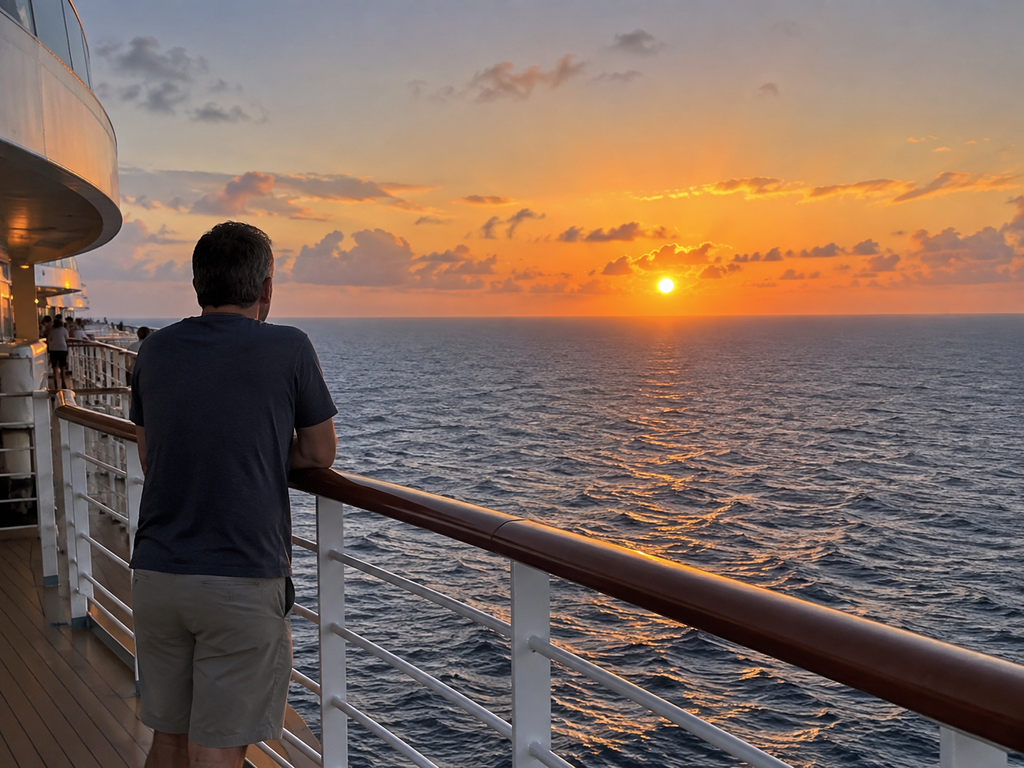
A family vacation changed in a matter of hours
Gigler was traveling with his wife, Michelle, and their three sons. According to information provided by his family to the media, he had worked for more than two decades as a programmer at Esri, the geographic information systems company based in Redlands.
There was another painful detail: Thomas and Michelle’s 15th wedding anniversary was only days away.
Nothing about the beginning of the cruise suggested how it would end.
Carnival Panorama had departed Long Beach on September 13 for a week-long voyage to Mexico. By September 19, its port visits were over and the ship was heading home.
Then Gigler could no longer be located.
At first, a missing passenger on a cruise ship does not necessarily mean someone is in the ocean. A modern cruise vessel is enormous. There are cabins, restaurants, lounges, decks, entertainment venues and countless places where someone might be temporarily out of contact.
So the search began aboard the ship.
Before searching the ocean, the crew had to search the ship
Carnival Cruise Line said its team initiated search and investigation procedures after learning that the passenger was missing.
Passengers reported hearing announcements as crew members attempted to locate him. At one point, guests were instructed to return to their cabins while checks were conducted.
There is a practical reason for such a procedure.
Before treating a disappearance as a man-overboard emergency, the crew needs to establish whether the missing person might still be somewhere aboard the vessel.
At the same time, another investigation can take place almost invisibly: reviewing surveillance footage.
That proved crucial in this case.
According to Carnival, video from the ship ultimately confirmed that Gigler had gone overboard.
The nature of the emergency had suddenly changed.
This was no longer a search through corridors and cabins.
It was a search across the Pacific.
The search moved from Carnival Panorama to the ocean
U.S. authorities were notified, as were their Mexican counterparts.
The U.S. Coast Guard’s Rescue Coordination Center Alameda became involved in the response, and fixed-wing aircraft were deployed as part of the search. The Mexican Navy and commercial vessels in the area also participated.
Carnival said it was supporting Gigler’s family.
Carnival Panorama eventually had to continue toward California, arriving back in Long Beach without the missing passenger.
For the family that had boarded together only days earlier, the cruise had ended in a way almost impossible to imagine when they left port.
Why finding one person in the ocean becomes so difficult
From the upper decks of a cruise ship, the sea can appear almost motionless.
For search-and-rescue teams, it is anything but.
A ship traveling at cruising speed can cover a substantial distance in a short period. Meanwhile, a person or object in the water does not remain at the point where it entered the sea. Wind, waves and currents begin moving it.
This means rescuers are not simply looking for someone at one set of coordinates.
They are trying to calculate where that person may have moved since entering the water.
And the longer the delay between the incident and its discovery, the greater the uncertainty can become.
That is why surveillance footage can be so valuable. Investigators can determine an approximate time of the event, correlate it with the ship’s recorded position and use that information to establish a more meaningful starting point for a search.
But the Carnival Panorama case also highlights a distinction that is often overlooked when people hear that a cruise ship has cameras.
Recording someone going overboard is not necessarily the same as detecting it immediately
It is easy to assume that if a camera captured an incident, someone on the bridge must have known about it the instant it happened.
Those are two different capabilities.
A conventional surveillance system can continuously record parts of a vessel. If someone is later reported missing, crew members can review those recordings and reconstruct the person’s movements.
An automated man-overboard detection system has a different objective: to recognize a possible overboard event as it occurs and trigger an alert.
This distinction has been discussed for years in the United States.
The Cruise Vessel Security and Safety Act includes provisions concerning technology capable of capturing images of passengers who fall overboard or detecting such events when appropriate technology is available. Congressional discussions of cruise safety have also addressed automated MOB systems and some of the practical challenges involved in implementing them reliably.
Those challenges matter. A detection system operating around a large moving vessel has to distinguish a human being from countless other movements and objects while minimizing false alarms.
In the specific case of Carnival Panorama, however, publicly available information does not establish enough detail about the exact automated detection configuration operating aboard the ship at the time to conclude that an automatic alarm should have been generated.
What Carnival has confirmed is narrower: after Gigler was reported missing, the crew investigated, and surveillance footage confirmed that he had gone overboard.
That distinction prevents an important technological question from turning into an unsupported accusation.
Did he fall, or did he jump?
Some reports, including accounts citing Carnival and authorities, have described Gigler as having “jumped overboard.”
That wording naturally raises another question: why?
It is also where responsible reporting has to stop short of filling the gaps.
Members of Gigler’s family have said publicly that they do not understand what could have led to what happened. Relatives have disputed speculation about marital problems and said they were unaware of circumstances that would provide an obvious explanation.
Those statements tell us what the family knew and believed.
They do not provide a psychological explanation for Gigler’s actions.
A surveillance camera may show a person’s physical movements. It cannot reveal with certainty what that person was thinking, feeling or intending in the minutes beforehand.
Unless investigators uncover additional evidence, assigning a motive would mean turning an unanswered question into a story simply because the absence of an explanation feels uncomfortable.
How can someone go overboard from a modern cruise ship?
After incidents like this, one question appears repeatedly: aren’t cruise ship railings designed to prevent people from falling?
They are.
Modern passenger vessels use physical barriers and railings intended to reduce the risk of accidental falls. Under ordinary circumstances, simply walking along a deck should not result in someone suddenly tumbling into the sea.
But railings are only one part of maritime safety.
Surveillance, missing-person procedures, communication between ships and rescue authorities, and technology intended to identify overboard incidents all contribute to the response when something goes wrong.
No individual safeguard can explain every incident or prevent every possible human action.
That is also why conclusions should not be drawn merely from the fact that someone ended up in the water.
The circumstances matter.
In Thomas Gigler’s case, some of those circumstances remain unknown.
What is established — and what remains unanswered
By September 23, several parts of the story could be separated from the speculation surrounding it.
Thomas Gigler was 56 and the father of three children. He was traveling aboard Carnival Panorama with his family as the ship returned from Mexico to California. He was reported missing on September 19. Carnival initiated a search and reviewed surveillance footage. The footage confirmed that he had gone overboard, and American and Mexican authorities became involved in the subsequent search.
Those are the facts around which the story can be reconstructed.
The most compelling question, however, is precisely the one the available evidence does not answer.
Why?
There is a peculiar expectation in the age of ubiquitous cameras that video will give us the complete truth about an event.
Sometimes it gives us only the mechanics.
A camera can establish that a person walked through a door, entered a particular area or crossed the edge of a ship. It can establish a time and a place. It can transform a disappearance into a known sequence of physical events.
But it cannot automatically reconstruct everything that happened inside a person’s life before those few seconds were recorded.
For the people searching Carnival Panorama that afternoon, the footage solved one mystery.
They finally knew where Thomas Gigler had gone.
For the family that had expected to return from their vacation together, however, the much harder question remained — one that no surveillance camera, on its own, could answer.