
Few medical scenes are as recognizable as the one we’ve all seen countless times in movies. A patient goes into cardiac arrest, the heart monitor turns into a flat line, someone grabs the defibrillator, shouts, “Clear!”, delivers a shock, and seconds later the heartbeat magically returns.
It’s dramatic.
It’s memorable.
And in most cases, it’s not how real life works.
For decades, films and television have led people to believe that a defibrillator’s purpose is to restart a heart that has completely stopped beating. The truth is far more interesting. A defibrillator can save lives, but not in the way Hollywood has taught us.
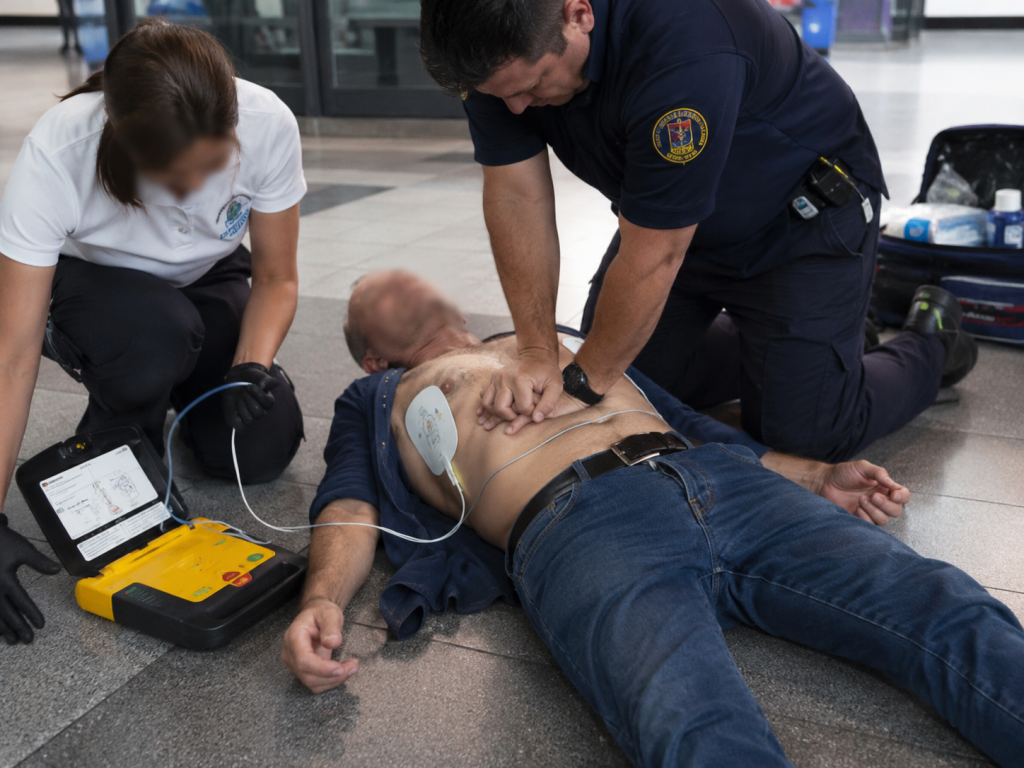
Your heart is powered by electricity
Most people think of the heart as a powerful muscle that pumps blood throughout the body. While that’s true, every heartbeat actually begins with an electrical signal.
A small group of specialized cells acts as the heart’s natural pacemaker, generating electrical impulses that travel through the cardiac muscle in a precise sequence. This electrical activity coordinates every contraction, allowing the heart to pump blood efficiently.
In a healthy adult, this process repeats around 100,000 times every day without us ever noticing.
As long as those electrical signals remain organized, the heart continues doing its job. But when the electrical system becomes chaotic, the consequences can be life-threatening.
Not every cardiac arrest looks the same
When people hear the words “cardiac arrest,” they often imagine a heart that has completely stopped.
In reality, that’s only one possibility.
One of the most dangerous conditions is called ventricular fibrillation. Instead of pumping blood, the lower chambers of the heart quiver uncontrollably. The heart muscle is still electrically active, but the contractions are completely uncoordinated and ineffective.
From the outside, the person has no pulse, loses consciousness within seconds, and stops breathing normally.
Although the heart hasn’t stopped electrically, it has stopped functioning as a pump.
This is exactly the type of emergency where a defibrillator can make the difference between life and death.
A defibrillator doesn’t “start” the heart
This is the biggest misconception.
The electrical shock delivered by a defibrillator is not meant to switch the heart back on. Instead, it briefly stops the abnormal electrical activity that’s causing the chaos.
Think of it as pressing the reset button on a frozen computer.
By interrupting the disorganized electrical signals, the shock gives the heart’s own natural pacemaker an opportunity to regain control and restore a coordinated rhythm.
If everything goes well, the heart resumes pumping blood effectively on its own.
What if the heart has completely stopped?
Sometimes there is no electrical activity at all.
Doctors call this condition asystole, commonly known as a “flatline.”
In this situation, there is nothing for a defibrillator to reset.
Delivering an electric shock will not restart the heart because there isn’t an abnormal rhythm to interrupt.
Instead, treatment focuses on high-quality cardiopulmonary resuscitation (CPR), medications used during advanced life support, and identifying the underlying cause of the cardiac arrest. A heart attack, severe oxygen deprivation, massive blood loss, electrolyte imbalances, hypothermia, or certain poisonings are just a few of the conditions that may need to be corrected before the heart can recover.
Why CPR matters so much
When the heart stops pumping blood, the brain begins losing its oxygen supply almost immediately.
Every passing minute without circulation reduces the chances of survival and increases the risk of permanent brain injury.
Chest compressions cannot replace a functioning heart, but they can generate enough blood flow to deliver some oxygen to the brain and heart until emergency responders arrive or a normal rhythm is restored.
This is why immediate CPR is one of the most important links in the chain of survival.
Why public AEDs are so effective
Automated External Defibrillators (AEDs) are now found in airports, shopping centers, schools, sports arenas, and many other public places.
Some people hesitate to use them because they’re afraid of making a mistake.
Fortunately, these devices are designed to guide anyone through the process.
Once the adhesive pads are placed on the person’s chest, the AED analyzes the heart rhythm automatically. If a shock is needed, it will clearly instruct the rescuer what to do. If no shock is appropriate, the device simply won’t allow one to be delivered and instead instructs the rescuer to continue CPR.
In other words, modern AEDs are built to prevent accidental misuse.
Why do some patients receive multiple shocks?
Television often suggests that one shock solves everything.
Real emergency care is rarely that simple.
Some abnormal heart rhythms require repeated defibrillation attempts, with periods of CPR and medication given between shocks. The patient’s underlying condition, how quickly treatment began, and the cause of the cardiac arrest all influence whether the heart can recover.
Every case is different.
The Hollywood myth
Movies have unintentionally created one of medicine’s most persistent misconceptions.
When a monitor displays a flatline, doctors don’t immediately reach for the defibrillator. In true asystole, the priority is continuous CPR, advanced life support, and treating the cause of the arrest.
Defibrillation is reserved for specific shockable rhythms, not for every cardiac arrest.
Understanding that distinction may seem like a small detail, but it’s one that has saved countless lives.
The bottom line
Defibrillators are among the greatest advances in emergency medicine, and they save hundreds of thousands of lives every year. Their role, however, isn’t to bring a completely silent heart back to life. Instead, they interrupt life-threatening electrical chaos, giving the heart an opportunity to regain its natural rhythm.
If someone collapses from cardiac arrest, the most important actions remain the same: call emergency services immediately, begin CPR as quickly as possible, and use an AED if one is available.
Those first few minutes often determine the outcome.
The next time you watch a dramatic hospital scene where a flatline is followed by an instant electric shock and a miraculous recovery, you’ll know that real medicine tells a much more fascinating—and far more accurate—story.