
A Strange Daily Ritual That Left Millions Wondering
At first glance, it sounds like one of those unbelievable stories that only exist on social media.
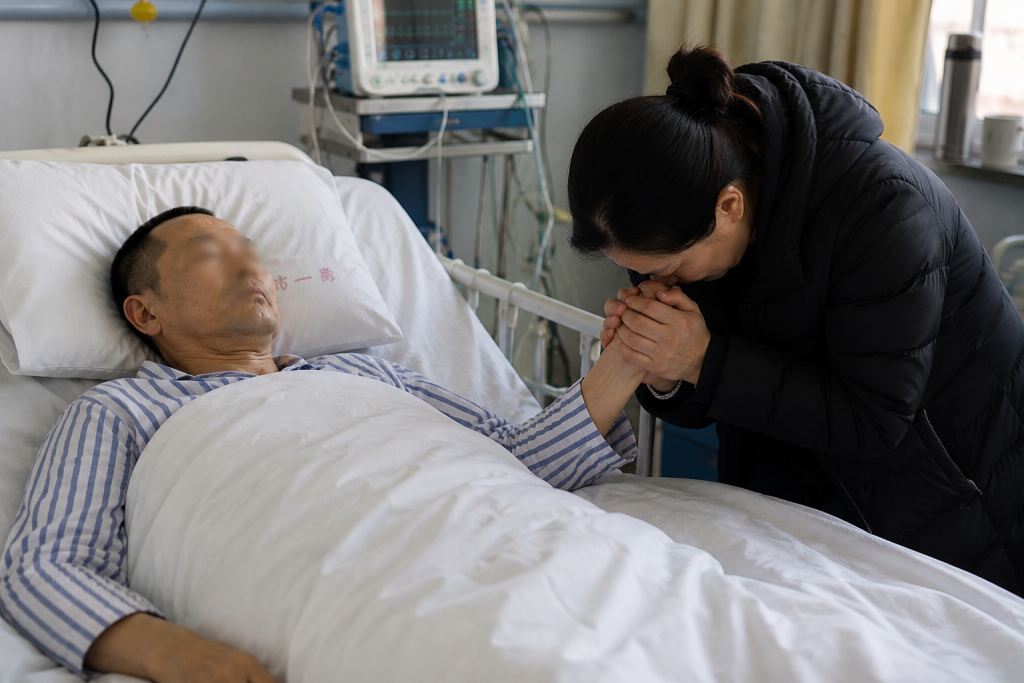
A woman sits beside her husband’s hospital bed every day, gently biting his toes while he lies unconscious. She repeats the same unusual routine for years. Then, one day, he begins to recover. Eventually, after nearly seven years, he looks at her and quietly says, “I love you.”
Countless online posts have presented this as if the unusual gesture itself brought him back.
The truth is both more complicated and far more inspiring.
This is not the story of a miracle cure. It is the story of extraordinary commitment, modern neurological rehabilitation, and a family that refused to abandon hope when the odds seemed almost impossible.
One Split-Second Decision Changed Everything
In 2019, Zhao Jinqian reportedly stepped in to save a young child from danger.
The child survived.
Zhao suffered a devastating traumatic brain injury.
Although doctors managed to save his life, the damage to his brain was severe. His future was uncertain, and meaningful recovery appeared unlikely. For his family, every day became a battle between hope and reality.
A Wife Who Refused to Walk Away
For Song Mei, accepting defeat was never an option.
She left her job to become her husband’s full-time caregiver, knowing that the journey ahead could last for years.
Her days followed the same exhausting routine. She helped clean him, repositioned his body to reduce the risk of pressure injuries, stretched his limbs, massaged weakened muscles, and spoke to him constantly, believing that familiar voices might still reach him even when there was no visible response.
Caring for someone with a severe brain injury is physically demanding, emotionally draining, and financially overwhelming.
To help cover medical expenses, Song began selling her artwork online, often surviving on only a few hours of sleep each night.
The family of the child Zhao had rescued never forgot what he had sacrificed. According to media reports, the child’s father raised and borrowed money to help support Zhao’s ongoing treatment despite facing financial difficulties himself.
The Story Behind the Toe-Biting
This unusual detail is what transformed the family’s private struggle into an international viral story.
Without context, it sounds bizarre.
With context, it makes far more sense.
Doctors had encouraged regular sensory stimulation of Zhao’s hands and feet as part of his rehabilitation program. These exercises are sometimes used alongside physical therapy to encourage neurological responses and help maintain sensory input during long-term recovery.
During one of these sessions, Song noticed a slight reaction after applying stronger stimulation to one of his toes.
She never believed this single action would heal him.
She simply added it to the long list of daily rehabilitation exercises she was already performing.
Day after day.
Month after month.
Year after year.
Not because anyone guaranteed success, but because every tiny response felt worth pursuing.
Brain Recovery Is Rarely Straightforward
Traumatic brain injuries remain among the most challenging conditions in medicine.
While the human brain has an extraordinary ability to reorganize itself through a process known as neuroplasticity, recovery varies dramatically from one patient to another. Some individuals improve within months, while others require years of rehabilitation. Unfortunately, many never regain the abilities they once had.
Progress often comes so gradually that it can be difficult to notice from one day to the next.
That is why rehabilitation specialists focus on consistency rather than quick results.
Every movement, every exercise, and every small response matters.
Small Victories Became Signs of Hope
Zhao’s recovery did not happen overnight.
It unfolded slowly.
He first began reacting to external stimulation.
Later, he showed signs that he understood conversations around him.
Eventually, he responded with simple hand movements.
With assistance, he was even able to stand briefly.
To an outsider, these improvements might have seemed modest.
To his wife, they were proof that years of effort had not been wasted.
The Words She Had Waited Years to Hear
In the summer of 2026, nearly seven years after the accident, something remarkable happened.
Zhao turned toward Song.
He said her name.
Then he quietly told her,
“I love you.”
According to Chinese media reports, when therapists later encouraged him to practice writing, one of the few words he consistently managed to write was his wife’s name.
After years of silence, those simple moments meant more than any dramatic headline ever could.
What the Viral Posts Get Wrong
Many social media posts suggest that biting Zhao’s toes somehow woke him from unconsciousness.
There is no scientific evidence supporting that claim.
Medical professionals have never described the gesture as a treatment capable of reversing severe brain injury or awakening patients from a vegetative state.
Instead, it appears to have been one small part of a comprehensive rehabilitation program that included physical therapy, sensory stimulation, long-term nursing care, and years of extraordinary dedication.
His recovery cannot be attributed to one unusual action.
It was almost certainly the result of ongoing medical treatment, rehabilitation, the brain’s natural capacity for adaptation, and the relentless commitment of those who never stopped caring for him.
The Real Lesson Behind the Story
Viral headlines often simplify complex stories because simple explanations spread faster.
But Zhao and Song’s journey deserves to be remembered for a different reason.
It is the story of a man who risked his life to save a child.
It is the story of a woman who chose hope over despair every single day for nearly seven years.
And it is a reminder that recovery from severe brain injury is rarely defined by one dramatic breakthrough. More often, it is built through thousands of ordinary moments of care, patience, persistence, and love.
Perhaps the most extraordinary part of this story was never the unusual gesture that captured the internet’s attention.
Perhaps it was the quiet determination to keep showing up every day, long after most people would have given up.