
For Patty Ellen, what began as childbirth reportedly became a medical emergency that would permanently change the way she thought about life and death.
As medical staff worked to resuscitate her, Patty says her perception of what was happening around her changed completely. Instead of experiencing the scene from her hospital bed, she remembers feeling separated from her body, observing events from somewhere above.
Then, according to her account, the hospital surroundings seemed to disappear.
What came next was even more extraordinary. Patty says scenes from her past appeared around her, not as ordinary memories but as an immersive experience in which different moments from her life seemed to unfold in every direction.
Her story belongs to a much larger and still incompletely understood phenomenon: the near-death experience, commonly known as an NDE.
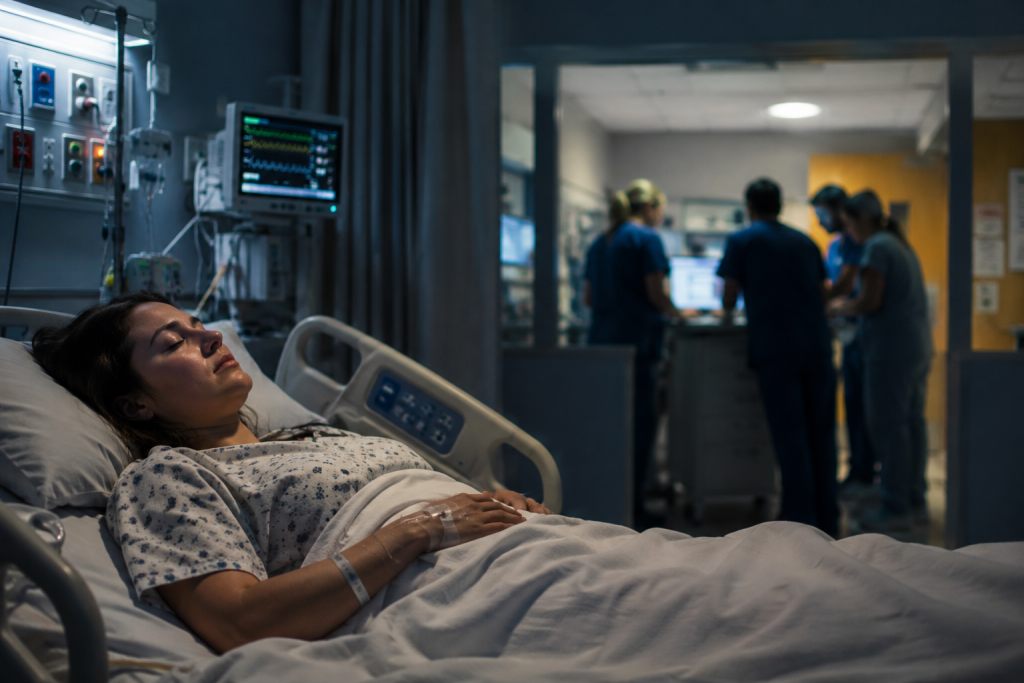
A life remembered from an entirely different perspective
Patty has described the experience as something resembling a panoramic review of her life. What affected her most, however, was not simply seeing familiar people or happy memories.
She says she was confronted with occasions when she believed she had hurt others or behaved in ways she later regretted.
The experience became frightening. Patty recalls wondering whether she was facing some form of judgment and fearing that what came next might be hell.
Then the atmosphere changed.
According to Patty, she became aware of a presence she could not identify. She remembers feeling as though a hand had been placed on her shoulder, but she does not describe an ordinary spoken conversation. Instead, she says she received an unmistakable impression that she needed to forgive herself.
Above everything else, she remembers an overwhelming sense of love.
There is no scientific way to independently verify the spiritual elements of such an experience. Patty’s description is her personal recollection of what happened during an extreme medical event, and it should be understood as such.
Yet the characteristics of her account are far from unique.
Similar experiences have been reported by people from very different backgrounds after surviving cardiac arrest and other life-threatening medical crises.
Then she heard her baby
While Patty remembers experiencing something entirely removed from the hospital around her, the medical team was attempting to resuscitate her.
According to her account, one sound suddenly reached her.
A baby was crying.
It was her newborn child.
Patty says hearing that cry immediately changed everything. She felt as though she was being given a choice between remaining where she was and returning.
Thinking of her baby, she chose to return.
She describes the transition back into her body as abrupt rather than peaceful, occurring while resuscitation efforts were underway.
She survived.
What remained afterward was not simply the memory of an unusual event but a profound change in how she viewed mortality.
Why some NDE survivors say they no longer fear death
Patty has said that one of the lasting effects of the experience was a dramatic reduction in her fear of dying.
That kind of psychological change has also appeared in accounts from other people reporting near-death experiences. Some describe becoming less focused on possessions or status. Others say relationships became more important or that their priorities changed considerably.
Whether someone interprets such an experience neurologically, psychologically or spiritually is another matter.
For researchers, the central question is more specific: what happens to the human brain and to conscious experience when circulation suddenly collapses and doctors begin cardiopulmonary resuscitation?
The answer is proving to be considerably more complicated than the familiar idea that the brain simply switches off the moment the heart stops.
Cardiac arrest is not the same as irreversible death
When cardiac arrest occurs, the heart can no longer maintain adequate circulation. Blood flow to the brain falls dramatically, and consciousness is typically lost very quickly.
Without successful intervention, prolonged interruption of circulation can cause devastating and eventually irreversible brain injury.
This distinction matters because popular descriptions of NDE cases frequently use phrases such as “died and came back to life.”
Medically, that can be misleading.
A person who experiences cardiac arrest and is successfully resuscitated has not necessarily experienced irreversible biological death, and cardiac arrest should not be confused with brain death.
At the same time, scientists have increasingly become interested in what happens inside the brain during the period surrounding cardiac arrest and resuscitation.
It may not be a simple transition from normal consciousness to complete inactivity.
What the AWARE II study found
One of the major attempts to investigate these questions scientifically has been the AWARE research program led by physician and researcher Sam Parnia.
AWARE II, published in the medical journal Resuscitation in 2023, studied people who experienced cardiac arrest in hospitals. Researchers investigated survivors’ recollections while also attempting to collect physiological information during cardiopulmonary resuscitation.
Where circumstances allowed, EEG monitoring was used to examine electrical activity in the brain.
Researchers reported that some EEG recordings obtained during prolonged CPR contained activity across frequency bands including delta, theta, alpha and beta. The authors discussed whether some of the observed patterns could be compatible with neurophysiological processes normally associated with cognitive activity.
The finding is intriguing, but it has sometimes been exaggerated when discussed outside scientific literature.
AWARE II did not prove that people remain conventionally conscious after their hearts stop. It certainly did not demonstrate that consciousness survives death or provide scientific evidence of an afterlife.
What it did contribute was evidence that brain physiology during resuscitation may be more complex than the popular image of an instantly inactive brain suggests.
Why would someone feel as though they had left their body?
One striking feature of Patty’s account is her recollection of perceiving events from outside her physical body.
This type of experience is frequently associated with NDE reports, but neuroscience has provided some important clues about how such sensations might arise.
Our sense of being located inside our bodies feels effortless, yet the brain has to construct that perception continuously.
Visual information must be integrated with touch, balance and proprioception — the system that allows us to know where our limbs are positioned even with our eyes closed.
The temporoparietal junction is among the brain regions involved in combining information relevant to our perception of the body and our position in space.
Neurological observations and experiments have shown that disturbances affecting these systems can produce striking alterations in bodily self-perception, including sensations resembling an out-of-body experience.
In other words, the human brain possesses mechanisms capable of generating the feeling that one’s point of view has become detached from the physical body.
That provides a plausible neurological framework for at least part of the phenomenon. It does not mean that every detail of every reported NDE has been explained.
The strange phenomenon of the “life review”
Patty’s recollection of seeing episodes from across her life also has parallels in other near-death accounts.
Researchers studying NDEs sometimes refer to this phenomenon as a life review.
Descriptions vary considerably. Some people report a rapid succession of autobiographical memories. Others describe numerous events appearing almost simultaneously. Occasionally, people say they did not merely remember what happened but experienced powerful emotions connected with their previous actions.
This can create the impression of watching a complete recording of one’s life.
Human memory, however, does not operate like a video archive.
Memories are reconstructed through networks distributed across the brain, and their retrieval can be profoundly influenced by emotion, context and physiological state. Our perception of time can also change dramatically under unusual conditions.
Extreme physiological stress could therefore alter the way autobiographical memories, emotions and the passage of time are experienced.
Scientists have proposed several neurological explanations for life-review phenomena, but there is currently no single mechanism that satisfactorily explains every report.
Does an NDE prove that there is life after death?
This is where a medical question meets a philosophical and, for many people, religious one.
Scientifically, the evidence has clear limits.
There is currently no reliable evidence demonstrating that near-death experiences prove the existence of an afterlife or establish that human consciousness can function independently of the brain.
That does not mean people who describe these experiences are necessarily fabricating them.
A subjective experience can feel extraordinarily vivid and meaningful regardless of its underlying mechanism. The brain is capable of producing experiences that feel completely authentic to the person having them.
Researchers have consequently explored numerous possible contributors to NDEs, including abrupt changes in cerebral blood flow and oxygen availability, neurochemical responses to extreme stress, altered activity across brain networks, disruptions in multisensory processing and the way memories are encoded or reconstructed around a medical crisis.
These explanations are not necessarily mutually exclusive. Several mechanisms could operate simultaneously.
What researchers still lack is a single, comprehensive explanation capable of accounting for every feature reported in every near-death experience.
There is also a limit to what science can answer
Modern medicine can measure electrical brain activity, circulation, oxygen levels, heart rhythm and many other physiological processes during resuscitation. Researchers can interview survivors and compare recurring features of their experiences.
Those methods can potentially tell us a great deal about what happens to the brain during an extreme medical emergency.
The existence of an afterlife, however, is a different type of question.
Science works by testing observations that can be measured, reproduced or independently examined. A person’s private experience, no matter how powerful, cannot by itself establish the existence of a supernatural reality.
The reverse should also be stated carefully. Neurological explanations for aspects of NDEs do not scientifically establish that a spiritual dimension is impossible. That conclusion would go beyond what the evidence can demonstrate as well.
Someone approaching Patty’s experience from a religious perspective may regard it as profoundly spiritual. A neuroscientist may see the same account as an unusual opportunity to understand perception, memory and consciousness under extreme physiological conditions.
Those interpretations should not be confused with what has actually been established by evidence.
Patty’s story leaves us with a question science is still investigating
Publicly available accounts allow us to describe what Patty says she experienced, but they do not provide access to the complete medical documentation needed to independently reconstruct every clinical detail of her emergency.
That limitation matters.
Her encounter with an unidentified presence, her panoramic memories and the sense that she was offered a choice to return should therefore remain clearly attributed to her testimony rather than presented as independently verified events.
The broader phenomenon, however, is a legitimate subject of scientific investigation.
People who survive cardiac arrest and other critical medical emergencies do sometimes report vivid experiences involving unusual perceptions, memories, feelings of peace or apparent separation from the body. Researchers continue to investigate when these experiences occur and which neurological processes might contribute to them.
Some pieces of the puzzle already have plausible scientific explanations. Others remain much less certain.
For Patty, however, the experience appears to have left behind something more personal than a scientific question. Whatever was happening physiologically during those critical moments, what she remembers was powerful enough to transform her relationship with mortality.
She says she no longer fears death in the same way.
Future research may reveal much more about why people facing extreme medical crises sometimes experience brilliant light, altered perceptions of their bodies, extraordinary autobiographical memories or overwhelming feelings of peace.
But the larger question remains unresolved.
Are near-death experiences ultimately remarkable products of a human brain under extraordinary physiological stress, or do they touch upon something that current scientific instruments are simply unable to measure?
Patty Ellen’s experience cannot answer that question.
What it can do is remind us how much remains to be discovered about consciousness — and about one of the most mysterious boundaries human beings will ever encounter.