
Every year, thousands of babies enter the world far earlier than expected. For many of them, life begins not in their parents’ arms but inside the intensive care unit, surrounded by monitors, ventilators, and medical staff fighting to keep them alive.
Few stories illustrate that reality more powerfully than the journey of Derick Hall, a professional football player whose first moments of life were filled with uncertainty. Long before he stepped onto an NFL field, doctors questioned whether he would survive his first day.
Today, his story is often shared across social media as a symbol of hope. While many viral posts simplify or dramatize what happened, the true events are remarkable enough on their own.
A Beginning That Seemed Almost Impossible
Derick Hall was born extremely premature after a pregnancy that ended far sooner than expected.
According to his mother, Stacy Gooden-Crandle, he showed no obvious signs of life immediately after birth. In interviews reflecting on those terrifying moments, she described him as being “born dead”—a phrase that captured the overwhelming fear she experienced.
From a medical perspective, however, the situation was more precise. Hall was born without detectable breathing or a heartbeat and required immediate neonatal resuscitation. Within moments, doctors began emergency procedures designed to restore his vital functions.
Those first minutes would shape everything that followed.
A Fight Measured One Breath at a Time
Extremely premature infants face enormous challenges because many of their organs have not finished developing before birth. The lungs, brain, digestive system, and immune system are especially vulnerable.
Medical teams caring for these newborns often work under extraordinary pressure, knowing that every decision can influence the child’s future.
Hall’s mother later recalled that physicians warned her his chances of survival were incredibly small—around one percent. Whether expressed as an estimate or a reflection of the seriousness of his condition, the message was clear: the outlook was grim.
Still, the medical team continued fighting.
Five Months Inside the Neonatal Intensive Care Unit
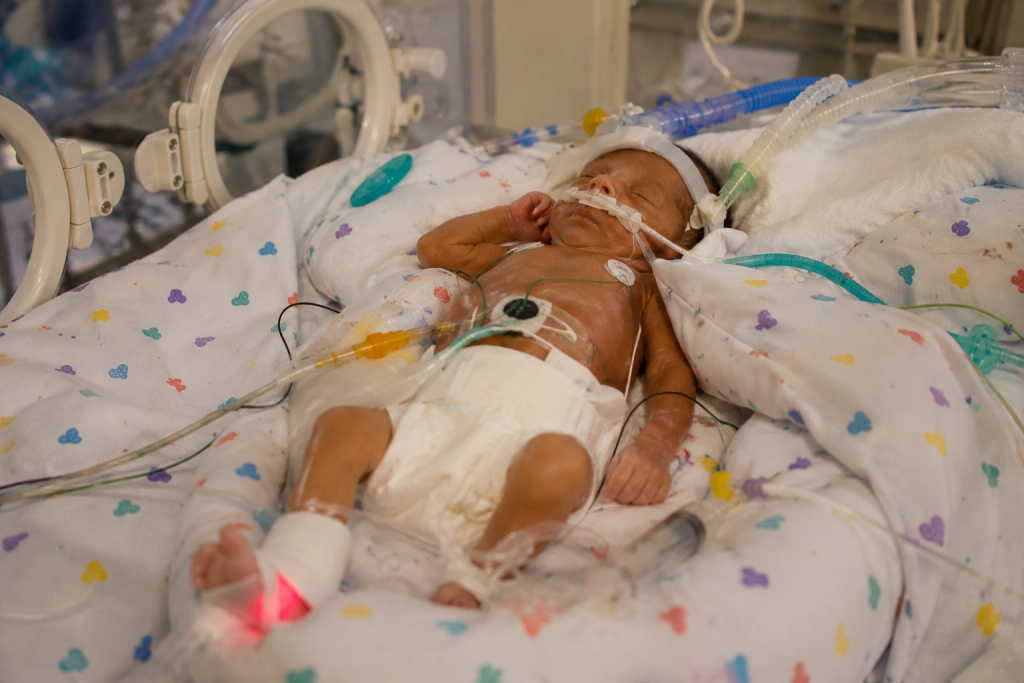
Instead of going home within days, Derick Hall spent approximately five months in a Neonatal Intensive Care Unit (NICU), where fragile newborns receive around-the-clock specialized care.
Life inside a NICU is unlike anything most parents ever imagine. Tiny patients are connected to breathing equipment, feeding tubes, heart monitors, and countless sensors that allow doctors to react instantly if their condition changes.
For babies born this early, progress rarely follows a straight line. One day can bring encouraging news, while the next may introduce a new complication.
Hall endured that difficult journey before he was finally strong enough to leave the hospital.
Growing Stronger Against the Odds
Surviving infancy was only the beginning.
Like many children born extremely premature, Hall experienced respiratory problems and asthma while growing up. These complications are common because premature lungs often continue developing long after birth.
Despite those challenges, his health gradually improved.
As he grew older, he discovered a passion for sports. Few people looking at the energetic young athlete would have guessed how fragile his start in life had been.
Discovering Football
Hall eventually found his place on the football field, where determination became one of his defining qualities.
His athletic ability continued to develop throughout high school, attracting attention from college recruiters. He later joined Auburn University, one of the most respected football programs in the United States.
At Auburn, Hall became known for his relentless work ethic and explosive defensive play. Season after season, he developed into one of the program’s standout defenders, earning recognition as an elite edge rusher capable of changing games.
Years of discipline, training, and perseverance transformed him from an overlooked child with serious medical challenges into a legitimate NFL prospect.
Achieving the Dream
In 2023, that dream became reality when the Seattle Seahawks selected Derick Hall in the NFL Draft.
For football fans, it was another promising player beginning his professional career.
For his family, it represented something much deeper.
The tiny premature baby whose survival had once seemed almost impossible was now competing among the best football players in the world.
His journey was not defined by a single miraculous moment but by decades of resilience, medical care, family support, and relentless personal effort.
Why the Story Continues to Inspire
Hall’s story resonates because it reminds people that medicine cannot always predict every outcome.
His mother’s unwavering hope has become an important part of the narrative, and she frequently speaks about the role her faith played during those difficult months. At the same time, she has consistently acknowledged the extraordinary work of the doctors and nurses who cared for her son.
The reality is that Hall’s survival was the result of many factors working together: rapid emergency intervention, months of advanced neonatal care, continuous medical monitoring, supportive family members, and Hall’s own remarkable determination as he grew older.
Reducing the story to a single explanation overlooks the incredible contribution of modern medicine and the years of effort that followed.
How Neonatal Medicine Has Changed
Advances in neonatal medicine have dramatically improved survival rates for babies born prematurely.
Modern ventilators, specialized medications that help immature lungs function, advanced nutritional support, and continuous monitoring allow many infants born weeks before their due date to survive when similar cases would once have been considered hopeless.
Even so, every premature birth is unique.
Doctors consider gestational age, birth weight, organ development, and numerous other medical factors before estimating a newborn’s chances of survival. No two cases follow exactly the same path.
Hall’s experience is therefore not a guarantee of what will happen in every situation, but it stands as an extraordinary example of what is sometimes possible.
Separating the Viral Claims from Reality
The phrase “born dead” has helped Hall’s story spread around the world, but it should be understood as his mother’s emotional description rather than a medical diagnosis.
The verified facts remain remarkable without embellishment.
He was born extremely premature, required immediate resuscitation, spent months in intensive care, overcame significant health challenges, excelled in college football, and ultimately reached the National Football League.
Those achievements are well documented and demonstrate just how unpredictable life can be.
A Story Bigger Than Football
Today, Derick Hall is known as an NFL player. But long before stadium lights and professional contracts, his greatest victory happened in a hospital where doctors refused to stop fighting for a newborn whose future was uncertain.
His story is not proof that every impossible situation will end happily, nor does it suggest that medical predictions are always wrong.
Instead, it serves as a powerful reminder that extraordinary outcomes can emerge from the most fragile beginnings. Behind every success lies a combination of science, skilled healthcare professionals, devoted family members, and years of perseverance.
For Derick Hall, the road to the NFL did not begin on a football field. It began in a neonatal intensive care unit, where simply surviving was the first—and perhaps the greatest—victory of all.