
When most people think about tigers, they picture strength. Massive paws, silent movement, enormous canine teeth and the ability to bring down prey far larger than themselves have turned these animals into symbols of raw power for centuries. Yet zoologists say one of the tiger’s most remarkable survival tools is something many people rarely think about at all: its tongue.
Over the years, viral posts online have claimed that a tiger’s tongue is rough enough to strip paint from walls or even tear flesh apart. While many of those posts exaggerate the truth for shock value, the real biology behind them is still extraordinary enough to sound almost unbelievable.
A tiger’s tongue is not smooth like a human tongue. Its surface is covered in thousands of tiny backward-facing structures known as filiform papillae. These microscopic projections are made from keratin, the same tough protein found in human fingernails, hair and animal claws.
Under magnification, they resemble rows of miniature hooks or hardened spines. Together, they create a surface so abrasive that it functions almost like natural sandpaper.
Why a tiger’s tongue feels so rough
Scientists have studied the tongues of large cats for decades, and the structure is far more sophisticated than it appears. Each papilla curves toward the back of the mouth, helping the tiger grip and pull meat while feeding.
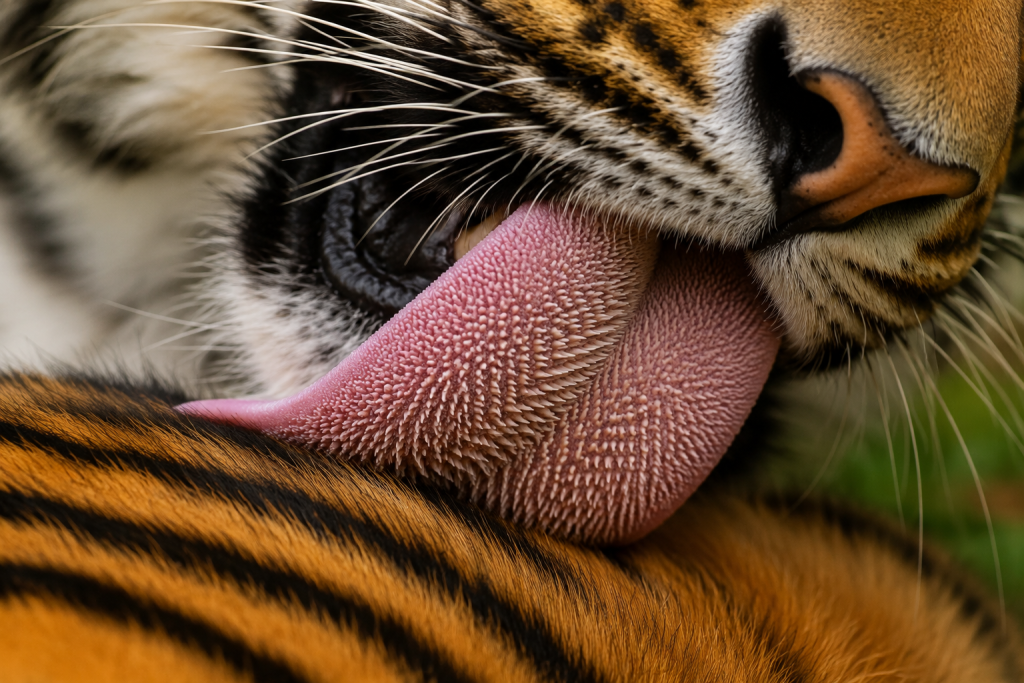
Unlike humans, large cats do not rely heavily on chewing. Instead, their tongues assist in stripping flesh from bones and moving food efficiently toward the throat. In the wild, conserving energy matters enormously. A successful hunt may require hours of stalking, explosive bursts of speed and the risk of injury. Once prey is captured, the animal must extract as much nutrition as possible.
That is where the tongue becomes an important survival adaptation.
Researchers who examined feline tongues using microscopic imaging found that the papillae are rigid enough to scrape tissue from bones while still remaining flexible enough to groom dense fur effectively.
Tigers use their tongues for far more than eating
The rough texture is not only useful during feeding. Grooming is another major reason these structures evolved.
Like domestic cats, tigers spend considerable time cleaning themselves. Their tongues help remove loose fur, dirt, dried blood and parasites trapped deep within the coat. The papillae also help distribute saliva through the fur, which may assist with temperature regulation in hot climates.
Biologists believe this grooming behavior plays a major role in maintaining skin health and reducing infection risk in the wild.
Many people are surprised to learn that the same mechanism exists in ordinary house cats. The rough sensation felt when a cat licks human skin comes from the exact same type of papillae, only on a much smaller scale.
In tigers, however, those structures are larger, denser and dramatically more powerful.
Can a tiger’s tongue really remove paint?
This is the part where internet myths often distort reality.
There is no official scientific classification describing a tiger’s tongue as a “paint remover.” However, zoologists and animal handlers have confirmed that the tongue is abrasive enough to damage soft surfaces and produce serious scraping injuries.
Large cats have been observed stripping meat from bones with remarkable efficiency, and some handlers have described the texture as powerful enough to scrape skin painfully if contact were prolonged.
Stories about removing paint likely grew from these real observations and became exaggerated through viral sharing over time.
In reality, the most fascinating part is not the internet legend itself, but the evolutionary engineering behind it. Nature effectively transformed the tongue into a multi-purpose survival tool capable of feeding, grooming and cleaning all at once.
Scientists even used cat tongues to inspire modern technology
One of the most unexpected discoveries came from researchers studying how feline tongues move saliva through fur.
A team from the Georgia Institute of Technology analyzed the hook-shaped papillae in detail and later designed a special grooming brush inspired directly by cat tongues. The structure was so efficient that researchers believed it could inspire applications in cleaning systems, robotics and even medical technology.
It was another reminder that some of nature’s most advanced designs are hidden in places people rarely notice.
Domestic cats and tigers are more closely connected than many realize
Despite the enormous difference in size between a house cat and a tiger, the two animals still share many anatomical features inherited from common feline ancestors.
The rough tongue of a household cat is essentially a smaller version of the same biological design seen in lions, leopards and tigers. Evolution adapted the structure for different scales of survival, but the core mechanism remained surprisingly similar.
For scientists, this is one of the clearest examples of how evolution refines successful traits rather than replacing them entirely.
Can tigers heal wounds by licking them?
This idea appears frequently in documentaries and wildlife stories, but the truth is more complicated.
Feline saliva does contain certain compounds with mild antibacterial properties, and licking may help remove debris from wounds. However, experts warn that excessive licking can sometimes worsen injuries rather than heal them.
In the wild, though, even limited cleaning can make a significant difference. For a predator that depends entirely on physical condition to hunt and survive, preventing infection is critical.
The real story is more fascinating than the viral myth
Social media posts often combine genuine biological facts with exaggeration designed to generate reactions and shares. Some memes even add offensive jokes or misleading claims that have nothing to do with actual zoology.
But the real science behind a tiger’s tongue is already remarkable on its own.
What appears to be an ordinary part of the body is actually a highly specialized evolutionary tool refined over millions of years. Every detail serves a purpose: feeding, grooming, cleaning and survival.
And perhaps that is what continues to fascinate scientists and animal lovers alike. The more researchers study large cats, the more they discover that nearly every part of these animals has been shaped with extraordinary precision by evolution itself.