
Throughout the history of medicine, only a handful of cases have completely transformed the way scientists understand the human brain. Some discoveries came from laboratories and carefully controlled experiments. Others emerged unexpectedly from tragedies that no one could have imagined would influence science for generations.
One of the most extraordinary examples began on a railroad construction site in the mid-19th century.
The man at the center of that story was Phineas Gage, a 25-year-old railroad foreman whose life changed in a matter of seconds after a catastrophic workplace accident in 1848.
What happened to him would eventually become one of the most studied neurological cases in history, not simply because he survived an injury that should have killed him instantly, but because doctors began to suspect that damage to certain parts of the brain could alter personality, judgment, emotions, and behavior in profound ways.
At a time when medicine still understood very little about how the brain actually worked, the case of Phineas Gage forced scientists to reconsider what made someone who they were.
Railroad Expansion and Dangerous Work in 1840s America
In the 1840s, the USA was undergoing rapid industrial growth. Railroads were expanding across the country at an extraordinary pace, connecting towns, cities, and trade routes that had previously been isolated.
Building those railroads was difficult and often extremely dangerous work.
Construction crews regularly used explosives to break through rock formations and prepare land for tracks. Safety regulations were minimal compared to modern standards, and serious accidents were common on many job sites.
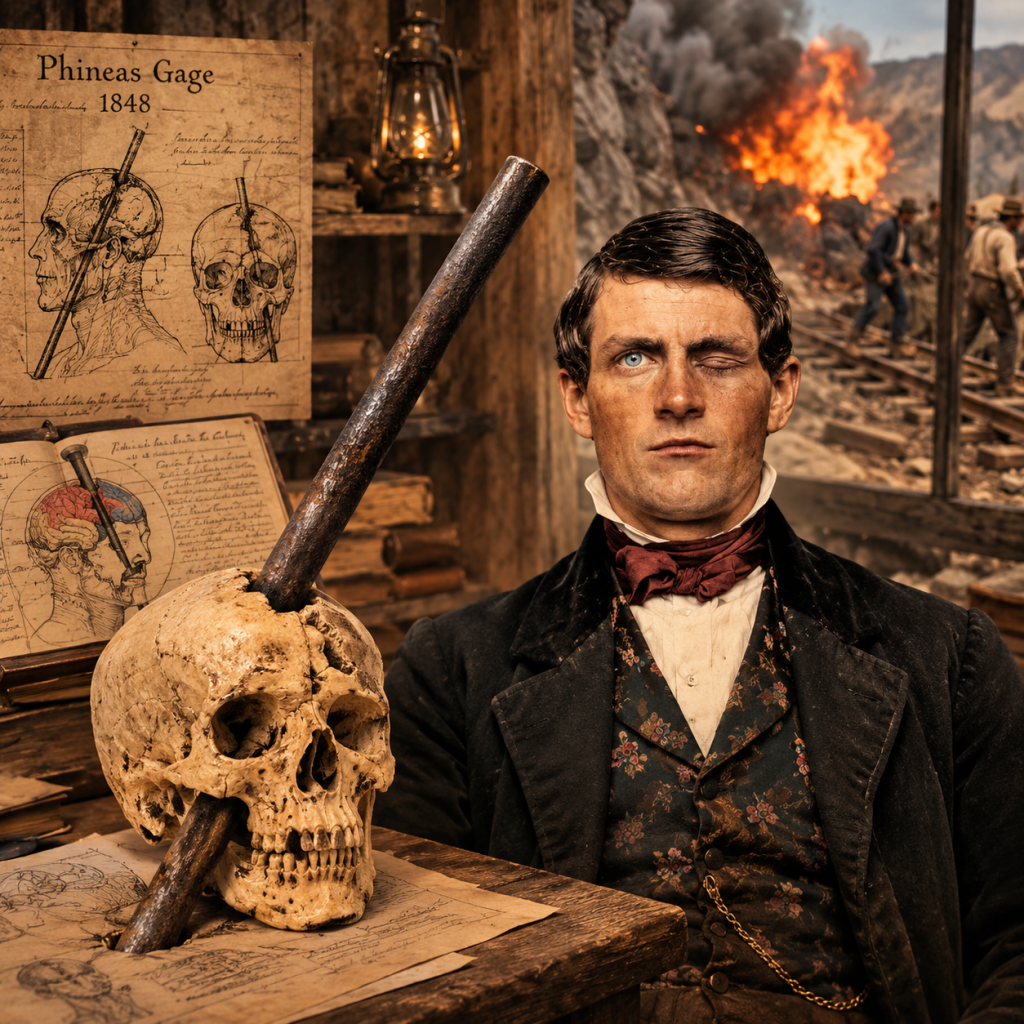
Phineas Gage worked for the Rutland & Burlington Railroad near Cavendish, Vermont. Historical accounts describe him as reliable, organized, and highly respected by his employers. He was considered capable of managing large crews and handling complicated blasting operations.
That reputation would later become important because the changes observed after his accident seemed so dramatically different from the man people believed they had known before.
The Explosion That Entered Medical History
On September 13, 1848, Gage and his crew were preparing an explosive charge inside a rock formation. The process involved drilling a hole into the rock, filling it with gunpowder, and compacting the material using a long iron tamping rod.
The tool itself was massive. It measured roughly 3 feet 7 inches long, weighed over 13 pounds, and was designed specifically for heavy industrial blasting work.
At some point during the operation, the gunpowder detonated prematurely.
The explosion launched the iron rod upward like a spear.
According to later medical reports written by physician John Martyn Harlow, the rod entered through the left side of Gage’s face, passed behind his left eye, traveled through the frontal portion of his brain, and exited through the top of his skull.
The iron bar reportedly landed dozens of feet away from the site after tearing through his head.
Even today, the details remain difficult to comprehend.
The Part That Shocked Everyone: He Was Still Alive
The most astonishing aspect of the case was not only the injury itself, but what happened immediately afterward.
Witnesses reported that Gage did not die instantly. Incredibly, he remained conscious long enough to speak and move with assistance after the accident.
Some historical accounts claim he was even able to climb into the cart that transported him to receive medical care.
One of the most repeated stories associated with the event says that when Dr. Harlow arrived, Gage calmly remarked, “Doctor, here is business enough for you.”
Whether every detail was recorded perfectly is impossible to know after so many years, but medical documentation confirms the essential truth: a man had survived after a large iron rod passed directly through his skull and frontal brain region.
Why Modern Scientists Still Find the Case Remarkable
From a neurological perspective, Gage’s survival was extraordinarily unlikely.
Modern researchers believe the rod narrowly missed deeper brain structures responsible for vital functions such as breathing, heart regulation, and basic consciousness. Although the frontal lobe suffered catastrophic damage, areas essential for immediate survival were not completely destroyed.
Even so, the following weeks were extremely dangerous.
Gage developed severe infections, fever, and episodes of delirium. Doctors in 1848 had no antibiotics, no brain scans, and no modern neurosurgery. At several points during his recovery, physicians believed he would not survive.
Against all expectations, his condition slowly improved.
Within months, he regained the ability to walk, speak, and function physically. He permanently lost vision in his left eye, but many of his motor and language abilities remained intact.
For doctors of that era, the case seemed almost impossible to explain.
The Personality Changes That Fascinated the Medical World
What transformed Gage from a medical curiosity into a scientific landmark were the behavioral changes reported after his recovery.
Before the accident, he had been described as disciplined, responsible, and emotionally stable. Afterward, friends and colleagues reportedly noticed major differences in his temperament and decision-making.
Dr. Harlow later wrote that Gage had become more impulsive, less patient, and less capable of following long-term plans. Some accounts claimed he became socially inappropriate at times and struggled with emotional control.
One famous description suggested that people who knew him felt he was “no longer Gage.”
For 19th-century medicine, this idea was revolutionary.
Until then, many scientists still debated whether different parts of the brain truly controlled different aspects of human behavior. Gage’s injury became one of the earliest cases suggesting that the frontal lobes were deeply connected to:
- impulse control;
- emotional regulation;
- social behavior;
- planning and judgment;
- personality and decision-making.
Today, modern neuroscience strongly supports those conclusions.
What Modern Brain Reconstructions Revealed
The story of Phineas Gage did not end with his death.
His skull and the famous iron rod were preserved and later studied by generations of researchers. Today, both remain associated with Harvard Medical School.
Using modern imaging techniques and digital 3D reconstructions, scientists have attempted to recreate the exact path of the rod through his brain.
These studies suggest that large portions of the frontal lobe’s neural connections were destroyed, including major areas of white matter responsible for communication between different brain regions.
The case became foundational for several fields of neuroscience, especially the study of traumatic brain injury and the relationship between brain damage and behavioral change.
Researchers also frequently reference Gage when discussing neuroplasticity — the brain’s ability to adapt and reorganize after severe trauma.
An Important Detail Often Left Out of Viral Stories
Over time, popular retellings of Gage’s story often exaggerated the idea that the accident completely destroyed his personality forever.
Modern historians and neurologists believe the reality was probably more complicated.
Years after the injury, Gage worked in Chile as a stagecoach driver, a demanding job that required memory, coordination, responsibility, and the ability to manage long routes and schedules.
That detail suggests his long-term recovery may have been far better than many simplified versions of the story imply.
While the injury clearly affected him, researchers now believe his brain may also have partially adapted over time, allowing him to regain some stability and functionality.
The Legacy of Phineas Gage
Phineas Gage died on May 21, 1860, at the age of 36 after experiencing seizures believed to be related to his earlier brain injury.
More than 175 years later, his story continues to appear in medical schools, neuroscience courses, psychology textbooks, and scientific discussions around the world.
Not because it is merely shocking, but because it helped change one of humanity’s deepest assumptions about the brain.
His case forced medicine to confront the possibility that identity, personality, emotions, and behavior are not abstract traits existing separately from the body, but biological processes closely tied to the physical structure of the human brain itself.