
For Ara Jane, progress once had a remarkably small measurement: three seconds.
Three seconds standing upright.
Then rest.
Then another attempt.
It sounds almost insignificant until you understand that this teenager from the Philippines had spent most of her life unable to stand and walk the way other children around her could. She had been born with a severe deformity affecting her lower limbs, and as she grew, moving around became increasingly difficult.
By the time doctors finally had the opportunity to correct her legs, they were not simply treating a condition present since birth. They were working with a body that had spent almost 16 years adapting to it.
The surgery would take roughly six hours.
Learning what to do afterward would take much longer.
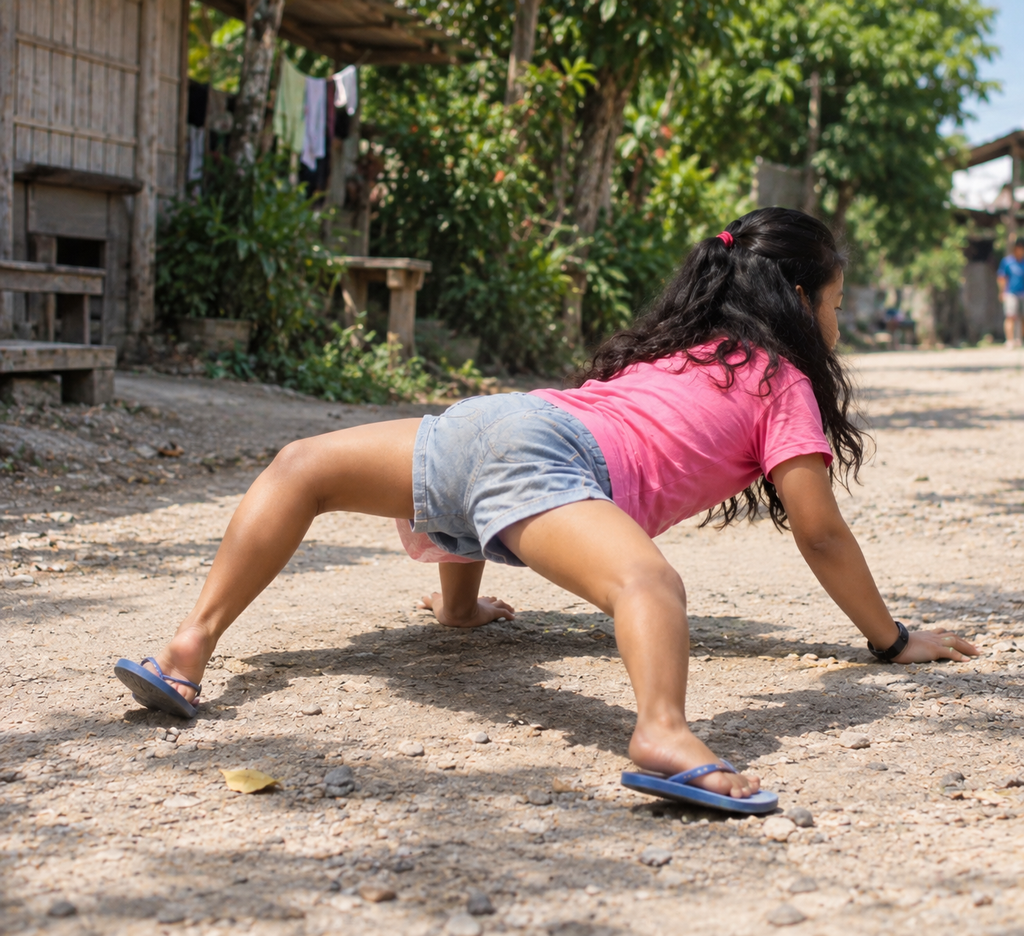
A problem her mother noticed from the beginning
Ara Jane’s mother, Aida, knew something was different as soon as her daughter was born. The baby’s legs were severely bent, and when Ara Jane was about three months old, her family managed to take her to a local doctor.
According to CURE International’s later account of the case, the family was told that surgery should wait until Ara Jane was somewhere between 16 and 20 years old. In the meantime, her parents were reportedly advised to save money for the procedure.
CURE says waiting was not medically necessary and that Ara Jane’s condition would have been easier to address when she was much younger. As she grew, the deformity became more difficult to correct.
There is an important distinction worth making here. Public accounts describe Ara Jane as having a severe congenital joint or limb deformity, but the medical information released publicly is not detailed enough to responsibly assign her a more specific diagnosis.
Photographs can show the severity of a condition. They cannot provide a diagnosis.
What the available records document much more clearly is how profoundly the condition affected her childhood.
School depended on whether someone could take her there
For many children, getting to school eventually becomes an ordinary part of independence.
For Ara Jane, it depended on someone else being available.
In a 2020 report by SunStar Davao, she explained that her mother normally took her to school. When Aida could not do it, another relative or someone else had to help. If nobody was available, Ara Jane stayed home.
Physical limitations were only part of what she faced.
She also experienced bullying because of the appearance of her legs. Eventually, the combination of mobility difficulties, pain and the social consequences of her disability became overwhelming. CURE International reports that she stopped attending school in seventh grade.
For her mother, this raised a frightening question about the future.
If Ara Jane remained dependent on other people for basic mobility, what would happen when her parents were no longer able to care for her?
The issue was no longer simply whether their daughter could walk. Her education, independence and opportunities as an adult were becoming tied to a medical problem the family could not solve on its own.
At 15, Ara Jane finally received a different answer
Ara Jane’s family lived near Tacurong in Sultan Kudarat, in the southern Philippines. Local government records indicate that the family was part of the country’s Pantawid Pamilyang Pilipino Program, commonly known as 4Ps, a social assistance program for low-income households.
Eventually, through local outreach efforts, Ara Jane came to the attention of a CURE medical team.
She was 15 when she was evaluated at a mobile clinic.
This time, the answer was not to keep waiting.
She could have surgery.
Treatment would take place at Tebow CURE Children’s Hospital in Davao City, several hours away from her home. Crucially for a family that had spent years without access to the operation, the treatment would be provided without the family having to bear its cost.
The hospital operates within the CURE International network and was developed in partnership with the Tim Tebow Foundation. It provides pediatric surgical care and openly incorporates a Christian mission into its work.
That partnership is also why Ara Jane’s story has more recently appeared on the Tim Tebow Foundation’s social media channels.
But the transformation shown in those photographs began years earlier, in an operating room.
Six hours of surgery were only the beginning
Correcting Ara Jane’s legs as a teenager was very different from treating a young child.
For years, her bones, joints and muscles had developed around the deformity. Her entire way of moving had adapted to the body she had.
The operation lasted approximately six hours. Surgeons corrected the position of her legs, which were then placed in casts to preserve the new alignment during healing.
More procedures followed. Just two days before Ara Jane turned 16, she underwent anesthesia again so the casts on both legs could be changed.
The surgery had changed the physical position of her limbs.
It could not instantly teach her body how to use them.
That part required rehabilitation.
Standing became something she had to learn
Ara Jane began physical therapy to strengthen her core and hip muscles and adjust to the new position of her legs.
At first, the goal was not walking across a room.
It was standing for three seconds.
She would stand.
Rest.
And try again.
Eventually three seconds became 30. Thirty seconds became a minute. From there came something she had waited almost her entire childhood to experience: steps.
The gradual nature of her recovery matters because dramatic before-and-after photographs can unintentionally erase everything that happens between them.
There was no instantaneous transformation.
There was major surgery, anesthesia, immobilization, physical therapy and repeated attempts to perform movements most people never remember learning.
By December 2020, the Tim Tebow Foundation reported that Ara Jane had spent about two months in the hospital before returning home. Rehabilitation continued there with stretching and exercises. She initially practiced walking with a frame and later progressed to using braces without the walker.
Before she could walk freely, there was another milestone
During her recovery in February 2020, Ara Jane attended Night to Shine, the Tim Tebow Foundation’s event for people with disabilities.
Her therapists did not yet want her placing too much strain on her recovering legs, so she attended in a wheelchair.
This part of her story was documented at the time by local media in Davao, not only by the organizations involved in her treatment.
For a teenager who had been mocked because of her physical difference, the significance went beyond attending a celebration.
She was entering a space deliberately created to celebrate people whose disabilities had so often made them feel excluded elsewhere.
At that point, however, nobody could yet know what Ara Jane’s life would look like several years later.
The story did not end with her first steps
Many stories about charitable medical treatment stop at the most emotionally satisfying moment.
A child receives surgery.
The first steps are photographed.
The story ends.
Ara Jane’s case is particularly valuable because there is a documented follow-up.
In February 2024, CURE International published an update on the young woman she had become. Ara Jane could walk without the pain that had dominated her childhood. She could go shopping, spend time with friends and help her family at home.
And she had returned to school.
That last detail may be every bit as consequential as the ability to walk.
Restoring mobility had reopened something that the condition had gradually taken away: the possibility of continuing her education and building a more independent adult life.
Her return to Night to Shine offered a particularly striking comparison.
Ara Jane attended again in 2023.
This time, she walked the red carpet. She danced. She also met Tim Tebow and Demi-Leigh Tebow.
The girl who had once needed a wheelchair at the event was now moving through it on her own feet.
Then she returned for someone else
There is another chapter that rarely fits into a viral before-and-after post.
Ara Jane eventually returned to Tebow CURE Philippines, but not because she needed the same treatment again.
She went to meet Beby Jane, a younger girl undergoing treatment for a condition CURE described as similar to hers.
For a child facing surgery and rehabilitation, Ara Jane could offer something unusually tangible.
She did not have to explain what recovery might make possible.
She could simply stand in front of her.
She could walk.
The Christian faith of Ara Jane and her family is an important part of the way they have described their experience, and faith is also central to both CURE International and the Tim Tebow Foundation.
At the same time, the medical process behind her improved mobility can be described without ambiguity: specialized surgery followed by immobilization, rehabilitation, physical therapy and years of adaptation.
Recognizing one part of the story does not require obscuring the other.
The most important part of Ara Jane’s story may be what happened before the surgery
The images of Ara Jane before and after treatment are extraordinary because the physical difference is immediately visible.
But they can also distract from a more uncomfortable truth.
According to CURE’s account, this was not a case in which medicine had no treatment to offer and a breakthrough suddenly appeared when Ara Jane was 15.
Treatment had been possible earlier.
What Ara Jane lacked was timely access to it.
Her family’s limited financial resources, access to specialists and the medical advice they received when she was an infant all formed part of the long road that eventually brought her to surgery.
That distinction changes the meaning of the story.
The nearly 16 years before the operation cannot be returned to her. They included school days she missed because nobody could take her, bullying she should never have experienced and years in which ordinary independence remained out of reach.
Surgery did not erase any of that.
It changed what could happen next.
And for Ara Jane, that new future did not begin with a dramatic walk across a stage.
It began with three seconds.
Then 30.
Then a minute.
Then one step.
Years later, the girl who once depended on someone else simply to get to school was able to return to the hospital where her life had changed and stand in front of another child beginning a similar journey.
This time, Ara Jane was not the girl waiting to see whether walking might someday be possible.
She was the person showing someone else what could come after the waiting.